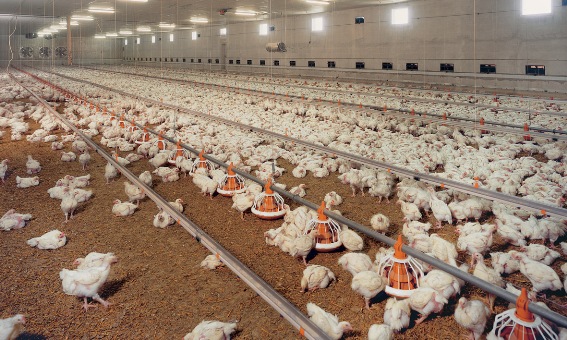


The Spanish poultry sector is at a key moment of transformation and growth. This was made clear during the virtual forum organised today, 4 February, by Avianza, the Spanish Interprofessional Association for Poultry Meat, in which experts of the calibre of Josep Solé, President of Avianza, Jordi Montfort, Secretary General, and Carlos Garcés, researcher and President of the European Federation of WPSA (World’s Poultry Science Association), took part.

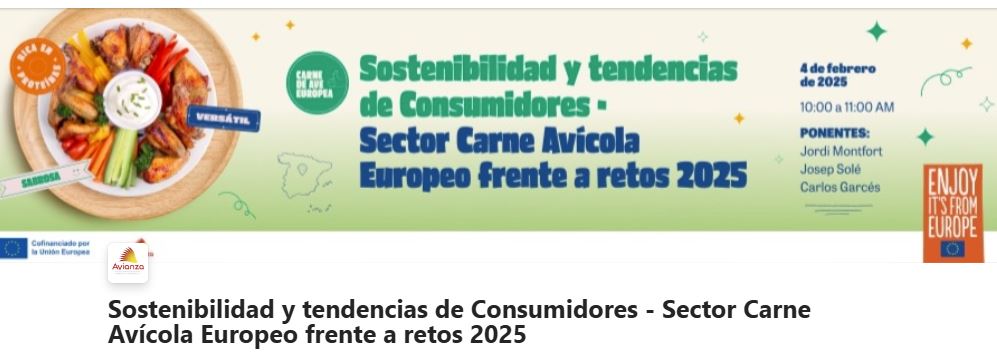
At this event, entitled “Sustainability and Consumer Trends. The challenges facing the Spanish and European poultry sector in 2025“, the major challenges and industry forecasts for 2025 were discussed, and the results of the “Sustainable European Poultry Meat” campaign, co-funded with the European Union, were assessed.
Below, we present a comprehensive analysis prepared by NeXusAvicultura of the main topics covered, from consumer trends to environmental sustainability, including the economic implications and animal welfare.
1. Poultry farming: the most sustainable animal protein
One of the major headlines to emerge from the forum was the assertion that poultry meat production is, today, the most sustainable among animal proteins. According to Carlos Garcés, continuous improvement in feed efficiency (feed conversion ratio) and the incorporation of technological advances have enabled Spain and Europe to achieve a dramatic reduction in CO₂ emissions per kilogram of meat produced. This milestone is all the more significant given the continuous increase in poultry meat consumption on a global scale.
Key factors underpinning this sustainability

- Lower carbon footprint: Being monogastric animals, poultry generate fewer methane emissions than other livestock species.

- Manure management: Simpler compared to other livestock sectors, which reduces the environmental impact.
- By-product utilisation: The use of oil refining co-products and even the potential development of insect-based feed ingredients are examples of circular economy principles in action.
2. Sustainability: a multi-dimensional concept
During the debate, it was emphasised that sustainability is not limited to the environmental dimension. Carlos Garcés stressed that any future strategy for the poultry sector must address the following pillars:
- Economic sustainability: This is the primary form of sustainability — without it, no other form of sustainability is possible. Poultry farms and integrators must be profitable in order to ensure the continuity of operations and consumer access to poultry protein.
- Social sustainability: Chicken is a staple, affordable food that contributes to food security.
- Cultural sustainability: Poultry meat is an essential part of Spanish and European gastronomy, both in everyday cooking and in haute cuisine.
- Environmental sustainability: Linked to the optimisation of resource use — such as water and energy — and the reduction of pollutant emissions (CO₂, nitrogen and phosphorus).


3. Situation of the sector in Spain: leadership and challenges
Spain has become the second largest poultry meat producer in Europe, behind only Poland. Production volumes of chicken, turkey and quail continue to grow, in line with rising consumption. Avianza highlighted how conventional chicken remains the dominant product on supermarket shelves, with approximately 77% of the poultry meat market share. Nevertheless, a consumption niche also exists for products such as free-range and organic chicken, which, whilst accounting for no more than 3% of total production, remain as complementary offerings.
Consumption dynamics:
- Conventional chicken is recording steady growth of around 7% per year in recent periods.
- Free-range chicken shows more irregular trends and has even declined in some quarters, due to its higher cost.
- The sector faces the challenge of balancing growing demand with the space requirements and planning permits needed to build new poultry houses.
4. Regulatory challenge: The European Chicken Commitment (ECC)
The forum examined in detail the push by certain animal welfare NGOs to promote a new production standard known as the European Chicken Commitment (ECC), which would introduce additional requirements regarding stocking density, environmental enrichments, gas stunning and slow-growth strains, among others.

Although some of these measures are already being complied with in the European Union (particularly those relating to welfare and quality control), there is concern about the economic and logistical impact of their universal implementation. All three speakers agreed that it is unnecessary, unworkable and would dramatically increase the cost of producing chicken, whilst failing to achieve its stated objectives — since meeting current demand would require the construction of more than 9,692 new poultry houses across Europe, at an estimated cost of €8.24 billion.

Main concerns of the sector:
- Drastic reduction in production capacity: Lower stocking densities and slow-growth genetics would reduce production volumes by more than 40% on the same floor area.
- Cost increases: Feed, energy and infrastructure costs could rise by around 20–22%.
- Risk of supply shortages: With demand continuing to rise, the full adoption of these criteria could lead to supply shortfalls or a very significant increase in imports from third countries.
- Campaign funding: It was revealed that only 1% of the budgets of these “altruistic” organisations comes from their members, and consumers are unaware that 97% of their financial resources come from foreign foundations such as “Open Philanthropy”, which have an interest in supporting the ECC lobby in Brussels — a clear example of external pressure, not from citizens but from lobby groups, on EU legislators. It was also highlighted that the enormous budgets of these animal welfare NGOs exceed those of all the interprofessional associations combined.


5. Economic and social impact of the production model shift
According to the experts, it is essential to analyse the practical consequences of forcibly shifting the conventional chicken production model towards more restrictive systems. The Spanish consumer is demanding ever greater quantities of chicken at accessible prices, as market figures confirm. A product that becomes dramatically more expensive could trigger a shift in consumption towards lower-quality options or imports from countries with lower standards of animal welfare and sustainability.


6. Biosecurity and health challenges: the shadow of avian influenza
Another topic addressed was avian influenza, whose continued presence forces market closures and demands the strictest biosecurity measures on farms. Spain stands out for its low number of cases, thanks to its predominantly intensive production system and strict compliance with health protocols. However, zero risk does not exist, hence the constant attention paid to transport regulations and epidemiological surveillance systems.
7. Outlook for 2025: a sector in constant motion
Looking ahead to 2025, the Spanish poultry sector is preparing to consolidate its position and adapt to potential regulatory changes, without compromising its core strengths:
- Maintaining competitiveness: Investment in technology and production efficiency to deliver poultry meat at an affordable price.
- Strengthening animal welfare: Certifications such as Welfare Quality and Avianza Animal Welfare Spain will become increasingly widespread, guaranteeing standards verified by third parties.
- Exploring new markets: Diversifying exports and capitalising on commercial opportunities in countries such as Mexico and South Africa.
- Promotional campaigns: The “Sustainable European Poultry Meat” initiative aims to inform consumers and position poultry meat as the most balanced option from a nutritional, economic and environmental standpoint.

8. Forum conclusions
The debate organised by Avianza has made clear the strength and determination of a sector that is not afraid of change, but which is equally unwilling to sacrifice its competitiveness and its essential role in feeding millions of people. The key, according to participants, lies in reconciling all the relevant factors: sustainability, animal welfare, economics and public health.
In short, poultry meat is cementing its position as the protein of the present and the future, with undeniable potential for innovation and improvement. Sustainability in its multiple dimensions, and respect for real consumer demand, will be the cornerstones of Spanish and European poultry farming in the years ahead.
