
Costs and implications of the European Chicken Commitment (ECC)
The Association of Poultry Processors and Poultry Trade in the EU Countries (AVEC) published a new study in 2024 providing an in-depth analysis of the additional costs and potential implications of adopting the European Chicken Commitment (ECC).
Numerous companies across Europe, from large retailers, supermarkets, restaurants and catering companies, have already signed up to the ECC, under pressure from the animal welfare NGO lobby. The objective of the animal welfare movement is, in its own view, to improve the welfare of chickens and go one step further than current EU legislation. The ECC commits its signatories to applying several requirements — such as the use of slower-growing chicken breeds, lower stocking densities and the use of enrichment features — throughout their fresh, frozen and processed poultry supply chains by 2026.

As ECC compliance progresses, crucial questions remain unanswered regarding its environmental implications and its effects on broiler meat production. AVEC therefore commissioned ADAS, a British agricultural consultancy firm, to study the potential consequences of a complete transition of current EU broiler production to ECC standards.
According to Birthe Steenberg, Secretary General of AVEC, “the key aspect of this study lies in its emphasis on calculating costs per kilogram of meat, unlike previous research focused solely on consequences for live birds or liveweight, which does not accurately reflect market realities, since we sell meat, not live animals.” Jason Gittins, Technical Director of ADAS, adds that “due to differences in meat yields between standard and ECC production, previous studies often underestimated the true impact of switching to the latter.”
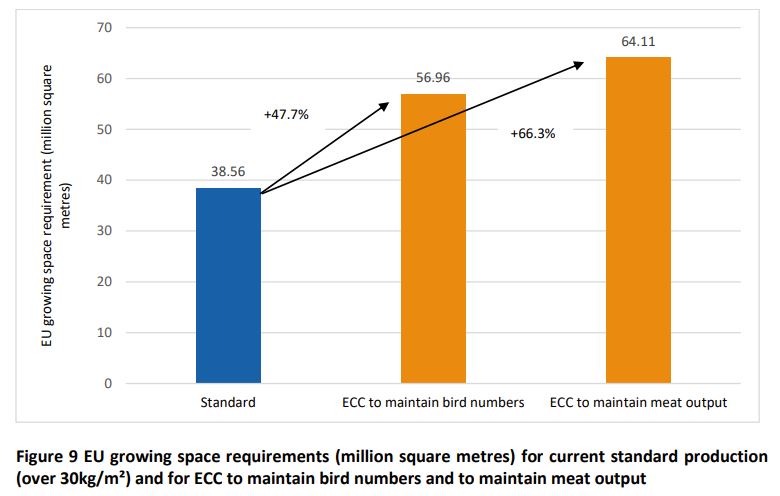
The study, published in 2024, concludes that a full transition to ECC standards would result in:
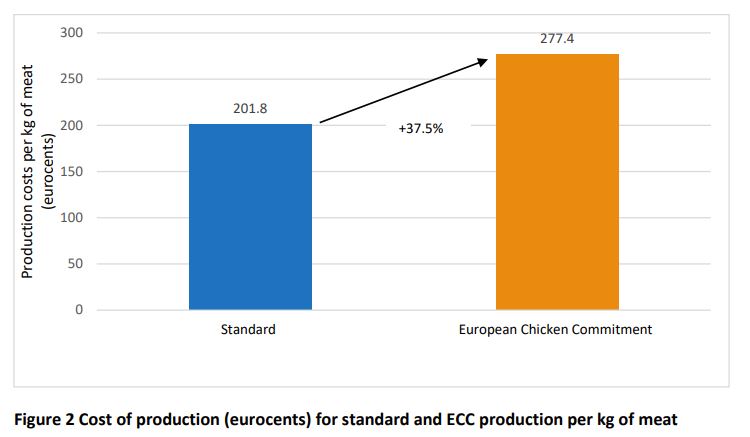
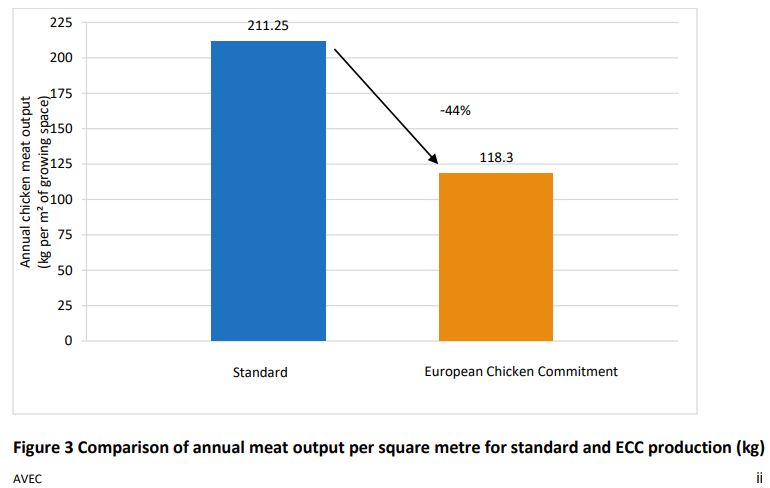
An additional production cost of 37.5% per kilogram of meat, a 35.4% increase in water consumption, a 35.5% increase in feed consumption, a 24.4% increase in greenhouse gas emissions per kilogram of meat produced, a 44% reduction in total meat produced compared to current production methods within existing EU growing space (>30 kg/m²), and the need to construct 9,692 new poultry houses, at an estimated cost of €8.24 billion, to maintain current production levels.
These production effects would inevitably lead to price increases that could exclude a large proportion of consumers from purchasing poultry meat or dramatically increase imports from third countries outside the EU with lower animal welfare standards.
AVEC President Gert-Jan Oplaat, emphasising the importance of consumer choice and decision-making, adds that “while the ECC aims to improve animal welfare, it is crucial to recognise that these improvements carry significant economic and environmental implications, and that — given that EU poultry consumption is forecast to grow over the next 10 years — consumers should have the option to select higher-welfare products if they so wish, but it is crucial that standard, affordable options remain available.”
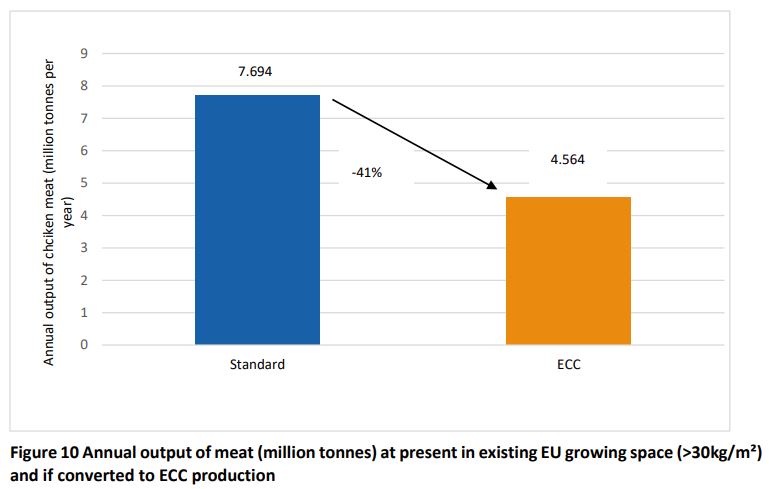
Should the EU ultimately make compliance with the European Chicken Commitment mandatory, these would be the consequences for broiler producers, for the entire European poultry industry and for the end consumer:
- An additional production cost of 37.5% per kilogram of meat.
- A 35.4% increase in water consumption, equivalent to an additional 12.44 million cubic metres per year.
- A 35.5% increase in feed consumption, adding 7.3 million additional tonnes.
- A 24.4% increase in greenhouse gas emissions per kilogram of meat produced.
- A 44% reduction in total meat production compared to current standard production methods within existing EU growing space (>30 kg/m²).
- The need to construct 9,692 new poultry houses, at an estimated cost of €8.24 billion, to maintain current production levels.

AVEC stated that these production effects would inevitably lead to higher prices, which could exclude many consumers from purchasing poultry meat or “dramatically increase imports from third countries with lower animal welfare standards.”
Group President Gert-Jan Oplaat said: “While the ECC seeks to improve animal welfare, it is crucial to recognise that these improvements carry significant economic and environmental implications.
“Given that growth in poultry meat consumption is forecast in the EU over the next 10 years, consumers should have the option to choose higher-welfare products if they so wish, but it is crucial that broilers reared under current standard conditions remain available.”
Further reading:
-. Presentation “WELFARE OF BROILER CHICKENS ON FARM” Cristina Rojo Gimeno. Working group scientific coordinator, BIOHAW Unit ANIMAL WELFARE PLATFORM 15 JUNE 2023 Animal Welfare Platform 15 June 2023 (20 pages)
-. “Costs and implications of the European Chicken Commitment in the EU” AVEC report, 2024 (56 pages)
-. EFSA scientific opinion on “Welfare of broilers on farm” © 2023 European Food Safety Authority. EFSA Journal published by Wiley-VCH GmbH on behalf of European Food Safety Authority. (236 pages)
-. Production costs at NeXusAvicultura.Com