
New avian influenza outbreak confirmed in Olmedo affecting 315,000 laying hens
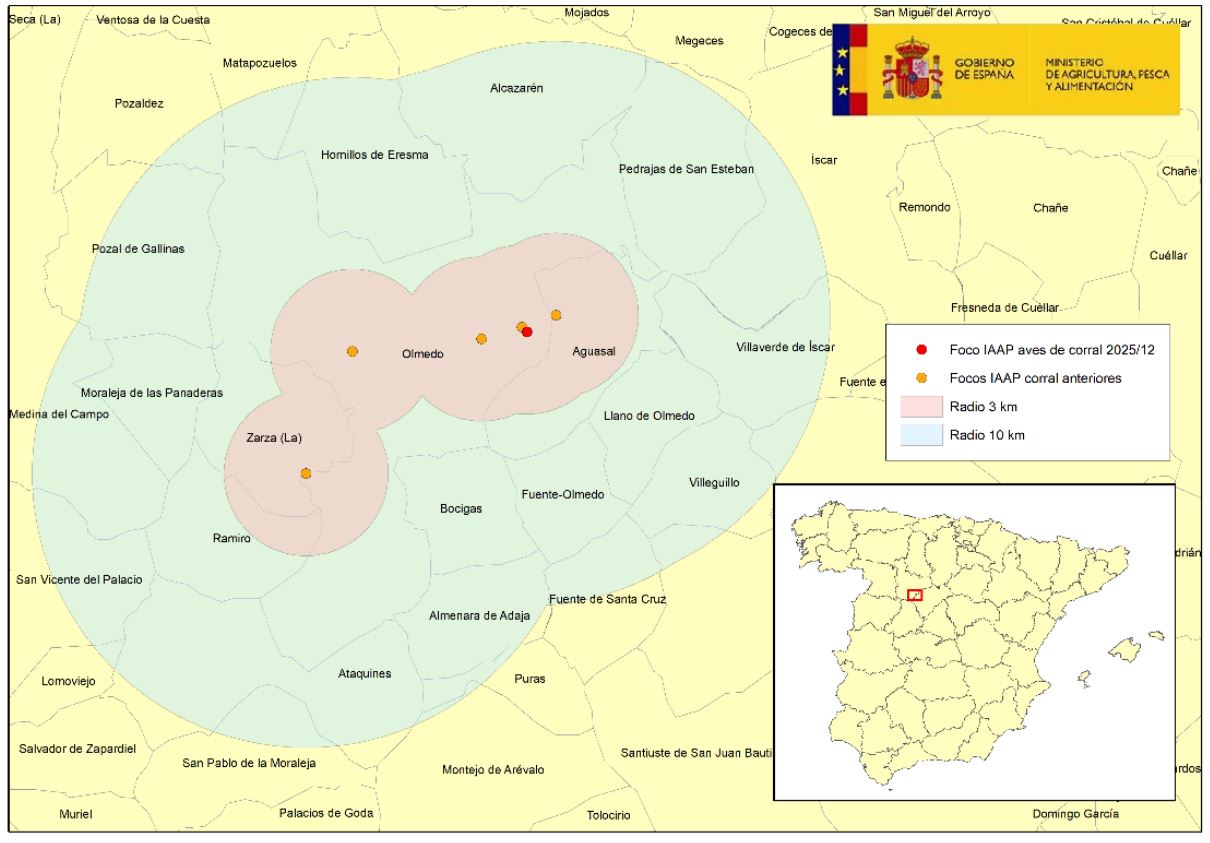
Valladolid, 15 October 2025 – The veterinary authorities of Castilla y León notified on Wednesday, 15 October, a new outbreak of highly pathogenic avian influenza (HPAI) H5N1 at a laying hen farm located in Olmedo, province of Valladolid. The holding, which houses approximately 315,000 birds, represents the twelfth confirmed outbreak in Spain during 2025 and the sixth recorded in the province of Valladolid.
Based on our tally at NeXusAvicultura.com, using official data provided by the Ministry of Agriculture, the Avian Influenza outbreaks in Spain in 2025, which began in July, will have resulted (up to 15/Oct/2025) in the culling of more than two and a half million farm birds, of which 96% are laying hens.
A Snowball Effect
After the first cases on turkey and breeder farms between 18 July and the first week of September 2025, less than a month ago, on 19 September the snowball effect began with a sixth outbreak at a farm of 760,000 hens, following which three further outbreaks were declared on 1 October affecting more than 552,000 laying hens, a tenth outbreak on 6 October affecting more than 800,000 laying hens, another “smaller” outbreak this past Monday the 13th with repercussions “only” for 66,000 laying hens, ending (or so we would hope) with the twelfth outbreak, once again in Olmedo, involving these 315,000 hens that will have to be culled.
Chronological sequence of the outbreak
Suspicion of infection arose on 14 October following the detection of an abnormal increase in mortality on the farm, which immediately triggered emergency health protocols. The Official Veterinary Services (OVS) of the Junta de Castilla y León visited the holding that same day to proceed with the preventive standstill of the premises, carry out the corresponding epidemiological investigation, and collect the official samples required for diagnosis.
The Central Veterinary Laboratory of Algete, the national reference centre for avian influenza in Spain, officially confirmed the presence of subtype H5N1 following analysis of the submitted samples. The health authorities consider that the most likely source of this new infection is related to the proximity of the farm to outbreak number 6/2025, previously notified in the same municipality.
Control measures implemented
In compliance with Commission Delegated Regulation (EU) 2020/687, the authorities have adopted the following immediate control measures:
- Full standstill of the affected holding and of farms located within the restricted zone from the moment of suspicion
- Compulsory culling of all birds on the holding and official destruction of carcasses, feed, and other materials that could act as vehicles for virus transmission
- Comprehensive epidemiological investigation to determine the source of the outbreak and identify possible risks of spread
- Establishment of a restricted zone encompassing 15 commercial farms, all of which have already been under standstill since 19 September

National epidemiological situation
With this new case, Spain records 12 HPAI outbreaks in poultry during 2025, distributed geographically as follows:
- Valladolid: 6 outbreaks
- Huelva: 2 outbreaks
- Badajoz: 1 outbreak
- Toledo: 1 outbreak
- Guadalajara: 1 outbreak
- Madrid: 1 outbreak
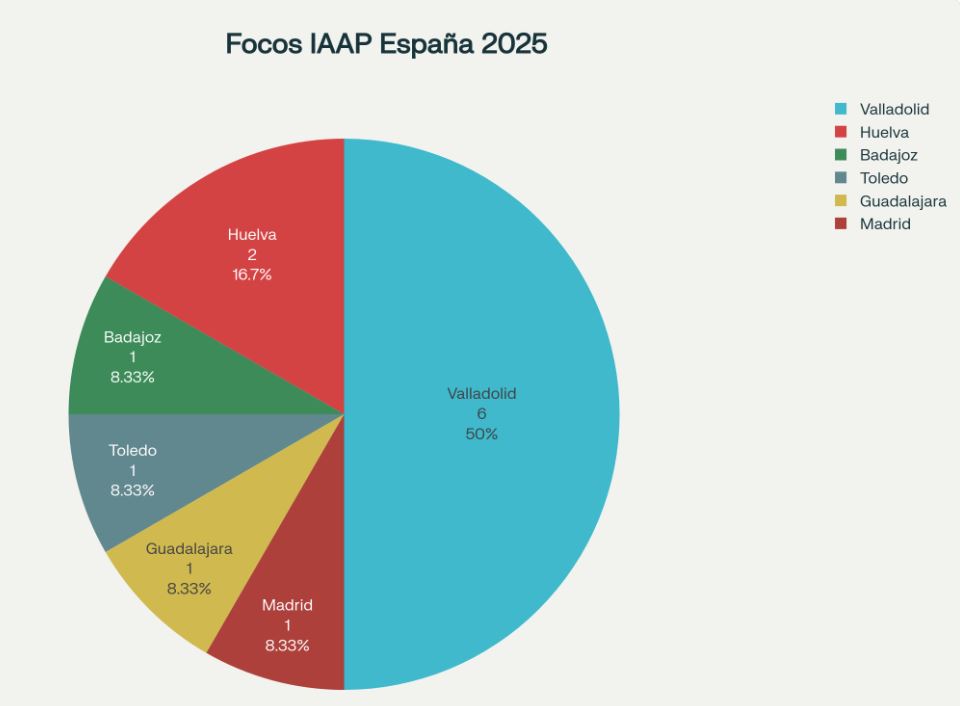
Geographical distribution of HPAI outbreaks in Spain during 2025
The chart clearly illustrates that Valladolid is the most affected province with 6 outbreaks (50% of the total), followed by Huelva with 2 outbreaks (16.7%). The provinces of Badajoz, Toledo, Guadalajara, and Madrid each record a single outbreak, representing 8.3% respectively of the national total.
This concentration of cases in Valladolid, particularly in the municipality of Olmedo, suggests localised spread requiring intensified surveillance in that geographical area.
In parallel, since the start of the epidemiological season (1 July 2025), 47 outbreaks in wild birds have been detected across Andalusia, Extremadura, Galicia, Asturias, the Basque Country, Castilla-La Mancha, Castilla y León, Madrid, and Catalonia, in addition to 3 outbreaks in captive birds in the Basque Country, Andalusia, and the Valencian Community. nota-actualizacion-situacion-iaap-15_10_2025.pdf
Economic impact on the sector
The resurgence of avian influenza in Spain after more than two years free of the disease in commercial farms is generating a significant economic impact for the poultry sector.
The costs associated with eradicating each outbreak include:
- Animal culling and compensation payments
- Specialised cleaning and disinfection operations
- Strengthening of biosecurity measures
- Veterinary and diagnostic costs
- Loss of future production
- Labour costs during the mandatory sanitary depopulation period
So far in 2025, more than 2 million laying hens have been culled, along with several thousand turkeys and breeders, as a result of the recorded outbreaks. The most severe cases have occurred over the past three weeks in the province of Valladolid.
Biosecurity and prevention measures
The health authorities emphasise the critical importance of maintaining and reinforcing biosecurity measures on poultry holdings to prevent new outbreaks. The main recommendations include:
External biosecurity
- Establishment of well-defined security perimeters with controlled access points
- Strict vector control (rodents, insects, wild birds)
- Mandatory disinfection of vehicles, equipment, and personnel
- Restricted access to authorised personnel only
Internal biosecurity
- Implementation of the “all-in/all-out” system to prevent mixing between batches of birds
- Proper mortality management with designated disposal areas
- Water quality control and treatment with sanitising agents
- Safe handling of manure and organic waste
Health surveillance
- Daily monitoring of animal health indicators (mortality, water and feed intake, egg production)
- Immediate notification to the Official Veterinary Services upon any suspicion
- Ongoing training of personnel in biosecurity protocols
Risk to human health
The health authorities maintain that the risk of transmission to humans is very low for the general population and low for individuals with occupational exposure, provided that the established preventive measures are observed. The professional groups with the greatest exposure include veterinarians, workers on affected farms, hunters, ornithologists, and laboratory personnel.
It is important to note that this virus cannot be transmitted through the consumption of cooked poultry meat, eggs, or processed products derived from them, although it is recommended to minimise unnecessary contact with birds showing clinical signs or found dead.
Outlook and ongoing surveillance
The Spanish poultry sector faces a critical period, particularly during the autumn season, when the incidence of avian influenza traditionally increases due to wild bird migrations. The concentration of cases in the province of Valladolid, particularly in the municipality of Olmedo, suggests localised spread requiring intensified surveillance.
The authorities continue to implement active and passive surveillance protocols, maintaining the established restricted zones, and coordinating efforts between regional, national, and European administrations to contain the spread of the virus and protect both animal health and public health.
The official MAPA listing of Latest registered notifications of notifiable animal diseases in Spain provides daily updates from the authorities.

For further information on Avian Influenza:
-. News on Vaccination of poultry farmers and personnel in contact with production birds to prevent zoonosis risks.
-. News on Vaccination of production birds to prevent AI outbreaks
-. Triple avian influenza alert: Portugal, Spain, and Germany confirm cases on poultry farms. (5 Sept 2025)
-. Avian Influenza on NeXusAvicultura
Tracking of Avian Influenza cases on poultry farms in Spain in 2025:
-. 1st outbreak of 2025 (18 July, Extremadura): Alert over an Avian Influenza outbreak at a 7,000-turkey farm in Extremadura
-. 2nd outbreak (28 July, Toledo): Second AI outbreak detected, this time in breeders in Toledo
-. 3rd outbreak (1 Sept., Huelva): The spectre of H5N1 returns to Andalusia: 8,500 turkeys culled due to avian influenza in Huelva.
-. 4th outbreak (8 Sept., Guadalajara): Spain records its fourth AI outbreak of 2025, this time at a breeder farm in Guadalajara
-. 5th outbreak (9 Sept., Huelva): H5N1 positive confirmed at the 8,400-bird poultry farm in Valverde del Camino, Huelva, Andalusia
-. 6th outbreak (19 Sept., Valladolid): H5N1-type AI detected at a 760,000 laying hen farm in Valladolid
-. 7th, 8th and 9th outbreaks (1 Oct, Valladolid and Madrid): 552,000 laying hens affected by three new AI outbreaks in Madrid and Valladolid
-. 10th outbreak (6 Oct, Valladolid): Tenth Avian Influenza outbreak detected in Spain. More than 800,000 laying hens to be culled.
-. 11th outbreak (13 Oct, Valladolid): Eleventh Avian Influenza outbreak detected in Spain at a 66,000 laying hen farm.
-. 12th outbreak (15 Oct, Valladolid): 315,000 new laying hens affected in the latest outbreak