

The silent revolution: The AI that “listens” to diseases on farms before the human ear can
The application of artificial intelligence in poultry farming — specifically applied to image and sound analysis as objective indicators of health and welfare in production birds — is one of the current lines of research with the greatest practical application across the entire poultry production chain.
It is in this context that, within the framework of the EBroilerTrack project, led by ITAVI, the results of an interesting study have been published, focused on the use of image and sound analysis to monitor the health and welfare of broiler chickens. The authors detail the development of artificial intelligence algorithms that enable individual tracking of birds on commercial farms, evaluating indicators such as movement speed and time spent in areas of interest. In addition, the study investigated the automatic detection of respiratory symptoms, specifically sneezes and rales associated with Infectious Bronchitis, using acoustic analysis for the early detection of pathologies. The results indicate that image-based systems perform well in animal detection and that increased nocturnal noise levels are a promising early indicator of disease. In essence, the research presents advances in non-invasive technologies aimed at improving the competitiveness of poultry production while ensuring transparency in animal welfare.
Image and sound analysis to revolutionise poultry welfare
Assuring consumers that poultry rearing respects animal welfare is fundamental for the poultry producer, but civil society is demanding greater transparency in poultry farming practices. Meeting these expectations must go hand in hand with the competitiveness of poultry meat production — a globalised and highly competitive market. New technologies are offering an opportunity to assess the concept of animal health and welfare through continuous, real-time measurements without disturbing the animals’ living environment.
The analysis of images and sound enables finer and more frequent analyses than those carried out by humans. These tools facilitate better monitoring and a greater capacity to respond to health problems or behavioural changes through predictive analytics. The article “Image and sound analysis for poultry health and welfare indicators” produced within the EBroilerTrack project, led by ITAVI, has generated promising proofs of concept in both the image and acoustic domains, specifically under controlled broiler rearing conditions.
“The advantage of these tools is that they allow data to be collected more regularly, without stressing the animals, more objectively and with less time consumption than the methods traditionally used by a human observer.”
The demand for transparency in poultry rearing
Growing public awareness of the way animals are raised is driving the poultry industry to introduce means of reporting on bird welfare and health. Traditionally, welfare assessment has been based on measurement protocols requiring the occasional observation of animals by trained personnel.
New technologies offer a significant advantage: they enable data collection more regularly, objectively and accurately (at the individual level), while requiring less time than traditional methods. The use of image or sound analysis would make it possible to identify a health or welfare problem at an earlier stage, enabling faster corrective action. This could limit the spread of pathologies to the entire flock and reduce the associated direct and indirect costs, such as limiting antibiotic use or reducing mortality.
According to previous studies, the majority of work related to precision livestock farming in poultry (42% of 264 publications) uses image analysis to measure welfare. The use of microphones is less common (14%). However, sound is crucial, as certain vocalisations can reflect welfare status (e.g., distress or comfort). Moreover, birds can emit other types of sounds, such as rales and sneezes, which directly reflect their health status, although these respiratory symptoms are only audible to the human ear when the disease is already well advanced.
“The use of image or sound analysis would make it possible to identify a health or welfare problem at an earlier stage, in order to limit the spread of the pathology to the entire flock and thereby reduce the associated direct and indirect costs.”
Individualised monitoring: computer vision in action
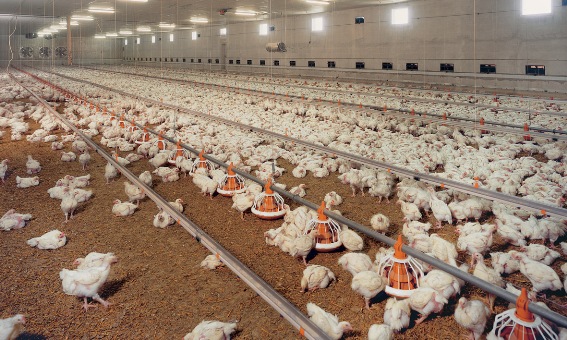
The primary objective in the image domain within the EBroilerTrack project was to develop a new artificial intelligence (AI)-based tracking system enabling the individual tracking of broiler chickens under commercial conditions.
Tracking and detection principles
The tracking method consists of two main components. The first is the individual detection of each broiler within the camera’s field of view, for which a convolutional neural network (CNN) is used. This model was trained on a database of nearly 1,000 images containing more than 10,000 broilers. A learning-based model is less sensitive to variations in light and contrast and separates crowded broilers more easily than a traditional machine vision approach.
The second component is tracking, where a unique identifier is assigned to each animal. Based on past positions, the algorithm predicts the animal’s position in the next image and assigns it the identifier of the broiler whose estimated position is closest.
This system generates a list of individual indicators crucial for health and welfare:
- Distance travelled and movement speed.
- Duration of activity periods and time spent at rest.
- Time spent in areas of interest (feeding or drinking zones, defined by circles around feeders or rectangles around nipple drinker lines).
- Surface area of the broiler as viewed from above and available area per animal (Voronoi cells).
Detection challenges and performance
Performance tests were carried out using recordings from commercial broiler farms with ROSS 308 birds, varying camera height (2.5 m, 3.7 m and 5 m). Sensitivity (TP/(TP+FN)) measures the proportion of broilers correctly detected.
Results showed that sensitivity decreased with increasing camera height but increased with bird age. For example, with a camera at 2.5 m, sensitivity increased from 96.9% at D12 to 100% at D39. By contrast, with a camera at 5 m, sensitivity ranged from 75.9% at D12 to 99.5% at D39.
The reason for this variation lies in the fact that the convolutional neural network is sensitive to the surface area of the animal in the image (number of pixels). A 12-day-old broiler filmed at 5 metres had a much smaller surface area (approximately 2,800 pixels) than a 39-day-old broiler at 2.5 metres (17,360 pixels). A critical threshold was identified: there appears to be a limit of between 3,500 and 4,000 pixels per animal, below which the detection rate drops dramatically.
With regard to stocking density, experimental results at D29 with densities of 10 and 20 broilers/m² showed a slight difference in sensitivity (99.2% for low density vs. 98.1% for high density), suggesting that density does not hinder detection when animals are uniformly distributed. However, the false discovery rate (FDR) was higher at low density (6.6%) than at high density (4.8%), as empty areas — where false positives appear — are more numerous.
Individual tracking performance
Tracking quality depends on detection capability and animal activity. At 39 days of age (at rest), there were almost no identification errors (0.03 errors per animal per minute). At 26 days of age (with greater activity), fewer than one error per animal per minute was recorded (0.67), equivalent to one error every 1.5 minutes. Errors are concentrated mainly in very high-density areas, such as resting zones close to walls. Although the results from this prototype are promising, tracking quality could be improved by enriching the image database in these specific high-density areas.
The bionic ear: early detection of Infectious Bronchitis
The acoustic component of the EBroilerTrack project focused on the specific case of Infectious Bronchitis (IB), a virus that causes respiratory problems in birds. Trials were conducted under experimental conditions, comparing a control room (T) with a room inoculated with IB (IB).
“A mean difference of 3 dB was detected at night in the Infectious Bronchitis (IB) room compared with the control room during the 5 days following inoculation.”
Monitoring noise levels as an early indicator
An average difference of 3 dB was detected at night in the IB room compared with the control room during the 5 days following inoculation. This result is significant, as it reflects a noise intensity twice as high in the test room. Clinical symptoms of IB (visible and audible) appeared between D+3 and D+4. However, analysis of sound levels showed a clear increase in intensity in the IB room from D+2 onwards. A difference of 2 dB or more is considered significant, corresponding to a 50% increase in sound intensity. Nocturnal noise levels therefore appear to be an interesting indicator for the early detection of a respiratory pathology.
Acoustic characterisation of symptoms
To develop an automatic detection algorithm, sneezes and rales were acoustically characterised. A database of 400 sound signals was labelled by 5 experts (veterinarians and animal scientists).
A sneeze was acoustically described as a short event of approximately 0.25 seconds, with its energy distributed across a frequency band of 200 Hz to 5 kHz. By contrast, a rale is a weaker, longer event with an average duration of 1.09 seconds, whose energy lies between 100 Hz and 1 kHz, and which can be confused with background noise.
Sneezes were characterised by acoustic parameters such as maximum amplitude, energy and RMS value of the signal (significantly higher than for rales). Rales were characterised by a greater duration and temporal spread.
“For the Sneeze class, the implemented neural network model showed a sensitivity of 95% in the automatic detection of respiratory symptoms.”
Performance of the automatic detection model
A neural network model (Multilayer Perceptron, MLP) trained on Mel-frequency cepstral coefficients (a scale that mimics human sound perception) was used to predict four classes: Sneeze, Rale, Peep and Other.
The implemented model showed an accuracy of 82% on test data. The most encouraging results were obtained for the automatic detection of sneezes, with a sensitivity of 95% and a specificity of 80%. The rale class showed a sensitivity of 65% and a specificity of 98%.
These results are quite promising, particularly for sneezes. However, the database used was relatively small, especially for the rale, peep and other classes. Future steps include populating the database with more labelled signals to improve model performance and robustness.
Conclusions and prospects
The EBroilerTrack study has demonstrated that the quality of image-based detection depends on several parameters, including camera height, animal age and size, density and activity. The algorithms developed for individual tracking on commercial farms show very high performance (> 99% of animals detected from day 26 with a camera at 2.5 m).
In the acoustic domain, nocturnal noise levels emerge as a promising indicator for the early detection of pathologies such as Infectious Bronchitis, even before symptoms are clearly audible to farm staff.
The next crucial step in both domains is to determine alert thresholds for the early detection of health and welfare disorders. Work is also under way to predict the expression of specific behaviours, such as exploration and preening, using activity data generated by the tracking system. These preliminary results under experimental conditions are encouraging for future trials confirming the consistency of the findings, such as the 3-decibel difference detected.
Source:
-. Image and sound analysis for poultry health and welfare indicators. Pauline Creach, Brunet Henry, Concordet Didier, Pajusco Nicolas, Riou Mickaël, et al.. Innovations Agronomiques, 2024, 94, pp.256-270. ⟨10.17180/ciag-2024-Vol94-art19-GB⟩. ⟨hal-04799208⟩. Correspondence : creach@itavi.asso.fr
Further reading:
-. “Vocalization Patterns in Laying Hens – An Analysis of Stress-Induced Audio Responses“. Neethirajan, Suresh. (2023). 10.1101/2023.12.26.573338.
-. “Acoustic precision livestock technologies applied in intensive production of Broiler Chickens for measuring productivity and animal welfare“
-. Practical uses of artificial intelligence in poultry farming
-. Bioacoustics applied in poultry farming