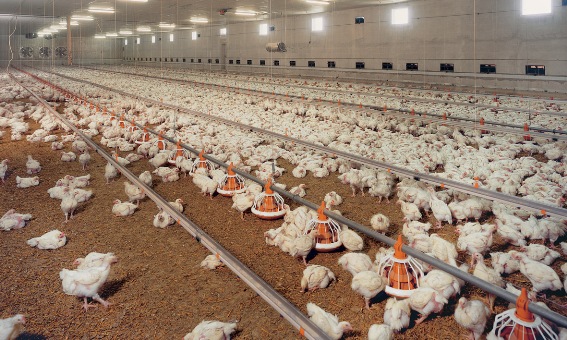

The publication of the “Egg Observatory” provides laying poultry producers with an ideal tool for assessing market development opportunities.
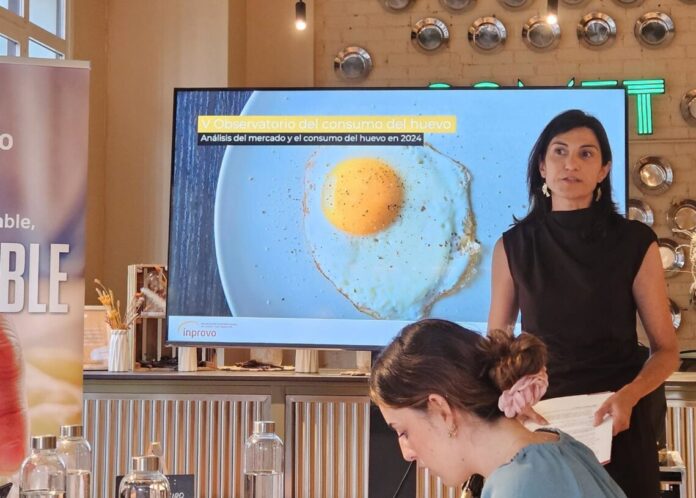
On 8 July 2025, the Annual Report “Egg Consumption Observatory“, covering developments in 2024, was presented in Madrid. This report has been published since 2021 and has been compiled by INPROVO. In this fifth edition, the quantitative analysis focuses on the household egg market and consumption in 2024, drawing on official data from the MAPA and the Kantar consumer panel. The “Egg Consumption Observatory in Spain”, produced by INPROVO, analyses egg consumption in Spanish households to understand eating and purchasing habits and assess market development opportunities.

Since 2019, the egg market has experienced sustained growth, with a cumulative increase of 58% in value.
During 2024, Spanish consumers consumed 420 million kilograms of eggs, equivalent to approximately 143 eggs per person per year, compared to 137 in 2023.
In 2024, Spanish consumers spent a total of €1,354 million on egg purchases, with an average expenditure of €29 per person. Since 2019, the egg market has experienced sustained growth, with a cumulative increase of 58% in value, representing almost €500 million in additional revenue. With a 97% household penetration rate, eggs maintain a near-universal presence in the shopping basket.
Furthermore, Spain ranks as the third largest egg producer in the European Union, accounting for 14% of total EU output. In 2024, production reached 1,169 million dozens of eggs, and the laying poultry sector generated a turnover of €2,130 million, representing 7.8% of the total value of national livestock production.
In Spain, each person consumed in 2024:
9 kg of eggs, 2.9% more than the previous year

Consumers are aware of the nutritional value of eggs and, as a result, consumption has not only held firm but has actually increased in 2024 despite rising prices.
Eggs have consolidated their position as the fresh food product that recorded the greatest growth in purchase volume in 2024, with an impressive increase of 2.9% compared to 2023. This growth contrasts markedly with the general food consumption average, which barely changed at -0.2% over the same period. In absolute terms, this increase represents a volume of approximately 550 million tonnes.
The upward trajectory of eggs is not an isolated phenomenon in 2024; over the past five years, the market has experienced sustained growth of 16.7% in volume and a remarkable 58% in value. This translates into an additional consumption of 1,260 million eggs per year in Spain compared to 2019.
Per capita consumption has also shown a significant increase. Spanish households consumed approximately 420 million kilograms of eggs in 2024, resulting in an average consumption of 9 kilograms per year and a mean of 143 eggs per person per year, surpassing the 137 eggs recorded in 2023. This implies consumption of nearly one egg per household per day, totalling around 18 million eggs consumed daily in Spanish homes.

Egg penetration in households is near-universal, reaching a notable 97% in 2024, a figure close to the levels recorded during the pandemic. Moreover, purchase frequency has increased slightly (+0.5%), with Spanish consumers buying eggs approximately once every 15 days (24 purchases per person per year), indicating a consistent presence in the shopping basket.
Eggs are not only a staple food, but also a culinary centrepiece. Three of the 15 most popular dishes in Spanish cuisine, according to Kantar, are the Spanish omelette (tortilla de patata), the plain omelette (tortilla francesa) and fried or smashed eggs, underscoring their cultural and gastronomic importance.
In terms of expenditure, Spanish households spent €1,354 million on egg purchases in 2024, with an average per capita expenditure of €29 per year. Despite a 14% increase in the average egg price in March 2025 compared to the previous year (€3.68/kg versus €3.23/kg), consumption has continued to grow — something INPROVO Director Mari Luz Santos described as “not particularly significant” given the “low unit value” inherent to the product and its role as a highly affordable protein source.
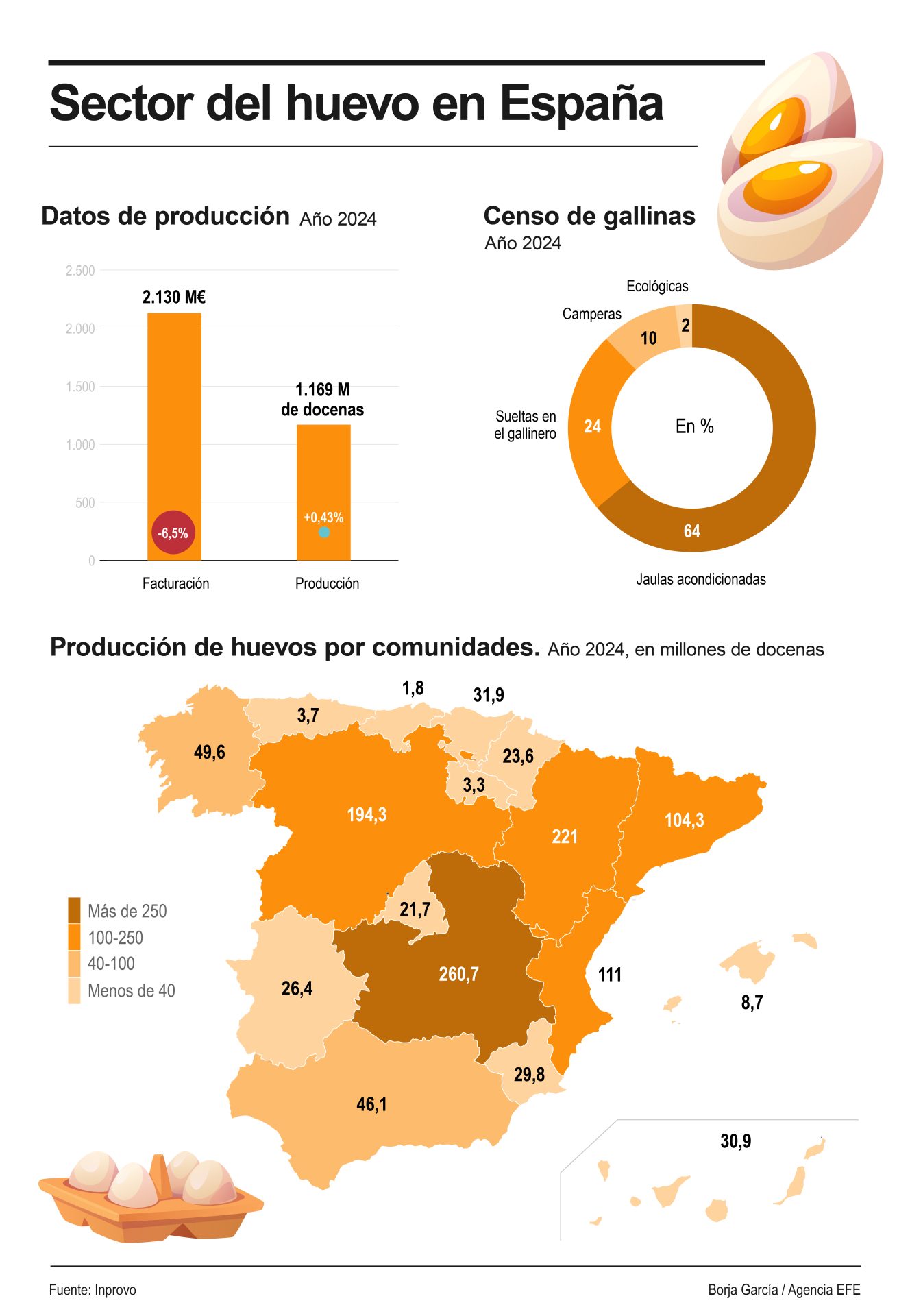
The egg sector generated €2,130M in turnover in 2024, with Aragón recording the greatest production growth of any region
The Spanish egg sector is a vital economic pillar. Turnover reached €2,130 million in 2024. This figure represents 7.8% of the total value of livestock production and 3.2% of total agricultural output in Spain.
In terms of production, Spain maintains its position as the third largest producer in the European Union, contributing 14% of total EU production. In 2024, output stood at 1,169 million dozens, recording a slight increase of 0.43% compared to 2023. Only France and Germany rank above Spain in this classification.
The egg sector not only contributes to economic wealth, but also plays a crucial role in the economic, social and territorial development of rural Spain. It generates approximately 15,000 direct jobs and around 60,000 indirect jobs, with a notable presence of young people and women, who make up 40% of the sector’s workforce.
Regarding the regional distribution of production, Castilla-La Mancha led the ranking with 260.7 million dozens, followed by Aragón (221 million) and Castilla y León (194.3 million). Other notable autonomous communities include the Valencian Community (111 million) and Catalonia (104.3 million).
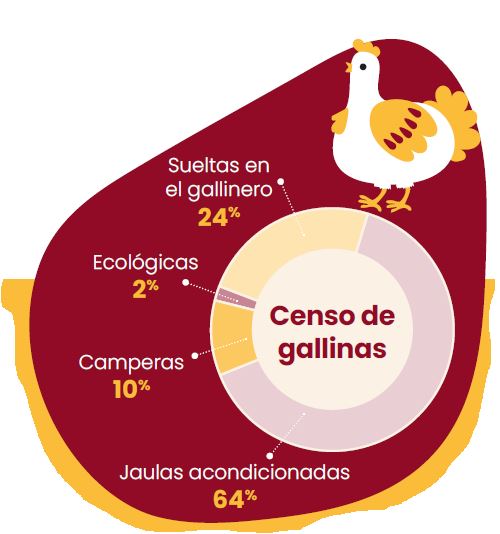
All new or converted laying farms are opting for cage-free systems, which are now used by 3 in every 4 laying farms in Spain
The Spanish poultry sector is rapidly adapting to new consumer demands, particularly with regard to animal welfare. Of the 1,623 laying hen farms in Spain, 76% already operate under alternative production systems. These include barn, free-range and organic systems.
This proportion has tripled over the past six years, demonstrating the enormous effort and significant investments made by producers. In 2024, one in every three eggs consumed in Spain already came from hens housed in these alternative systems. 42% of the volume and 43% of the value of packaged eggs come from hens reared in alternative systems.
INPROVO Director Luz Santos highlighted that these positive economic results in 2024 are key to enabling the sector to maintain these “firm commitments that require substantial investment”. While the transition to alternative systems entails higher production costs — such as the fact that “hens eat more and lay fewer eggs” — this investment is essential to respond to growing consumer awareness and ensure the long-term sustainability of the sector.

Free-range hens at Las Rosas de Canarias farm aviary. / Juan Castro. The Canary Islands consume 147 eggs per person per year and produce 30.9 million dozens, but due to the lack of available land, this autonomous community is compelled to source 40% of the eggs it consumes from the mainland.
Consolidating and increasing consumption, keeping avian influenza at bay, expanding export capacity and — above all — reducing red tape and streamlining the process of establishing new laying farms are the sector’s main challenges.
Although the sector is in a strong position, it is not without its challenges. Rising production costs and the recent inflationary crisis have contributed to adjustments between supply and demand at a global level. Additionally, factors such as avian influenza, which has affected European countries and the United States, and the administrative complexities involved in expanding farm capacity, are significant considerations.
However, these challenges are viewed as catalysts for innovation and continuous improvement. Mari Luz Santos herself has noted that, despite price increases, consumption has continued to grow, highlighting the fundamental importance of eggs in the Spanish diet. The sector’s resilience in the face of price volatility and market conditions demonstrates its robustness and the adaptability of poultry producers.
On the export front, although negotiations to supply eggs to the United States did not come to fruition due to price differentials (European eggs are 16% more expensive than those from suppliers such as Brazil or Turkey), the Spanish sector remains a significant exporter, with €323.66 million in exports in 2024, with France, Portugal, the United Kingdom and the Netherlands as the main destinations. This demonstrates the quality and competitiveness of “made in Spain” eggs in key markets.
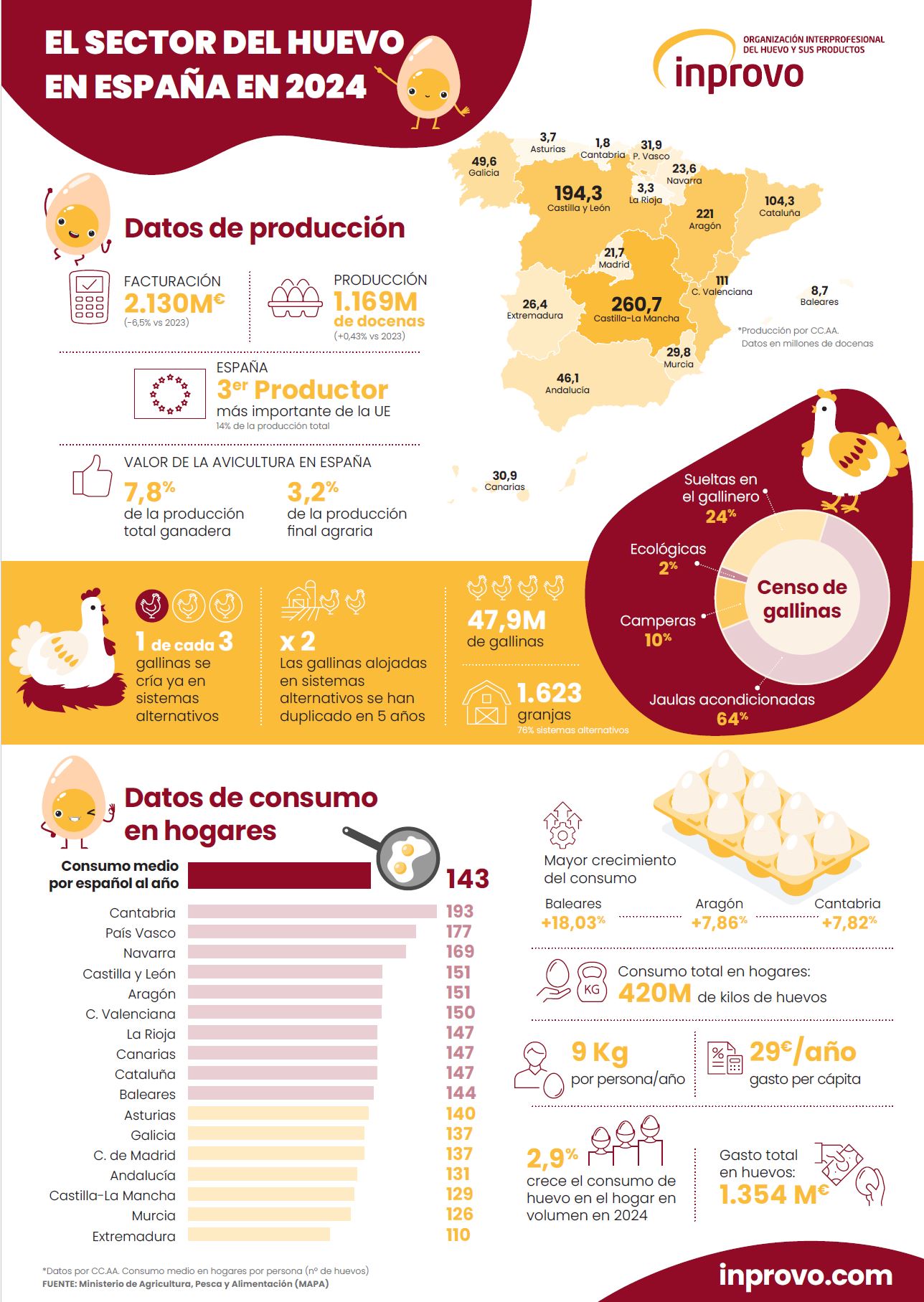
Summary table: key data for the Spanish egg sector in 2024
| Indicator | 2024 Data | Notes |
|---|---|---|
| Sector turnover | €2,130 million | A decline of 6.5% compared to the previous year, but representing 7.8% of the value of livestock production and 3.2% of total agricultural output. |
| Total production | 1,169 million dozens | Increase of 0.43% compared to 2023. Spain is the 3rd largest producer in the EU (14% of total). |
| Total household expenditure | €1,354 million | Average per capita expenditure of €29 per year. Growth of 58% in value since 2019. |
| Volume consumption (households) | 420 million kg (420,000 tonnes) | Increase of 2.9% compared to 2023. Growth of 16.7% in volume since 2019. |
| Annual per capita consumption | 143 eggs/person/year | Equivalent to 9 kg/year or 12 eggs/month. Exceeds the 137 eggs recorded in 2023. |
| Household penetration | 97% | One of the highest purchase penetration rates. |
| Employment (direct and indirect) | 15,000 direct, 60,000 indirect | Significant contribution to the economic development of rural Spain. 40% women. |
| Farms with cage-free systems | 76% (out of 1,623 farms) | Tripled over the past six years. In terms of the LAYING FARM CENSUS, in percentage terms, laying farms operating cage-free systems are now in the majority; in 2024, 76% of all laying farms (1,232 farms) operated cage-free. |
| Laying hen census in cage-free systems | 16.8 million laying hens (36%) are already in cage-free systems; however, although declining year on year, enriched cages still house the majority of the flock, with 31 million laying hens | In terms of PRODUCTION, in absolute figures, of the 47.8 million laying hens in Spain, 31 million (64%) remain in enriched cage housing. |
| Average egg price | €3.68/kg (March 2025) | Increase of 14% compared to the same month of the previous year (€3.23/kg). |
The collective effort of the entire egg sector has enabled it to achieve the first form of sustainability — economic sustainability — without which no other form is possible
The egg sector is capitalising on this period of economic prosperity to voluntarily undertake the conversion to alternative rearing systems (organic, free-range and barn-housed hens), which require significant investment. According to an independent study by CEU Valencia, the cost of eliminating cages for sector operators amounts to €2,000 million.
INPROVO emphasises the sector’s commitment to sustainability and animal welfare, recognising that strong economic results facilitate the necessary investment. The organisation’s president, Ester Muñoz, states that the sector is “helping to build a future based on animal welfare, sustainability and innovation”.
Poultry producers can be proud to be part of a sector that not only feeds the population efficiently and nutritiously, but also makes a significant contribution to economic and social development, particularly in rural areas. With these figures and prospects, the message is clear: eggs are, and will continue to be, a star product in the Spanish shopping basket.
Federico Castelló
Founder and Director of NeXusAvicultura
For further information:
-. INPROVO website and News on the Egg and Egg Products Interbranch Organisation
-. Poultry farming in Spain
-. European consumers wanted cage-free eggs. Now they have them. At 30% more than in 2024 — and that may not be the end of it…..
-. €2,300M: the cost of eliminating every single cage from Spain’s laying hen sector