
HEALTH ALERT: Unprecedented levels of Highly Pathogenic Avian Influenza in Europe during the autumn 2025 migration
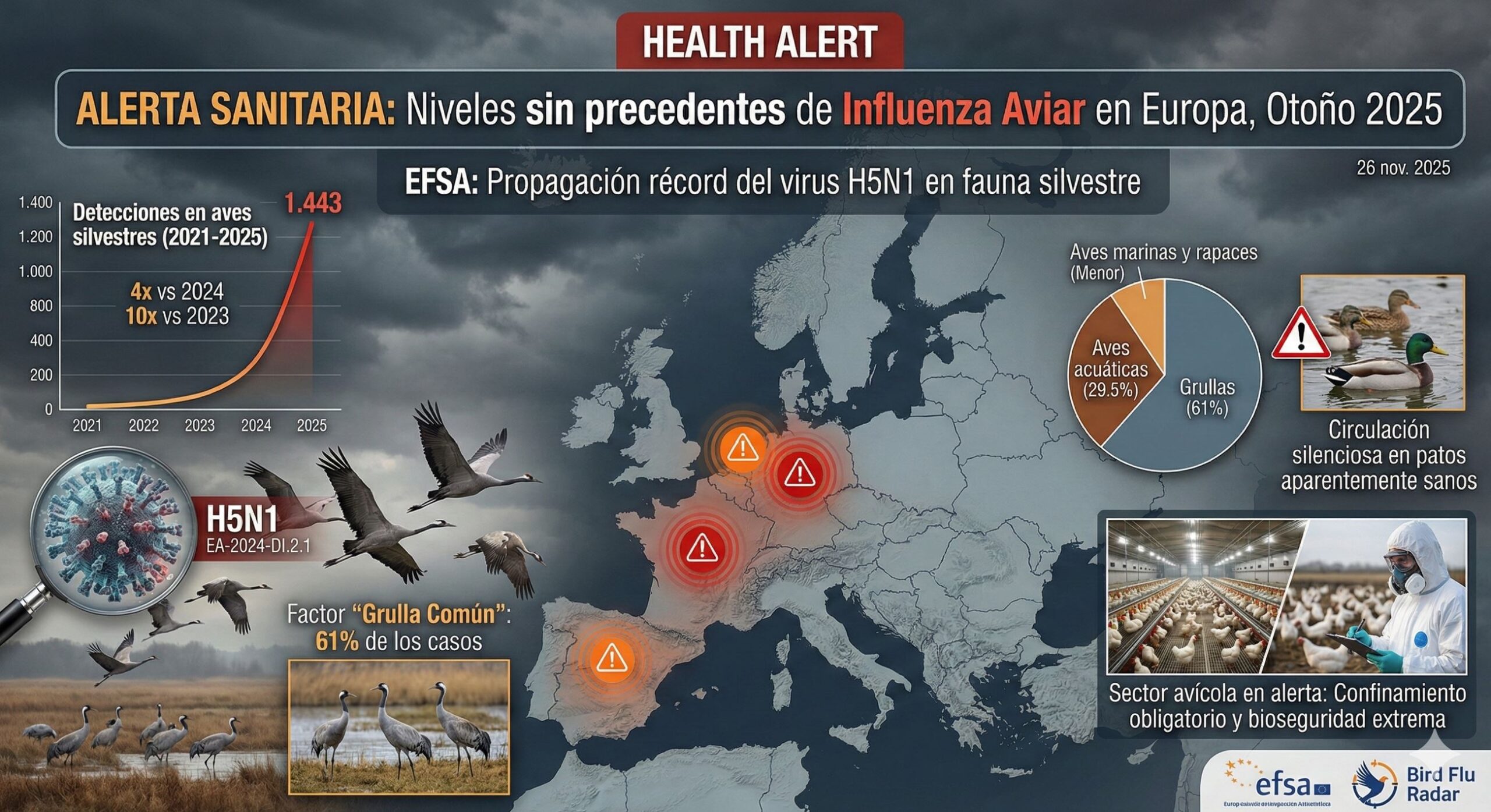
Brussels, 26 Nov. 2025. The European Food Safety Authority (EFSA), in collaboration with the EU Reference Laboratory, has issued an urgent statement in response to the current epidemiological situation. Between 6 September and 14 November 2025, Europe has recorded 1,443 detections of Highly Pathogenic Avian Influenza (HPAI) A(H5) virus in wild birds.
This figure represents a dramatic increase compared with previous years and marks the highest level observed for this period since at least 2016. The viral pressure in wildlife has triggered a parallel increase in outbreaks in domestic poultry, prompting the immediate activation of all protocols by the European professional poultry sector.
1. Comparative epidemiological analysis
The magnitude of the current outbreak becomes clear when comparing the data with previous epidemiological seasons. The number of detections in wild birds during the current period is four times higher than in 2024 and ten times higher than in 2023.
Table 1: Comparative environmental viral pressure in autumn (equivalent period). Data based on wild bird detections reported in Europe up to 14 November 2025.
| Epidemiological Year | Detection Level (vs 2025) | Observed Trend |
| 2025 | 1,443 detections (Reference) | Historical record since 2016 |
| 2024 | 4 times lower than 2025 | Significant current increase |
| 2023 | 10 times lower than 2025 | Massive epidemiological surge |
| 2022 | Half of 2025 | |
| 2021 | 4 times lower than 2025 |
EFSA warns that these figures are likely a significant underestimate of actual wild bird mortality, given that not all detections have yet been reported and not all cases in wild birds are detected.

Figure 1: Geographic distribution of HPAI virus detections in wild birds (cumulative total n=14,227) (pink) and in establishments (production farms plus backyard flocks) keeping domestic poultry (cumulative n=7,268) (blue) reported in Europe over seven epidemiological years by month of suspicion, from 1 October 2019 to 14 November 2025 (total n=21,495)
2. Virological profile and genetic evolution
99% of detections correspond to HPAI A(H5N1) virus. Phylogenetic analysis has revealed a critical evolution of the virus:
- New sub-lineage: The majority of identified viruses belong to EA-2024-DI.2.1, a new sub-lineage derived from the previously circulating EA-2024-DI.2 genotype.
- Origin and dispersal: This sub-lineage was probably recently introduced into Europe from the east during the autumn migration, spreading rapidly westwards.
- Reassortment risk: A high simultaneous prevalence of low pathogenicity avian influenza (LPAI) and HPAI A(H5) viruses has been detected in waterfowl, increasing the risk of mixed infections and the emergence of new reassortant viruses.

Figure 2: Geographic distribution, based on available geocoordinates, of HPAI virus detections in wild birds (1,443), reported by virus subtype, in Europe from 6 September to 14 November 2025.
Note: The unit reported is the number of HPAI virus detections at outbreak level and not the total number of HPAI virus detections in wild birds (as more than one species may be involved in a single reported HPAI virus detection).
3. Geographic distribution and main foci
The geographic spread is extensive, affecting 26 European countries. Germany is the current epicentre of the epizootic, followed by France and the Netherlands.
Table 2: Countries with the highest reported incidence of AI in wild birds (6 Sept – 14 Nov 2025)
| Country | No. of Detections | Observations |
| Germany | 909 | Main focus; first report of mass mortality in cranes. |
| France | 165 | South-westward spread following migratory routes. |
| Netherlands | 78 | High prevalence in apparently healthy mallards. |
| United Kingdom | 60 | Excluding Northern Ireland. |
| Spain | 48 | Confirmed arrival on the Iberian Peninsula. |
| Denmark | 28 | |
| Austria | 24 |

Figure 3: Geographic distribution, based on available geocoordinates, of HPAI virus detections in different categories of wild birds in Europe, by species category, from 6 September to 14 November 2025 (total n=1,443).
Notes: The unit reported is the number of HPAI virus detections in different categories of wild birds at outbreak level and not the total number of HPAI virus detections in wild birds (as more than one species may be involved in a single reported HPAI virus detection). “Mixed” refers to outbreaks involving multiple categories. “Other” groups all other affected categories not indicated in the legend. Source: ADIS, EFSA and WOAH (data extraction performed on 14 November 2025).
4. Species impact: The Common Crane Factor
Unlike previous seasons dominated by coastal seabirds, the species profile affected in 2025 has changed dramatically.
A. Common Cranes (Grus grus)
These represent the most alarming finding. Cranes are involved in 61% of all detections (877 out of 1,443 cases).
- Mass mortality began in Germany and has moved south-westwards towards France and Spain, following the species’ natural migratory route.
B. Waterfowl (Anatidae)
These account for 29.5% of detections (426 cases).
- Affects ducks, geese and swans.
- Critical finding: Active surveillance in the Netherlands has detected virus in apparently healthy wild ducks at a previously unseen prevalence, indicating a level of “silent” viral circulation far greater than mortality figures suggest.
C. Seabirds and raptors
44 detections were reported in colonial seabirds (mainly gulls) and 44 in raptors (mainly buzzards), representing a smaller proportion compared with cranes and Anatidae during this period.
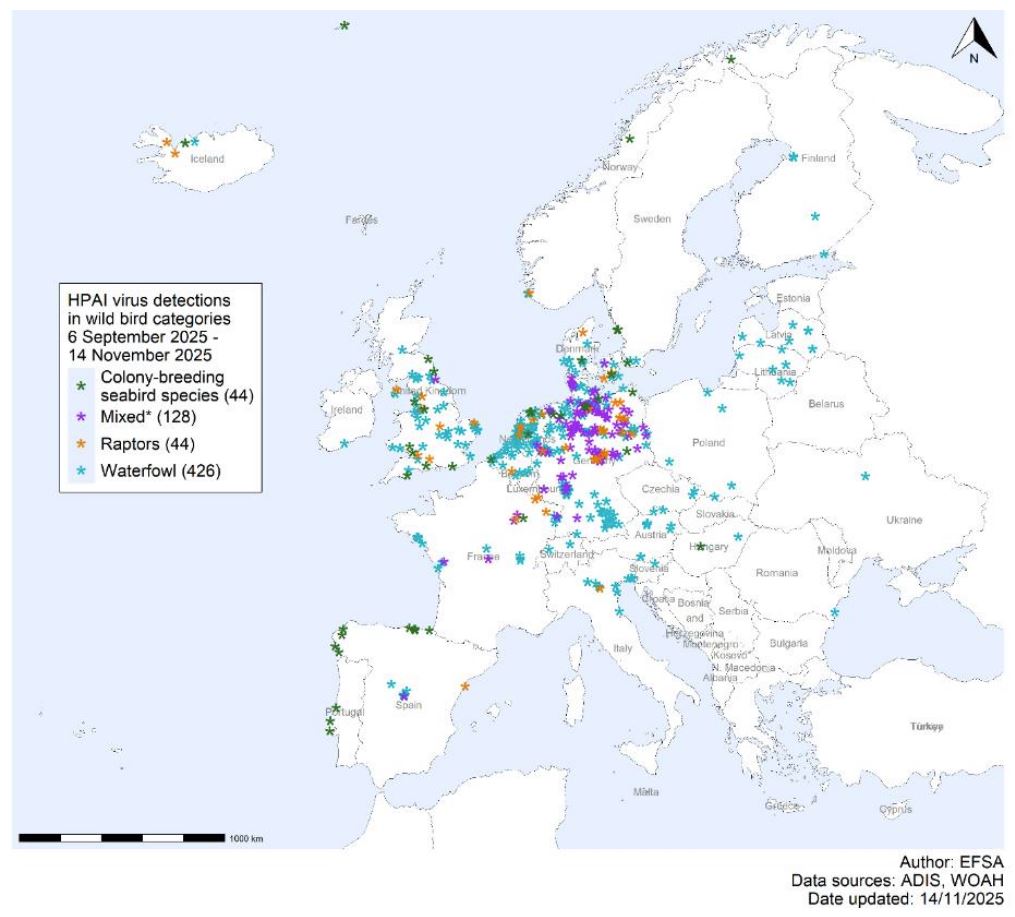
Figure 4: Geographic distribution, based on available geocoordinates, of HPAI virus detections in all categories of wild birds except crane cases (total n=642) in Europe, from 6 September to 14 November 2025
5. Implications for the poultry sector (farmed birds)
A direct and observed correlation exists between high circulation in wild birds and increased outbreaks on commercial farms.
- Current situation: An increase in HPAI outbreaks in domestic poultry has been observed across multiple countries.
- Forecast: High viral circulation is expected to continue and expand to new geographic areas in the coming weeks due to the ongoing migration towards wintering grounds in southern Europe and Africa.
- Imminent risk: Without additional measures, an increase in viral incursions into poultry establishments is likely.
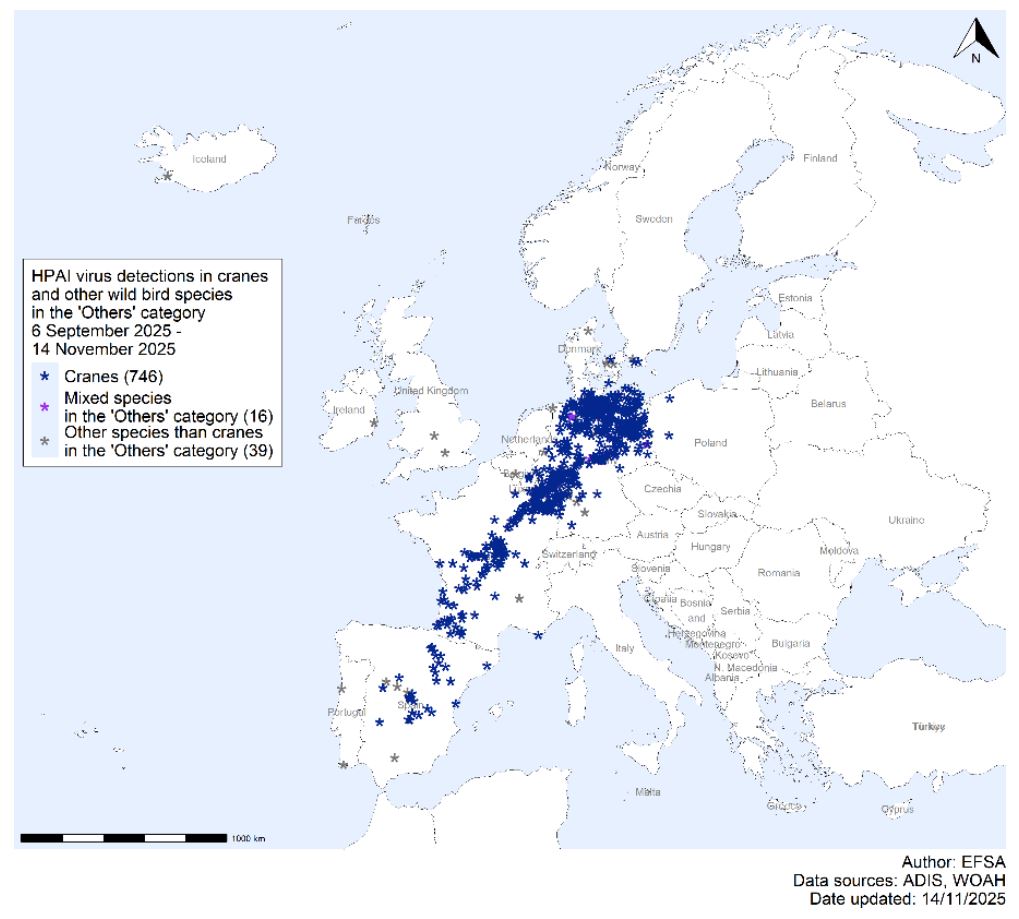
Figure 5: Geographic distribution, based on available geocoordinates, of HPAI virus detections in cranes (746 cases) and in “Other” categories of wild birds (55 cases), in Europe, from 6 September to 14 November 2025
6. Technical recommendations for poultry professionals
Based on the EFSA report, the following operational guidelines for urgent compliance are issued:
- Strict biosecurity: Optimisation and maintenance of high biosecurity standards throughout the production cycle and during slaughter/depopulation operations.
- Bird housing: The implementation of housing orders (indoor confinement) is strongly recommended in areas with active circulation in wild birds; mandatory confinement has already been adopted nationwide in countries such as Spain.
- Enhanced passive surveillance: Increase the sensitivity of early detection on farms at any compatible clinical signs.
- Environmental management:
- Prompt removal of wild bird carcasses in the vicinity is crucial to reduce environmental viral load.
- Avoid artificial feeding of wild birds to reduce congregation of susceptible species.
- Monitoring: Regularly consult the EFSA Bird Flu Radar to assess the probability of spatio-temporal introduction (https://app.bto.org/hpai).

By: NeXusAvicultura Technical Editorial Team
Source: European Food Safety Authority (EFSA) Journal 2025;23(11):9811
Data cut-off date: 14 November 2025
Further reading:
-. Avian Influenza on NeXusAvicultura
Want to stay one step ahead in poultry farming?
Subscribe free to our eNewsletter and receive a weekly selection
of the best information to anticipate trends, stay up to date and grow as a poultry industry professional.
NeXusAvicultura: Vision, Insight, Quality and Context.