
Avian influenza in Europe: strict farm controls as wild bird cases surge
Arenys de Mar, updated 1 Nov 2025. H5N1 avian influenza is experiencing a surge in cases across Europe, both on farms and in wild birds, triggering mass culls of production poultry and raising concerns about rising prices for eggs and poultry meat. The circulating strain of H5N1 is classified as highly pathogenic, capable of causing severe avian influenza.
Although H5N1 was first detected in the mid-1990s, outbreaks have only occurred on an annual basis since 2020. The H5N1 virus is now present on every continent, including Antarctica, and continues to be a concern for health authorities, scientists and wildlife specialists.
European health authorities and poultry producers are being put to the test by the increase in cases in the northern hemisphere, with outbreaks expected to continue throughout the winter.
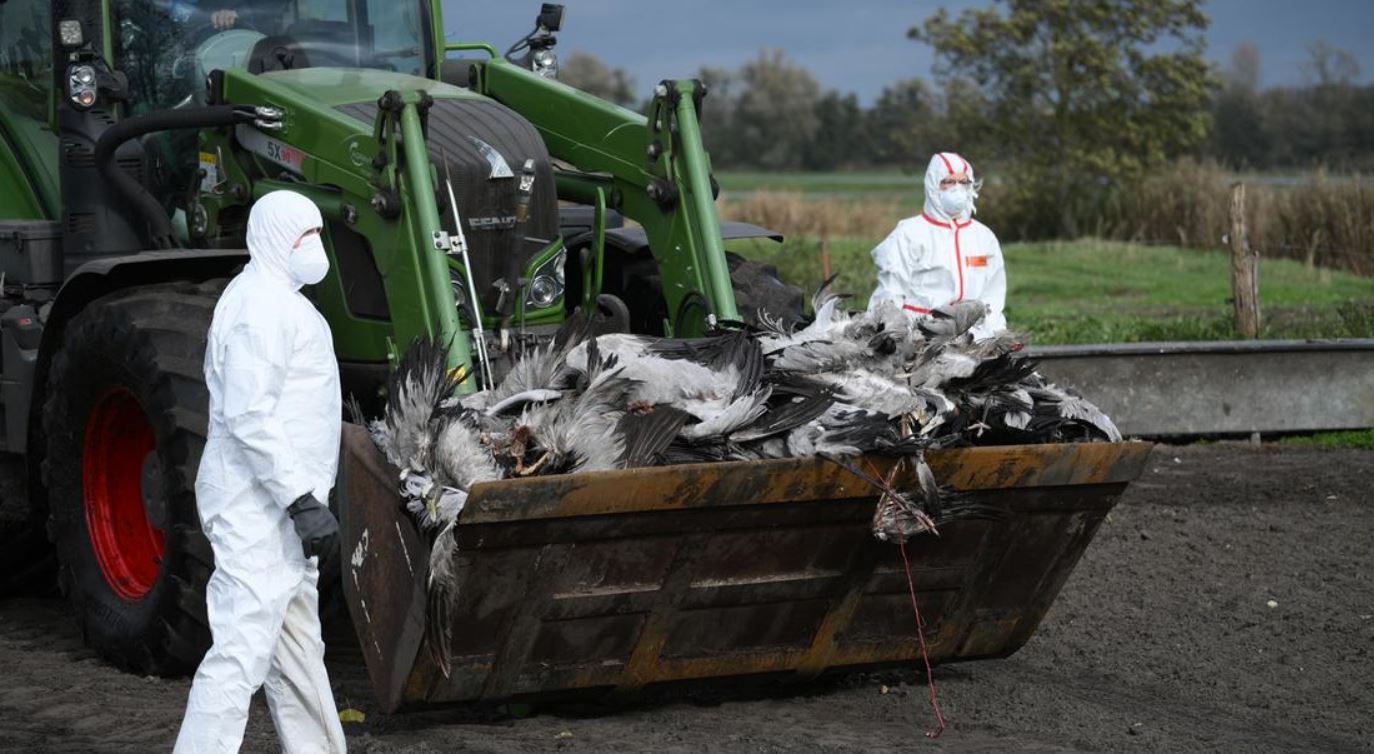
This October the H5N1 virus has already killed more than 3,000 cranes across Europe
The rise in cases coincides with autumn in the northern hemisphere, when migratory bird populations begin their annual journeys towards warmer climates. During their stopovers en route, these birds come into contact with local and farm birds.
A worrying factor is that migratory cranes have been infected with H5N1 for the first time, increasing the risk of spread to poultry when cranes rest near agricultural land. These migrations began earlier this year, and more species, such as migratory cranes, have become infected, raising the likelihood of poultry becoming infected, particularly if sick birds die in the vicinity.
Avian influenza used to occur only in winter, but there are now cases throughout the year, at least among wild birds.
Between early August and 26 October, the French epidemiological surveillance platform, which collates European data, detected 351 outbreaks in wild birds across Europe, with a sharp increase in cases across all categories compared with the same periods in 2023 and 2024. The last major wave of avian influenza in Europe was recorded in 2021–2022.
Transmission to farm birds occurs readily when infected birds shed H5N1 particles in their saliva, body fluids and faeces. The risk of close contact between wild and domestic animals has recently been demonstrated in Germany, where infected cranes have perished on their southward journey near Berlin and Stuttgart.

Country-by-country breakdown
Prevalence
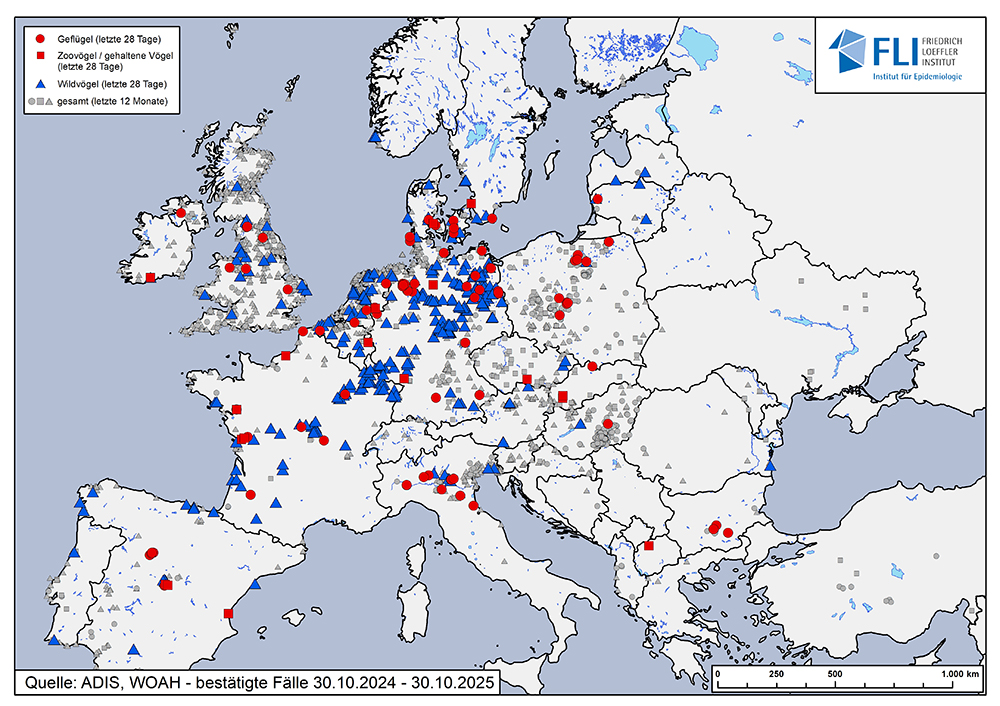
From 01/08/2025 to 26/10/2025, 85 poultry outbreaks (28 new), 18 captive bird outbreaks (6 new) and 351 cases in free-living wild birds (93 new) have been detected in Europe.
- Poultry: 14 countries have detected outbreaks since the start of the season. The five countries (six this week, as two are tied in fifth place) with the highest number of outbreaks are: Germany (26), Poland (13), Spain (12+2), Italy (8), Bulgaria (6) and United Kingdom (6).
- Wild birds: 20 countries have detected cases in wild birds since the start of the season. The five countries with the highest number of cases are: United Kingdom (141), Germany (59), Spain (37), Norway (31) and France (19).
Incidence and trends
On the domestic front, a sharp and sudden increase in incidence is being observed in Germany (see chart).

Figure: Prevalence (cumulative incidence) of poultry outbreaks in the five countries (six in the chart, due to the tie in fifth place this week) most affected since the start of the season (01/08/2024) (Source: European Commission ADIS, 27/10/2025; WAHIS-WOAH, 20/10/2025).
In wild birds, since early June 2025, an increase in incidence in seabirds has been observed, particularly in gulls in the North Sea, as well as the English Channel and the Atlantic coast. However, the number of detections in these species appears to be declining. In parallel, cases have been detected in waterfowl in a growing number of countries, including France, since September, in southern and central Europe (Austria, Germany, Poland) and in the United Kingdom. Furthermore, over the past two weeks, an outbreak has been recorded in cranes, with detections in Germany, Belgium, Luxembourg and France.
Germany
Germany has been a recent epicentre of activity, where authorities have reported a sharp rise in farm outbreaks in the past week, according to European data.

German farms have been forced to carry out mass culls, destroying half a million chickens, ducks, geese and turkeys, as well as thousands of head of livestock, to prevent further spread of the disease. Meanwhile, in the wild, specialised teams have been removing hundreds of cranes that have died from H5N1. The Friedrich-Loeffler-Institut (FLI), Germany’s federal animal health research agency, anticipates further infections and transmissions in November. In the last ten days of October alone, more than fifty outbreaks in wild birds were detected in Germany.
In response to the severity of the avian influenza outbreak in Germany, the German Poultry Association (ZDG) issued a statement on 24 October calling for a rapid reinforcement of biosecurity measures on farms at national level. Its president, Hans-Peter Goldnick, spoke to the press about the vulnerability of free-range turkey and laying hen farms, which are particularly affected by the epizootic. Goldnick called for free-range and organic farms to be able to maintain their certifications if their birds are temporarily housed indoors. These represent 30% of egg production, generating fears among producers of a possible shortage and a sharp increase in consumer prices.
In the statement, the association also welcomed the collaboration between the Länder and the federal government, as well as the consideration of the commercial value of birds culled at infected premises.
In its report of 30 October, the Friedrich-Loeffler-Institut (FLI) reported 20 new cases on farms since 23 October—doubling the number recorded up to that point—as well as 184 virus detections in wildlife, particularly in migratory cranes this year.
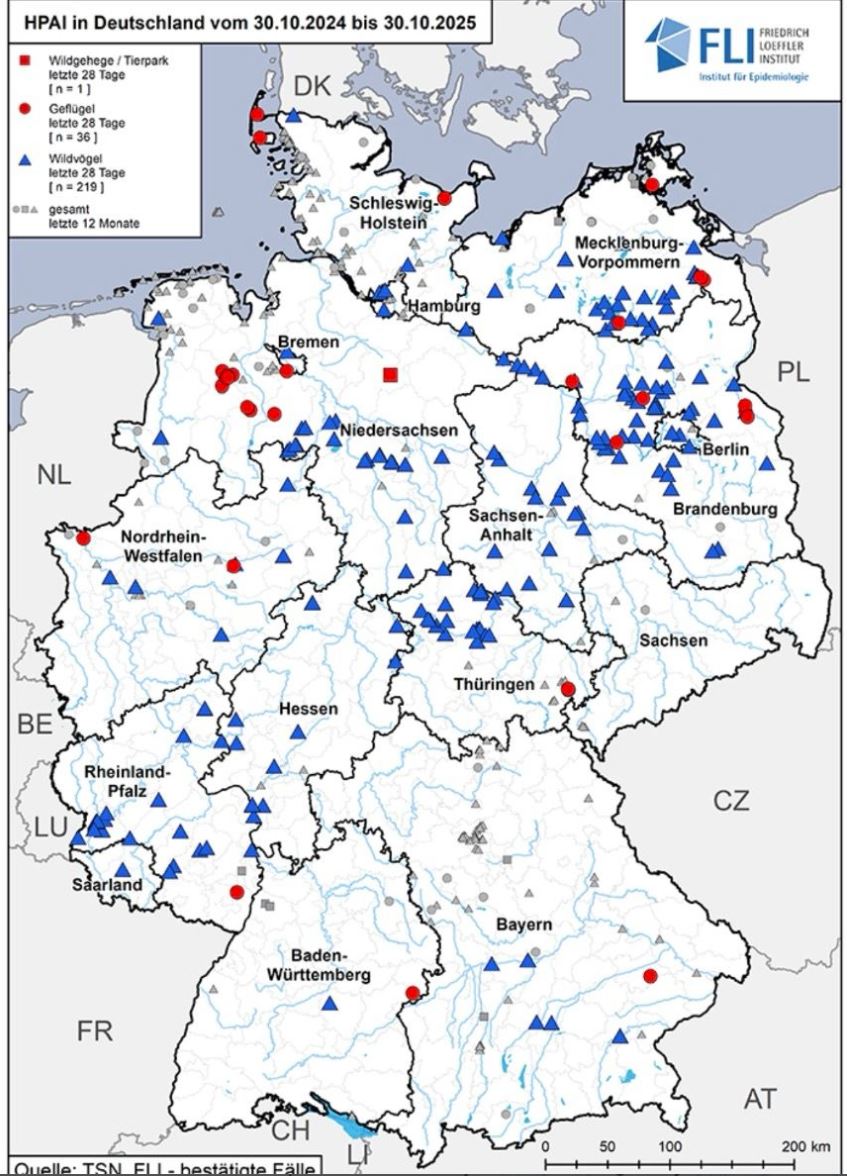
The weekly updated map on the status of highly pathogenic avian influenza (HPAI) infections in Germany, produced by the Friedrich-Loeffler-Institut (FLI), shows a significant increase in the number of cases compared with the previous week (23.10.). In poultry, 20 new outbreaks were recorded, doubling the figure, while in wild birds 184 positive findings were detected, although a single report may include a far greater number of dead animals. Due to the dynamic nature of events, these figures represent only a snapshot.
“We continue to observe a steady increase in cases, and no easing of the situation is in sight. On the map of Europe, the cases in wild birds are impressively apparent, coinciding with the autumnal migratory movement towards the south-west,” notes FLI President Professor Dr Christa Kühn.
Vigilance must not be relaxed, either in biosecurity measures for poultry or in the reporting of dead wild birds. Although local veterinary authorities are already extremely busy, the collection of dead wild birds remains essential.
France: more than 101,000 farm birds culled to date
France has officially described what is happening to wild birds as a “hecatomb,” although farm outbreaks have been relatively few (so far). The country raised its alert level to “high” on 22 October. This change is due to the early circulation of the virus in Europe, particularly in Germany.
Health authorities fear a “mass introduction” of the epizootic via common cranes. The phenomenon is described as a “hecatomb” and a “historic” event by the French Office for Biodiversity in Cher.
- Outbreaks and culls: Ten avian influenza outbreaks have been detected in France (six on commercial farms—including turkeys, ducks and laying hens—and four in non-commercial flocks). To date, more than 101,000 poultry have been culled as a result of the first nine outbreaks.
- Wild birds: The regions affected by the virus in common cranes include Landes, Corrèze and Marne, where more than 500 carcasses were found within a matter of days. In Lorraine, nearly 2,500 dead cranes were found; the virus causes neurological disorders, causing birds to “fall even from the sky.”
- Measures: Authorities are reminding the public of the importance of avoiding all contact with wild birds. Preventive vaccination of ducks, mandatory since 1 October 2023, has “significantly reduced mass culls and economic losses.”

United Kingdom
Cases have been detected in the United Kingdom. On 29 October 2025, the country’s Chief Veterinary Officer announced new mandatory housing measures for poultry and other captive birds in parts of northern, central and eastern England. From 30 October 2025, all individuals or poultry keepers with more than 50 birds in 21 specific counties (including Cheshire, Norfolk and Suffolk, among others) must keep their birds indoors. The aim is to reduce contact with infected wild birds during the high-risk winter season.
Other countries
The Netherlands has implemented measures similar to those of Germany to destroy thousands of infected birds. Farms have culled tens of thousands of birds. Denmark has also carried out actions to destroy thousands of infected birds. Belgium has been forced to put protective measures in place to prevent exposure of poultry flocks. It has raised its alert level to “high,” requiring poultry to be kept indoors. Cases have also been detected in Slovakia.
In Spain, avian influenza has killed more than 500 cranes in Aragón
We are already reporting extensively on each case in Spain. The most recent outbreak occurred on 20 October on a farm housing 51,000 broilers in Valladolid, and as of today (31 October 2025) no further farm outbreaks have been confirmed. Up to 31 October 2025, a total of 14 outbreaks on poultry holdings have been reported in Spain, affecting a total of 2,696,951 farm birds, to which wild bird cases must be added.
It is in wild birds that the situation has deteriorated significantly in the past week, particularly with cranes: in Aragón alone, 500 cranes have been found dead as a result of avian influenza, 350 of which were located around the Gallocanta Lagoon. As a consequence, 101 poultry farms in Aragón have been required to house their birds indoors in accordance with the resolution published by the Department of Agriculture, Livestock and Food of the Government of Aragón to minimise the risk of contagion. In total, these 101 holdings subject to the temporary ban on keeping poultry outdoors have a combined flock of more than 5,721,000 production birds, comprising hens, ducks, turkeys and partridges. This is a preventive measure to avoid possible contagion.

The measures proposed by the regional government include a ban on keeping farm birds outdoors, on housing ducks or geese together with other bird species, and on providing farm birds with water from sources accessible to wild birds, unless treatment to eliminate the virus is guaranteed. Gatherings of poultry or captive birds, such as fairs, exhibitions, shows or open-air events, are also prohibited unless prior specific authorisation has been obtained following a favourable risk assessment. Additionally, outdoor water tanks must be covered. Free-range or organic poultry holdings may continue to market their products under their usual production system during the restriction period, provided that their data in the official register are kept up to date. These measures will remain in force until 28 February 2026 and will be mandatory throughout the autonomous community of Aragón, the DGA reminds.

Within the remit of the Department of Environment and Tourism of Aragón, which is responsible for collecting carcasses, operations at Gallocanta have been reinforced with two Sarga teams comprising a total of 14 people. In addition, staff at the interpretation centre have received specific training on avian influenza and on the guidance they should provide to visitors to the area.
Tracking of Avian Influenza cases on poultry farms in Spain in 2025:
-. 1st outbreak of 2025 (18 July, Extremadura): Alert over an Avian Influenza outbreak on a 7,000-turkey farm in Extremadura
-. 2nd outbreak (28 July, Toledo): Second AI outbreak detected, this time in breeder flocks in Toledo
-. 3rd outbreak (1 Sept., Huelva): The spectre of H5N1 returns to Andalusia: 8,500 turkeys culled due to avian influenza in Huelva.
-. 4th outbreak (8 Sept., Guadalajara): Spain records its fourth AI outbreak of 2025, this time on a breeder farm in Guadalajara
-. 5th outbreak (9 Sept., Huelva): H5N1 positive confirmed on the 8,400-bird poultry farm in Valverde del Camino, Huelva, Andalusia
-. 6th outbreak (19 Sept., Valladolid): H5N1-type AI detected on a 760,000-layer farm in Valladolid
-. 7th, 8th and 9th outbreaks (1 Oct., Valladolid and Madrid): 552,000 laying hens affected by three new AI outbreaks in Madrid and Valladolid
-. 10th outbreak (6 Oct., Valladolid): Tenth Avian Influenza outbreak detected in Spain. More than 800,000 laying hens to be culled.
-. 11th outbreak (13 Oct., Valladolid): Eleventh Avian Influenza outbreak detected in Spain on a 66,000-layer farm.
-. 12th outbreak (15 Oct., Valladolid): 315,000 new laying hens affected in the latest outbreak
-. 13th outbreak (16 Oct., Toledo): 112,000 laying hens in Yeles, Toledo
-. 14th outbreak (20 Oct., Valladolid): 54,000 broilers in Valladolid
No new outbreaks have been recorded on poultry farms since 20 October (updated as of 1 Nov. 2025)
Further reading:
-. Avian Influenza on NeXusAvicultura