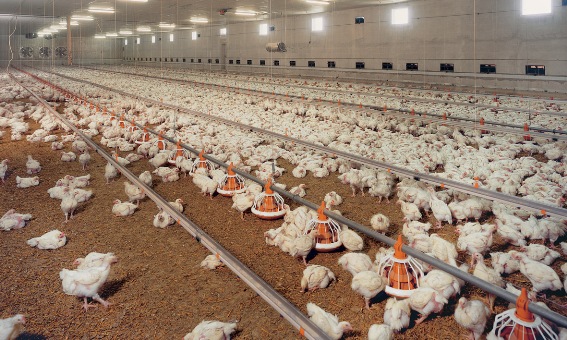


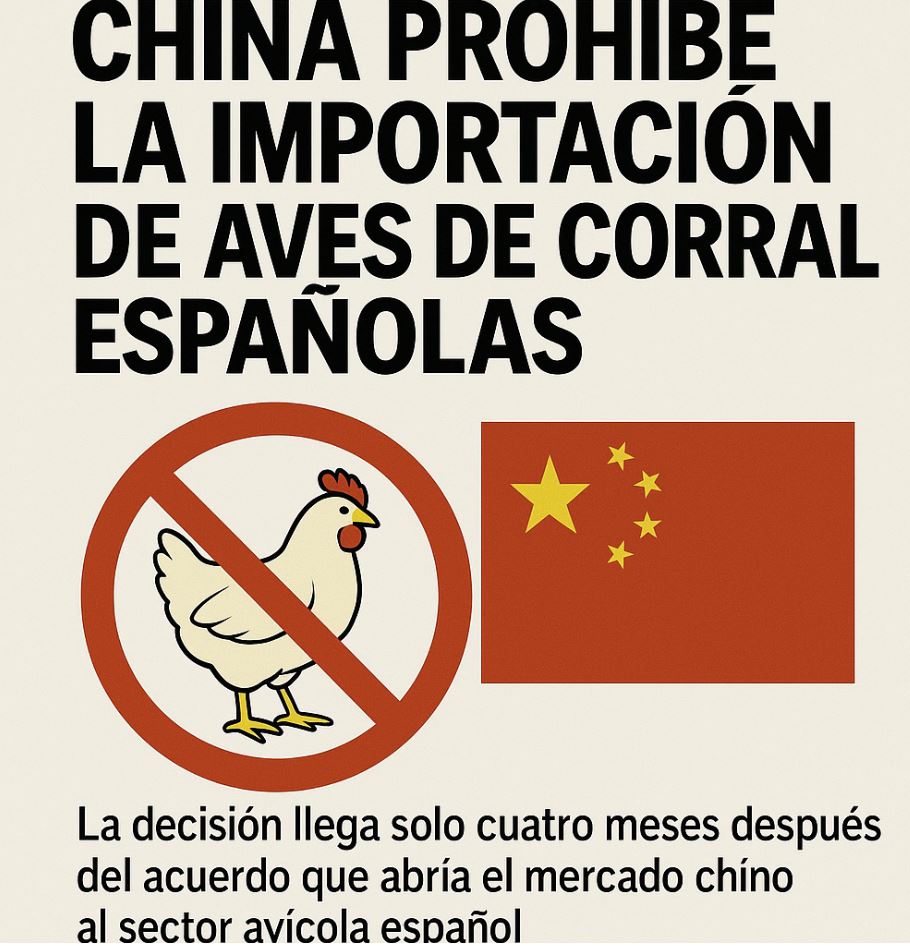
The decision comes just four months after the agreement that opened the Chinese market to Spain’s poultry sector
China decreed this August the immediate suspension of imports of Spanish poultry products following the confirmation of several highly pathogenic avian influenza (H5N1) outbreaks in various regions of Spain. The measure, communicated on Monday 4 August by the General Administration of Customs and the Ministry of Agriculture and Rural Affairs of the Asian country, entered into force on 7 August and remains in effect with no end date.
The Spanish Ministry of Agriculture, Fisheries and Food (MAPA) confirmed that, as a result of these outbreaks, Spain has lost its avian influenza-free country status before the World Organisation for Animal Health (WOAH). The country had gone more than two years without recording any case in poultry.
The Chinese authorities justify the suspension as a preventive measure to safeguard animal health and prevent the spread of the virus. In their communiqué, they stress that the decision is based on information submitted to WOAH and recall that as recently as May, Beijing took a similar measure against chicken imports from Brazil for the same reason.
The ban affects all entry routes, both direct and indirect, and includes fresh and processed products that may pose a zoonotic risk. The transport of these items through postal shipments or personal luggage is also prohibited. Any goods that fail to comply with the regulation will be destroyed or returned under customs control. Furthermore, China will require that all animal or plant waste unloaded from ships, aircraft or other means of transport arriving from Spain be subjected to special pest control treatments.
In Spain, the first avian influenza focus of this year was reported on 18 July at a turkey grow-out farm in Badajoz (approximately 7,000 birds). The second was detected on 28 July in Toledo, at a facility housing 50,000 breeder hens. According to MAPA, there is no epidemiological link between the two cases, with wild birds being the most likely route of transmission. In addition, eight foci in wild birds have been confirmed in 2025 in Andalusia, Extremadura and the Basque Country, and a further case in captive birds in the latter region.
The H5N1 virus, known for its rapid spread and high mortality in birds, is rarely transmitted to humans, but the cases that have occurred present a high case-fatality rate.
The ban represents a temporary setback for the Spanish broiler industry, which in April 2025 had succeeded in opening the doors of the Chinese market. At that time, Minister Luis Planas and the Vice Minister of Customs, Lu Weihong, signed a protocol permitting the export of poultry meat and derived products. China, MAPA noted at the time, is a key market owing to its high demand for poultry products and the commercial opportunities it offers for products with limited placement in other countries.
That agreement added to the 11 agri-food protocols signed with China since 2018. In 2024, Spain exported food to the Asian giant worth €1.864 billion, with a trade surplus of €253 million. Even so, China ranks ninth as a destination for Spanish exports and third among non-EU markets, behind only the United Kingdom and the United States.
Further reading:
-. Avian Influenza on the website of the Spanish Ministry of Agriculture
-. Avian Influenza on NeXusAvicultura