
An unprecedented autumn: pan-European expansion of avian influenza H5N1 in wild birds and poultry
The largest AI episode ever recorded in wild birds in Europe (since records began)
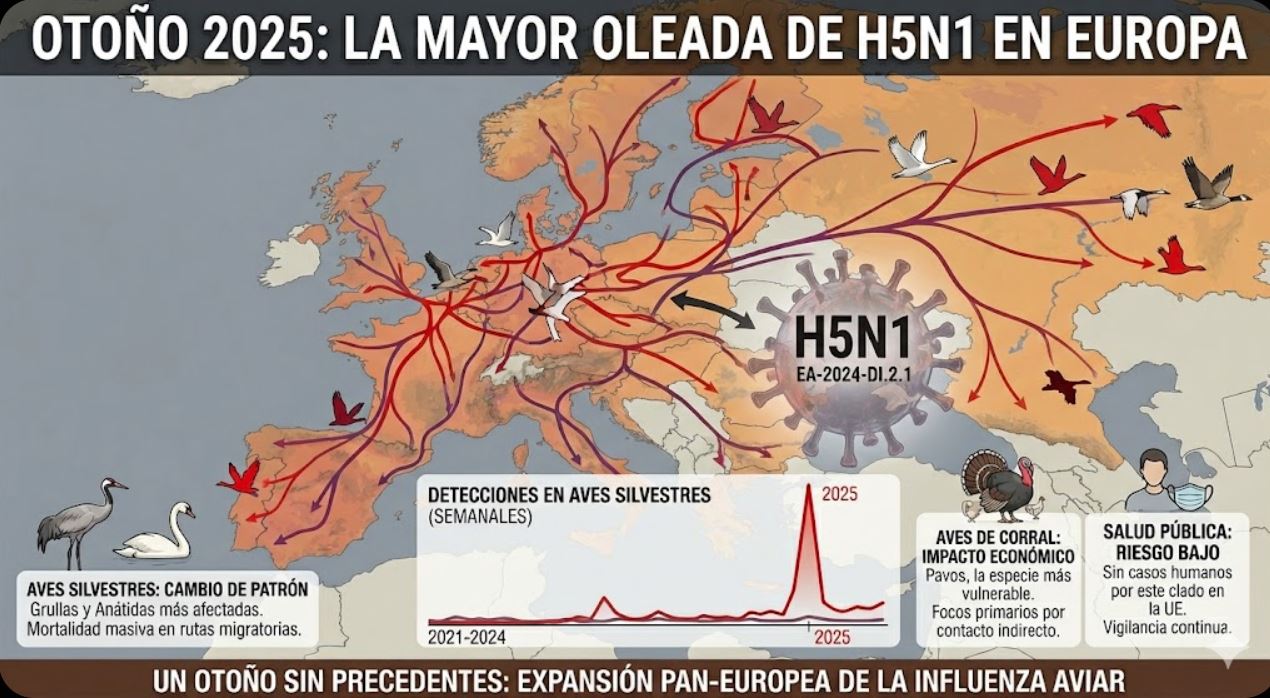
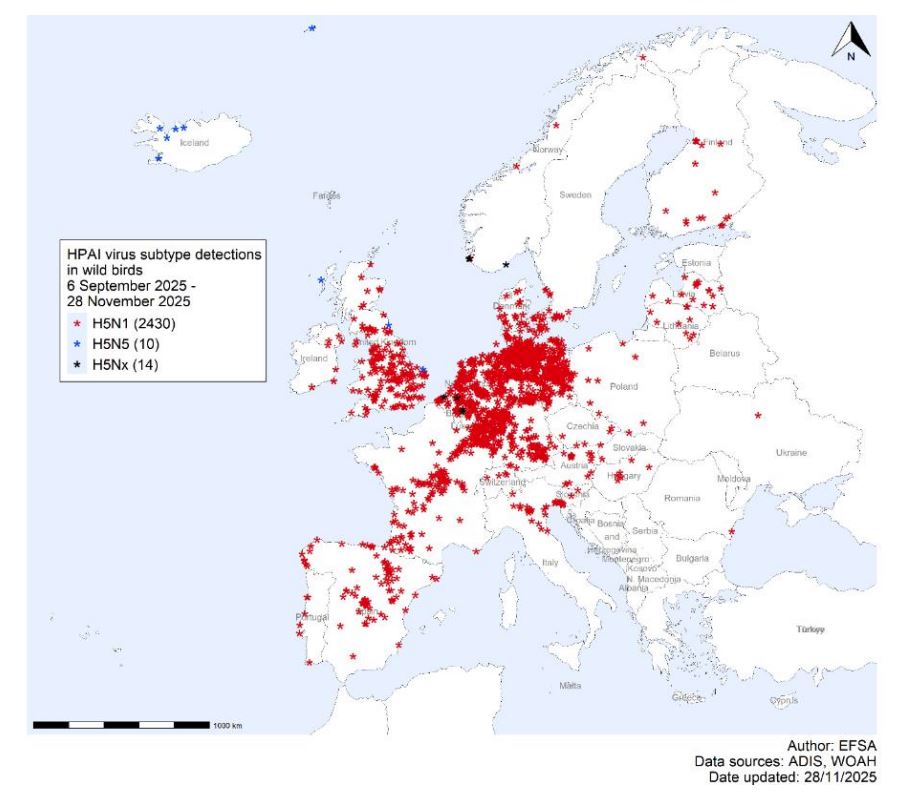
Brussels, 17 Dec. 2025. Between 6 September and 28 November 2025, Europe recorded 2,896 detections of highly pathogenic H5 avian influenza in birds: 368 outbreaks in poultry, 74 in captive birds, and 2,454 in wild birds, distributed across 29 countries. This figure represents an unprecedented increase for this time of year, with the number of detections in wildlife six times higher than in 2024, twelve times greater than in 2023, and clearly above the autumns of 2021 and 2022. These are the main findings of the recently published EFSA Quarterly Report Sep–Nov 2025 on the situation in Europe.
In domestic poultry, the total number of outbreaks is at levels comparable to 2022 and 2024, but with a broader geographical distribution, forming a “quadrilateral” stretching from Northern Ireland and Latvia to Bulgaria and Portugal. Germany leads the poultry outbreak count (138 outbreaks), followed by France (68), the United Kingdom excluding Northern Ireland (39), Italy (24), Poland (22), the Netherlands (19), and Spain (9), among others.
It should be noted that these are data for the analysed quarter; the total figures for 2025 are higher — for example, in Spain the total number of affected farms from 1 January 2025 has not been the 9 recorded in the last quarter but rather 14 outbreaks, the most recent being 20 October 2025 on a farm of 54,000 broilers.
It must be emphasised that these are outbreaks within the analysed quarter, not the 2025 total. In any case, the reports (downloadable in full at the foot of this article) are always issued for the same three-month periods, so both in terms of reliability and comparability with previous years they are absolutely conclusive regarding the trends shown.
And this is what is most concerning, as the dramatic increase in wild birds and the change in the types of birds affected are clearly visible — that is, the virus is mutating and is fully established in the natural environment. There is no need for alarmism, but we must adapt to this new reality that is here to stay.

This time-series chart compares, by epidemiological week, wild bird detections across the autumns of 2019–2025, with the autumn of 2025 clearly demonstrating the exceptional nature of this year.
Shift in pattern in wild birds
The most notable change has occurred in the wild bird component: the relative weight has shifted from colonial seabirds in summer 2025 to Anseriformes and Gruiformes during autumn. Of the 2,454 detections in wild fauna, 40% were associated with Anatidae (ducks, geese and swans), 46% with “other species” — a category dominated by common cranes —, 5% with mixed species and another 5% with raptors, while colonial seabirds now account for just 4%.
The common crane has emerged as an unexpected protagonist of the episode: 229 specifically identified individuals and a further 901 “unspecified cranes” — almost certainly of the same species — were all recorded as positive for H5, forming a mortality corridor crossing Europe from northeast to southwest. This band follows the western migratory flyway, from Germany and the Baltic countries through to France, Luxembourg and Spain, where wetlands such as Lac du Der-Chantecoq, Valleroy and Laguna de Gallocanta have concentrated thousands of dead cranes.
In parallel, the virus has had a significant impact on mute swans (187 records versus just 7 in the same period the previous year), greylag geese and Canada geese, as well as a wide range of Anatidae species not identified to species level. Mortality in swans has been particularly visible in the United Kingdom, Ireland, France and Italy, with episodes of dozens of dead birds at specific coastal and inland wetland sites.
Viral genotypes and new sub-lineage EA-2024-DI.2.1
Since September 2025, approximately 400 highly pathogenic H5 viruses from 17 European countries have been genetically characterised, the majority belonging to a single genotype designated EA-2024-DI. Within this genotype, two major groups are distinguished, EA-2024-DI.1 and EA-2024-DI.2, the latter being predominant and widely distributed from Portugal and the Caucasus to the United Kingdom and Ireland.
In autumn 2025, the dynamics changed with the emergence of a new sub-lineage, EA-2024-DI.2.1, which likely represents a recent introduction into Europe from viruses detected earlier in the year in Israel and Georgia. This sub-lineage was first identified in mid-September in Poland and within weeks had spread to at least 17 European countries in both wild birds (primarily Anseriformes) and domestic birds, accounting for the vast majority of genotyped viruses from poultry outbreaks during the analysed period.
Molecular analyses indicate that, as of 28 November 2025, none of the EA-2024-DI.2.1 viruses isolated from birds carry the mammalian adaptation mutations in PB2 or other markers associated with increased zoonotic potential that have been observed in some clade 2.3.4.4b viruses in previous years. Mammalian adaptation markers continue to be detected at low frequency in other H5Nx genotypes, but the overall biological impact of that mutational constellation remains uncertain and requires further investigation.

Poultry outbreaks and affected species
In poultry, turkeys are once again the most vulnerable species: 20.9% of European autumn outbreaks occurred on turkey farms, ahead of broiler farms (11.7%), domestic ducks (4.9%), domestic geese (3.3%) and other species, with nearly 8% of foci in mixed holdings. Germany accounts for 138 of the 368 poultry outbreaks (37.5%), with 2.37 million birds affected, although Spain exceeds it in terms of head count affected, concentrating 2.54 million birds across just nine outbreaks.
A distinguishing feature compared to previous seasons is that more than 80% of poultry outbreaks are classified as primary, with independent introductions attributable in the majority of cases to indirect contact with wild birds and high levels of environmental contamination. Secondary spread events (farm-to-farm) are far less frequent than in autumn 2024, when 57% of poultry outbreaks had a clear farm-to-farm transmission component.
The French experience adds a relevant nuance: more than 30 outbreaks have been detected on vaccinated duck farms, although EFSA cautions that it is still premature to draw conclusions on the role of vaccination from these data and underlines the need for specific analyses. In several countries (Germany, the Netherlands, Poland), foci are concentrated in areas with very high turkey and layer production density, where the combination of environmental viral pressure and high bird concentration further complicates risk management.

The plight of the cranes and the shift in wild species A qualitative change has been observed in the wild species affected. Whereas in previous periods colonial seabirds predominated, this autumn the virus has struck hard at Anatidae (40% of detections) and, above all, the “other species” category (46%), driven by mortality in common cranes.
The migration of the common crane became a vector of dispersal and mortality. Events began in Germany, with 2,500 deaths at Linum and 500 at Kelbra. Subsequently, up to 10,000 dead cranes were reported in the French Grand Est region, before the virus reached the Iberian Peninsula.
Global outlook and public health risk
Outside Europe, between 6 September and 28 November 2025, 269 HPAI detections were officially notified to WOAH, compared with 303 during the same period in 2024, across 15 countries in Africa, the Americas and Asia. In total, 230 of these detections occurred in domestic poultry and only 39 in wild birds, although EFSA warns that low reporting in wildlife is likely to underestimate the true magnitude of viral circulation.
During the same period, 19 human infections with avian influenza viruses were confirmed in four countries (Cambodia, China, Mexico and the United States), with two fatalities and all cases associated with exposure to birds or poultry environments. Despite the widespread circulation of H5N1 clade 2.3.4.4b viruses in European birds and multiple human exposure events, no human cases attributable to this clade have been documented in the EU/EEA, and international agencies continue to assess the risk to the general population as low.
ECDC classifies the risk of H5N1 clade 2.3.4.4b infection as low for the general population and low-to-moderate for individuals occupationally or otherwise exposed to infected animals or contaminated environments. FAO, WHO and WOAH maintain, in their tripartite assessment, that the overall public health risk from currently circulating H5 viruses remains low for the general population, although the temporal overlap with an early human influenza season theoretically raises the risk of co-infections and potential reassortment events.

Key highlights:
- Cranes, Anatidae and turkeys: the main protagonists of H5 avian influenza in Europe in 2025
- EA-2024-DI.2.1: the new H5N1 sub-lineage dominating the European landscape
- From seabird colonies to inland migratory flyways: H5N1 in Europe has changed
- Avian influenza in Europe, autumn 2025: high wild bird pressure, multiple foci and stable human risk
Source: Avian influenza overview September–November 2025 (EFSA Report, 72 pages, 10 Dec.)
For further reading, the NeXus selection:
-. 4th AI report 2025. Quarterly update on Avian Influenza Sep.–Nov. 2025. News on NeXusAvicultura.com
-. Avian influenza overview September–November 2025 (EFSA Report, 72 pages, 10 Dec.)
-. 3rd AI report 2025. Quarterly update on Avian Influenza June–Sep. 2025. News on NeXusAvicultura.com
-. Avian influenza overview June–September 2025 (EFSA Report, 63 pages, 25 Sep.)
-. 2nd AI report 2025. Quarterly update on Avian Influenza March–June 2025.
-. 1st AI report 2025. Quarterly update on Avian Influenza December 2024–March 2025.
-. 4th AI report 2024. Quarterly update on Avian Influenza Sep.–Dec. 2024.
-. 3rd AI report 2024. Quarterly update on Avian Influenza June–Sep. 2024.
-. Avian Influenza on NeXusAvicultura.com
Want to stay one step ahead in poultry production?
Subscribe free to our eNewsletter and receive a weekly selection
of the best information to anticipate trends, stay up to date and develop as a poultry industry professional.
NeXusAvicultura: Vision, Insight, Quality and Context.