

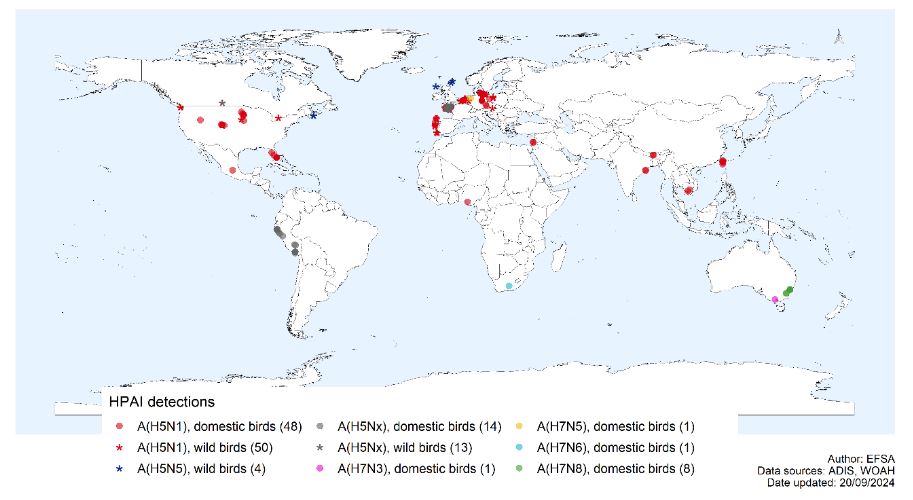
Between 15 June and 20 September 2024, 75 detections of highly pathogenic avian influenza (HPAI) A(H5) and A(H7) viruses were reported in domestic poultry (16) and wild birds (59) across 11 European countries, according to EFSA (European Food Safety Authority) in its latest scientific report on avian influenza published on 2 October 2024.
Although the total number of detections in Europe has remained low compared with previous epidemiological years, a notable increase in cases has been observed along the Atlantic, North Sea and Baltic coasts, and in particular an increase in the detection of highly pathogenic avian influenza viruses in seabirds breeding in colonies.
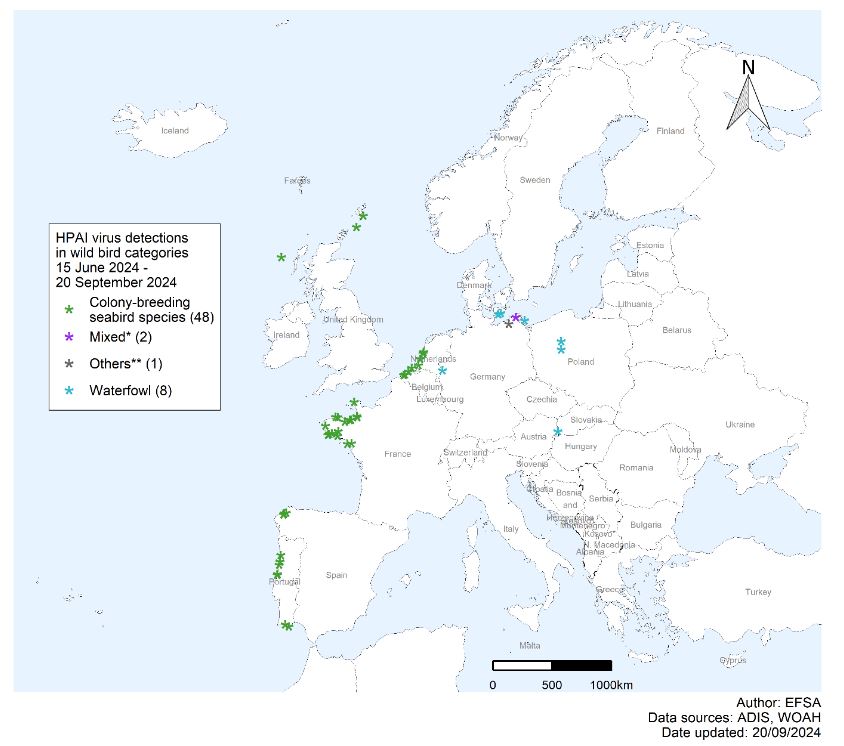
In addition to EA-2022-BB and other circulating genotypes, these detections also included EA-2023-DT, a new genotype that may transmit more efficiently among gulls. In Germany, HPAI A(H7N5) virus emerged in a poultry establishment near the border with the Netherlands.
During this period, no new highly pathogenic avian influenza virus infections in mammals were reported; however, the number of affected dairy cattle establishments in the United States increased to more than 230 across 14 states, and the highly pathogenic avian influenza virus was identified in three new mammalian species.
Between 21 June and 20 September 2024, 19 new human cases of avian influenza virus infection were reported in the United States (six A(H5N1) cases and five A(H5) cases), Cambodia (five A(H5N1) cases, one of which was fatal), China (one fatal A(H5N6) case and one A(H9N2) case) and Ghana (one A(H9N2) case).
The majority of human cases (90%, n = 17/19) had reported exposure to domestic poultry, live bird markets or dairy cattle prior to avian influenza virus detection or disease onset. Human infections with avian influenza viruses remain rare and no evidence of person-to-person transmission has been documented during the period covered by this report.
The risk of infection with clade 2.3.4.4b A(H5) avian influenza viruses currently circulating in Europe remains low for the general public in the European Union/European Economic Area (EU/EEA). The risk of infection remains low to moderate for individuals occupationally or otherwise exposed to infected animals or contaminated environments.
Source: EFSA
Further reading:
-. Avian influenza overview report June–September 2024. Published 2 October 2024 (66 pages)
-. Avian Influenza on NeXusAvicultura.com