
H5N1 avian influenza in Spain: unprecedented impact on laying hens, now two months without any farm cases, and risk remains high due to wildlife
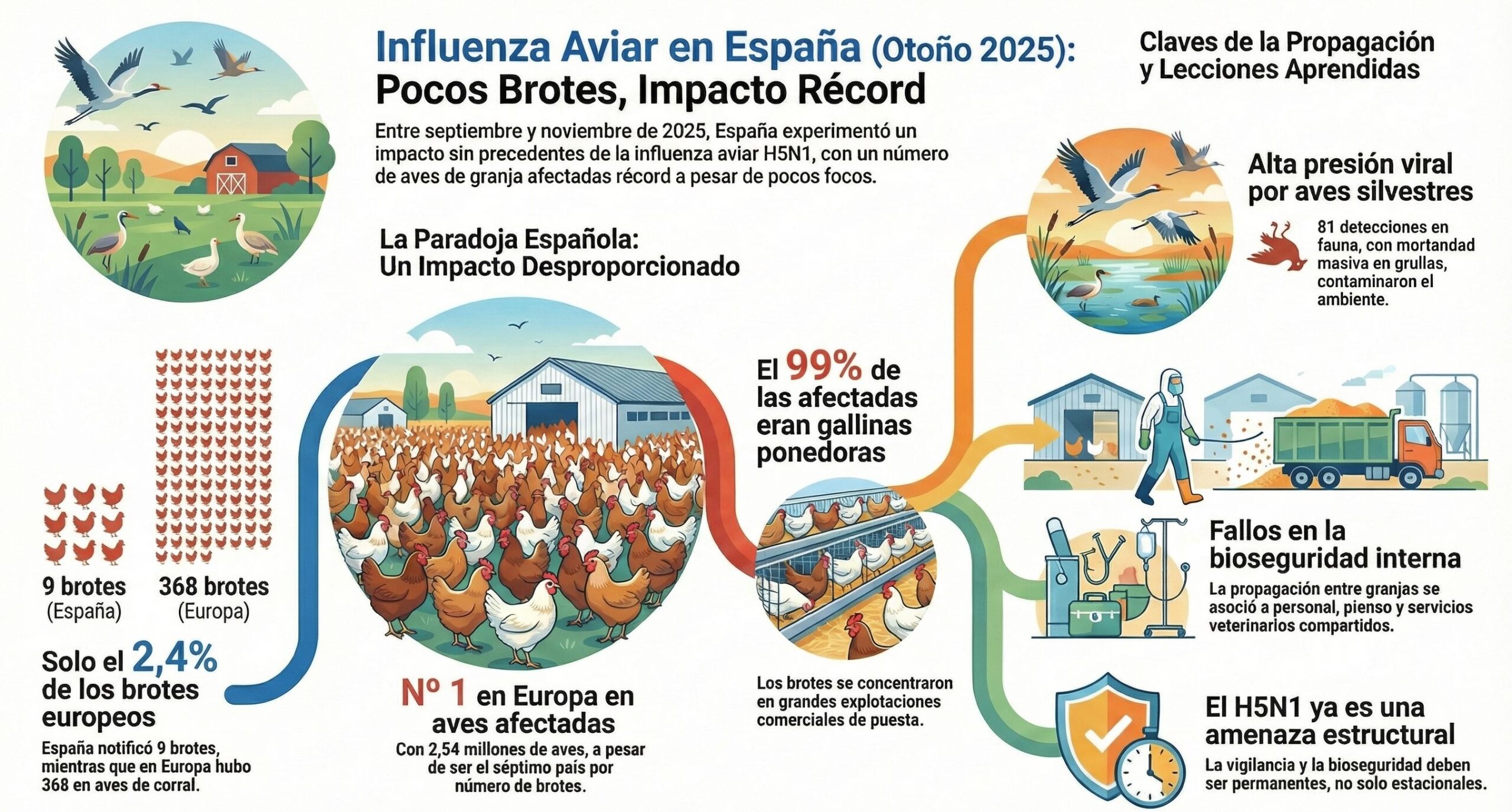
Between 6 September and 28 November 2025, Spain notified nine outbreaks of highly pathogenic H5N1 avian influenza on chicken and hen farms — a modest number of foci but highly significant in terms of the volume of birds involved. In total, 2.54 million birds were affected, placing Spain as the European country with the highest number of bird heads affected during this period, ahead even of Germany, despite recording far fewer outbreaks.
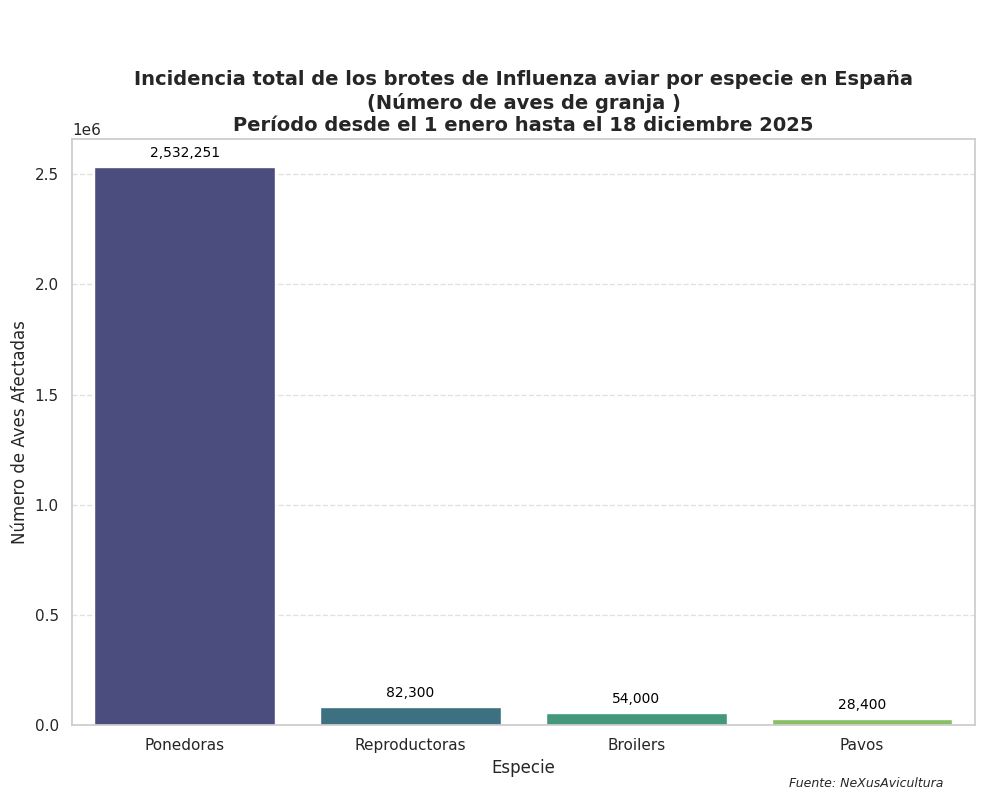
These are some of the conclusions of EFSA’s latest quarterly report, Avian influenza overview September–November 2025 (72 pages, 10 Dec.), which also highlights, with regard to Spain, that virtually all outbreaks were concentrated on commercial laying farms, with only a single broiler operation affected. Only one laying farm declared outdoor access, suggesting that the main risk factor is not so much the production system itself, but rather the level of biosecurity in the face of an environment heavily contaminated by virus originating from wild birds.

Spain: outbreak pattern in laying hens
Of the nine Spanish outbreaks in the analysed quarter (14 outbreaks — details of each at the foot of this article — in total for 2025), approximately two thirds were classified as primary introductions and one third as secondary, associated with epidemiological and operational links between farms. Six of the laying operations were spatially clustered and five shared the same owner, reinforcing the hypothesis of spread linked to internal management factors: feed produced on the farm itself, shared staff and veterinarians, or other biosecurity breaches.
Reported mortality on Spanish farms was relatively low in percentage terms — a median of 0.23% with a range of 0.003% to 2.68% — but the large size of the operations means that this percentage translates into a very high absolute number of birds. All foci reported clinical signs and mortality, indicating that, despite this relatively low mortality rate, the health impact at flock level was evident and clinically recognisable.
Spain accounted for only 2.4% of European poultry outbreaks but concentrated 25.4% of all domestic birds affected during the analysed period.
In four of the nine outbreaks, the epidemiological investigation identified indirect contact with wild birds as the most likely source, while in two others, operational biosecurity failures were detected — such as on-farm feed manufacture or shared veterinary services — and in three cases the origin remained undetermined. In one of the laying farms, 37 exposed persons were recorded, highlighting the importance of occupational protection plans and coordination with public health authorities.
Role of wild birds and the environment in Spain
Spain lies within a “band” of H5N1 detections in wild birds stretching from Lithuania to Portugal, with common cranes and Anatidae playing a particularly prominent role along the western migratory flyway. During the quarter analysed across the whole of Europe, 81 detections of highly pathogenic avian influenza in wild birds were reported in Spain — a high figure that contributes to a strong level of environmental contamination in wetlands and nearby agricultural areas.
The mass mortality of cranes in Germany, Luxembourg, France and, towards the end of October and early November, also in Aragon and Castilla-La Mancha, is linked to a new sub-lineage of genotype EA-2024-DI.2.1, which is also responsible for the majority of viruses circulating in domestic birds. In Aragon, for example, at least 720 cranes are estimated to have died from avian influenza, approximately 250 of them at the Gallocanta Lagoon Nature Reserve, a key staging site for the species.
Autumn 2025 confirms that H5N1 avian influenza has become integrated into the ecology of European wild birds and that biosecurity must adapt to this new reality.
This context — with high viral circulation in cranes and Anatidae and a high density of intensive laying operations — generates a risk of “diffuse” introduction via viral particles in the environment, mechanical vectors and indirect contacts with wild fauna. The experience of autumn 2025 reinforces the view that the virus is no longer a strictly seasonal visitor and demands a rethinking of biosecurity around the structural presence of H5N1 in European wild birds.

Lessons for on-farm management
For the Spanish poultry sector, the pattern described leaves several key messages. Surveillance must focus on the early detection of subtle changes in mortality and production, particularly in large laying hen complexes, where small percentage variations translate into very large absolute numbers of affected birds. The combination of clinical signs, early notification and a sensitive surveillance system has been decisive in identifying the foci.
Secondly, the investigation of the Spanish outbreaks highlights the blind spots in internal biosecurity: feed movement between houses, shared services, staff movement between farms within the same group, and the handling of potentially contaminated materials. In an environment of high ambient viral pressure, these internal factors can make the difference between a single outbreak and a cluster of chain outbreaks.
Thirdly, the intense circulation in wild birds makes it essential to strengthen passive wildlife surveillance and communication between the poultry sector and networks of ornithologists, environmental agents and wildlife rehabilitation centres. Detections in wild birds reflect only a fraction of actual mortality, so basing risk perception exclusively on officially diagnosed cases may underestimate the threat.

Spain in the European and global context
Across Europe as a whole, between 6 September and 28 November 2025, a total of 2,896 detections of highly pathogenic H5 avian influenza in birds were reported, of which 368 in poultry, 74 in captive birds and 2,454 in wild fauna, distributed across 29 countries. The number of detections in wild birds was six times higher than in 2024 for the same period and up to 12 times higher than in 2023, constituting an unprecedented situation since 2016.
Spain accounted for only 2.4% of poultry outbreaks but 25.4% of the total domestic birds affected in Europe, reflecting its high production scale. The new sub-lineage EA-2024-DI.2.1, first detected in Poland in mid-September, rapidly became predominant in domestic and wild birds in at least 17 European countries, without showing, to date, additional genetic markers of mammalian adaptation in birds.
Outside Europe, during the same period, 269 highly pathogenic avian influenza events were officially reported, with higher activity in North America — particularly in large turkey and meat duck integrations — and sporadic outbreaks in Asia, Africa and Latin America. European agencies conclude that the risk to the general public remains low and low-to-moderate for occupationally exposed individuals, with no significant changes in the overall public health risk assessment.
For more information on Avian Influenza:
-. News on Vaccination of poultry farmers and personnel in contact with production birds to prevent zoonosis risks.
-. News on Vaccination of production birds to prevent AI outbreaks
-. Avian Influenza on NeXusAvicultura
Tracking Avian Influenza cases on poultry farms in Spain in 2025:
-. 1st outbreak of 2025 (18 July, Extremadura): Alert over an Avian Influenza outbreak on a 7,000-turkey farm in Extremadura
-. 2nd outbreak (28 July, Toledo): Second AI focus detected, this time in breeder hens in Toledo
-. 3rd outbreak (1 Sept., Huelva): The spectre of H5N1 returns to Andalusia: 8,500 turkeys culled due to avian influenza in Huelva.
-. 4th outbreak (8 Sept., Guadalajara): Spain records its fourth AI outbreak of 2025, this time on a breeder farm in Guadalajara
-. 5th outbreak (9 Sept., Huelva): H5N1 positive confirmed on the 8,400-bird poultry farm in Valverde del Camino, Huelva, Andalusia
-. 6th outbreak (19 Sept., Valladolid): H5N1 AI detected on a 760,000-hen laying farm in Valladolid
-. 7th, 8th and 9th outbreaks (1 Oct., Valladolid and Madrid): 552,000 laying hens affected by three new AI outbreaks in Madrid and Valladolid
-. 10th outbreak (6 Oct., Valladolid): Tenth Avian Influenza outbreak detected in Spain. Over 800,000 laying hens to be culled.
-. 11th outbreak (13 Oct., Valladolid): Eleventh Avian Influenza focus detected in Spain on a 66,000-hen laying farm.
-. 12th outbreak (15 Oct., Valladolid): 315,000 new laying hens affected in the latest outbreak
-. 13th outbreak (16 Oct., Toledo): 112,000 laying hens in Yeles, Toledo
-. 14th outbreak (20 Oct., Valladolid): 54,000 broiler chickens in Valladolid
No new outbreaks have occurred on poultry farms since 20 October (updated as of 18 Dec. 2025)
Want to stay one step ahead in poultry farming?
Subscribe free to our eNewsletter and receive a weekly selection
of the best information to anticipate trends, stay up to date and develop as a poultry industry professional.
NeXusAvicultura: Vision, Expertise, Quality and Context.