
Quarterly update on AI from March to June 2025 (EFSA)
This quarterly report, just published on 24 June 2025, produced jointly by the European Food Safety Authority (EFSA), the European Centre for Disease Prevention and Control (ECDC) and the European Union Reference Laboratory for Avian Influenza (EURL), provides a comprehensive overview of the highly pathogenic avian influenza (HPAI) situation from March to June 2025.
The report details virus detections in poultry, captive birds and wild birds, as well as in mammals, both in Europe and globally. The document also examines human infection cases, highlighting the rarity of animal-to-human transmission and the absence of human-to-human transmission during the reporting period.
Waterfowl account for the majority of cases
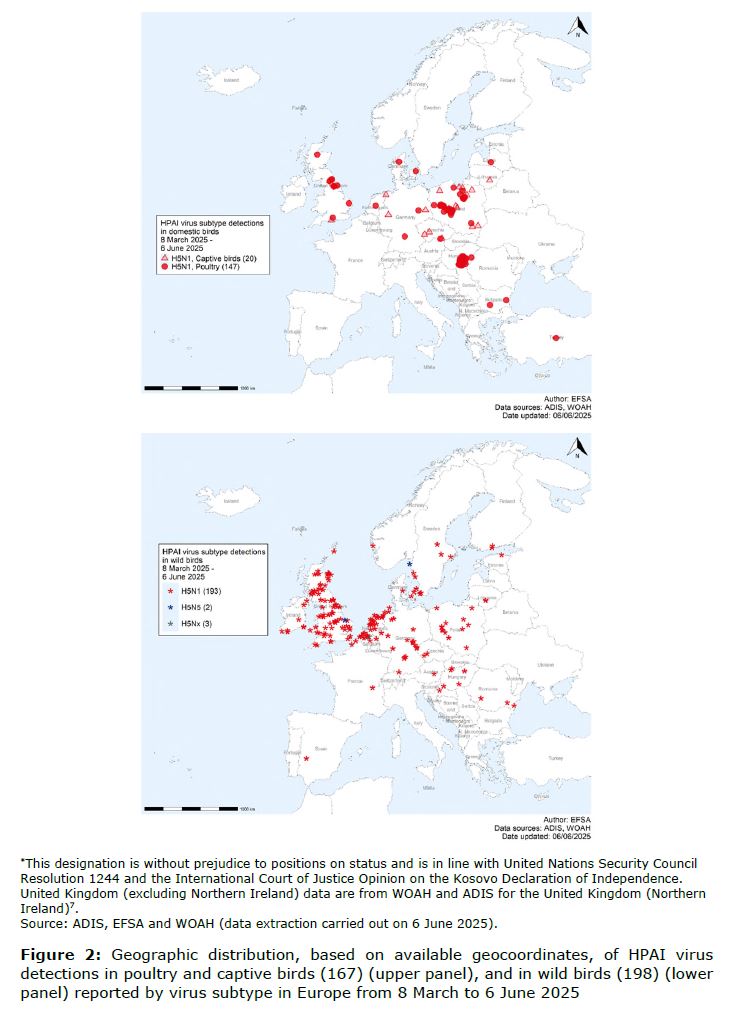
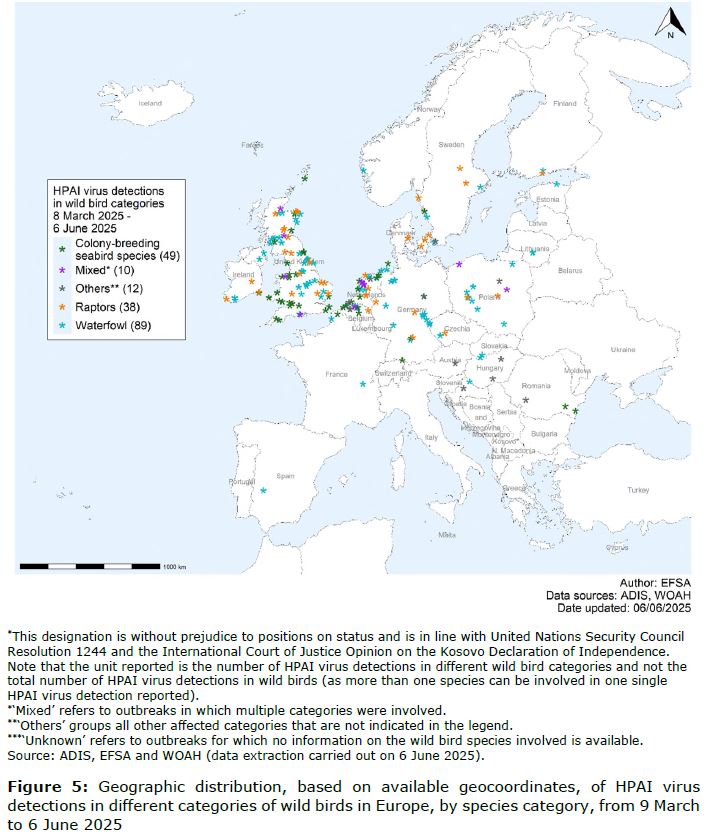
Between 8 March and 6 June 2025, 365 detections of highly pathogenic avian influenza (HPAI) A(H5) virus were reported in domestic (167) and wild (198) birds across 24 European countries. HPAI A(H5N1) virus detections were predominant and were located primarily in western, central and south-eastern Europe.
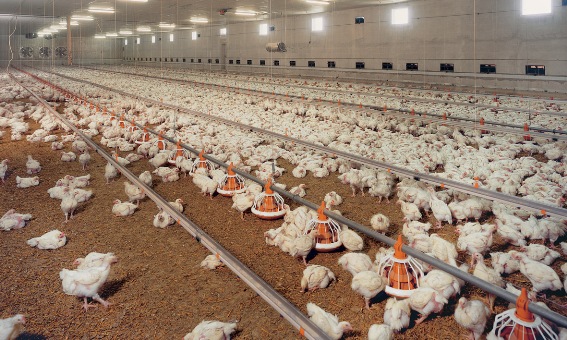
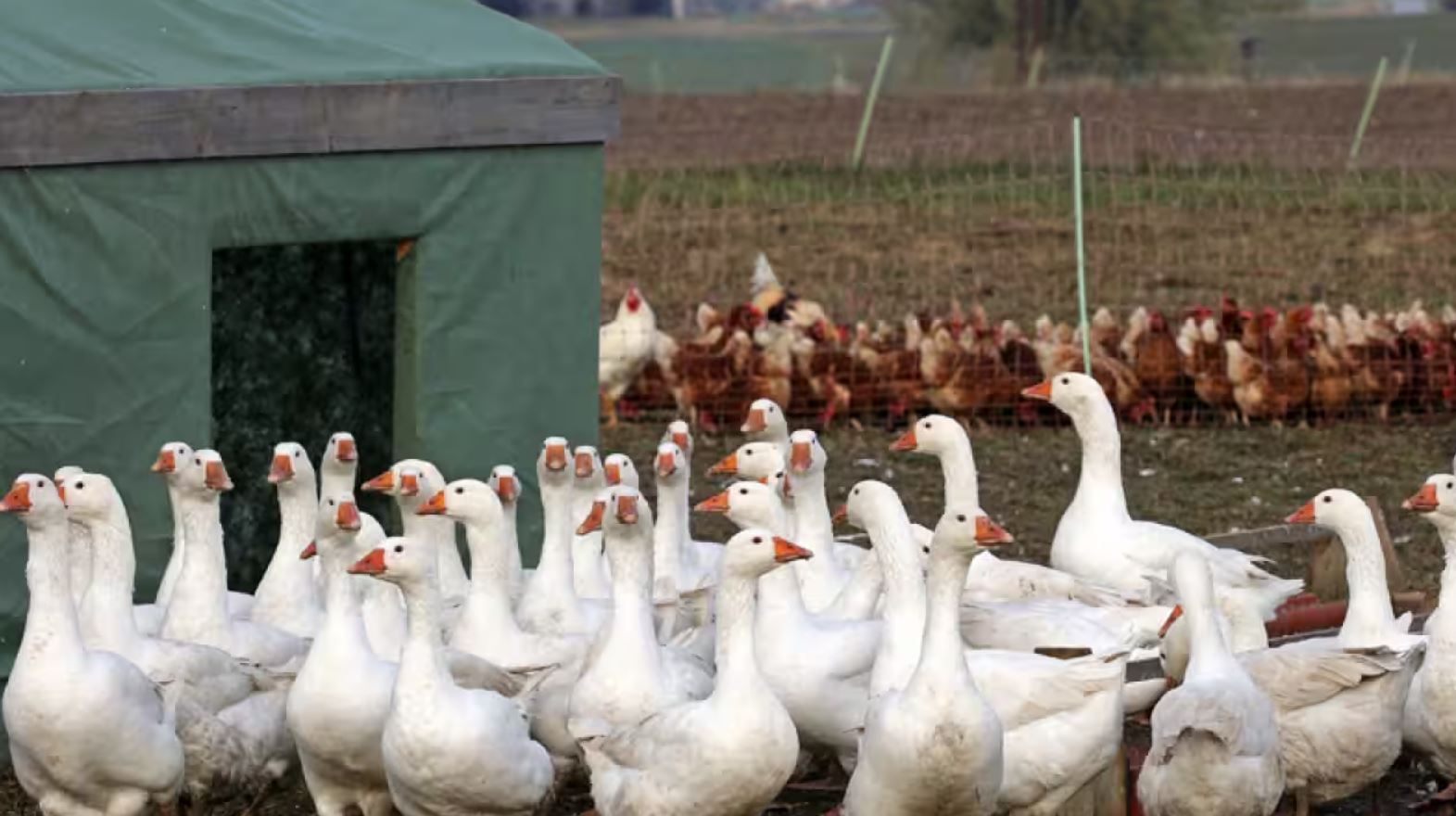
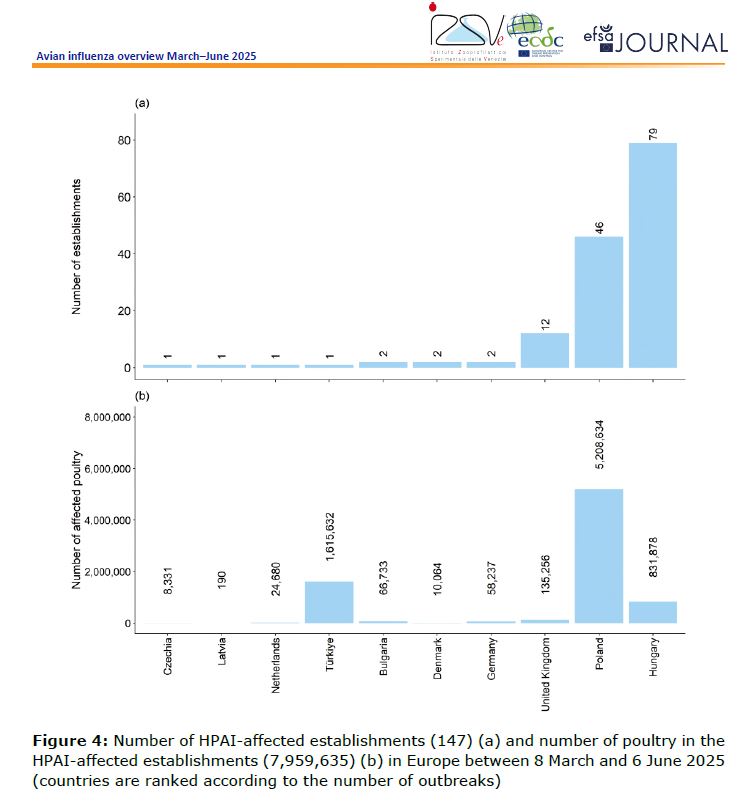
The majority of detections in wild birds involved waterfowl, particularly swans and geese, but gulls were also affected. Poultry establishments (ranging from industrial farms to simple sheds housing a handful of birds), particularly domestic ducks and chickens, continued to be affected in large numbers in Hungary and Poland.
In mammals, detections of HPAI A(H5N1) and A(H5N5) viruses were reported in a domestic cat, red foxes, Eurasian otters and grey seals. For the first time, an HPAI A(H5N1) viral infection was detected in a sheep in the United Kingdom.
Outside Europe, the United States of America (USA) continued to report A(H5N1) virus detections in dairy cattle, while the virus was detected for the first time in a grey fox (USA), a leopard cat (South Korea) and a long-tailed weasel (USA).
Between 8 March and 6 June 2025, 20 human avian influenza virus infection cases were reported, including four deaths, in six countries: Bangladesh (two A(H5N1) cases), Cambodia (two A(H5N1) cases), China (one A(H10N3) case, one A(H5N1) case and eleven A(H9N2) cases), India (one A(H5N1) case), Mexico (one A(H5N1) case) and Vietnam (one A(H5N1) case). The majority of human A(H5N1) cases (n = 5/8) reported exposure to poultry prior to detection or illness onset. Given the wide circulation of avian influenza viruses in animal populations, human infections remain rare. No human-to-human transmission has been documented during the reporting period. The risk of infection with clade 2.3.4.4b HPAI A(H5) viruses currently circulating in Europe remains low for the general public in the European Union/European Economic Area (EU/EEA) and low to moderate for those occupationally or otherwise exposed to infected animals or contaminated environments.
Concerning developments on the poultry front
During the reporting period, 365 detections of HPAI A(H5) virus were recorded in birds across 24 European countries. Of these, 167 were in domestic birds (including poultry and captive birds) and 198 in wild birds. The HPAI A(H5N1) strain was predominant and was located primarily in western, central and south-eastern Europe.
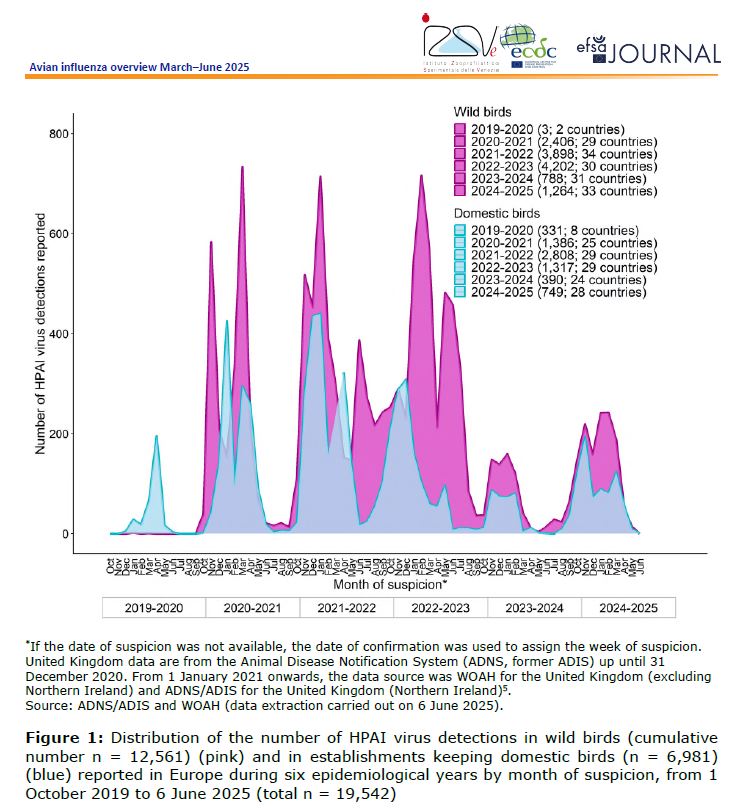
Despite a decline in the number of detections compared to the previous period, the 2024–2025 epidemic peak was longer and higher than that of 2023–2024, indicating that HPAI A(H5) virus persists in European wild bird populations. In poultry, the majority of outbreaks (147) were caused by HPAI A(H5N1) virus. Hungary and Poland accounted for 85% of poultry outbreaks, with 79 and 46 affected holdings, respectively. These holdings were primarily domestic duck (42%), chicken (16%) and turkey (16%) operations. In total, approximately 8 million birds died or were culled on affected holdings during this period. For veterinarians and poultry operators, it is crucial to note that indirect contact with wild birds was the most likely source of introduction in 88% of primary outbreaks, while indirect contact between holdings was the most common route in secondary outbreaks (86%). Biosecurity remains the first line of defence.
Avian influenza spills over into new mammal species
One of the most significant developments reported is the expansion of HPAI A(H5N1) virus detections to new mammalian species. For the first time, HPAI A(H5N1) viral infection was detected in a sheep in the United Kingdom. The case was identified in a ewe with mastitis on a holding where HPAI A(H5N1) had already been confirmed in captive birds. Outside Europe, the virus was also detected for the first time in a grey fox (USA), a leopard cat (South Korea) and a long-tailed weasel (USA).
Dairy cattle holdings in the USA continued to report HPAI A(H5N1) virus detections, with the number rising to 1,073 holdings across 17 states, although the rate of new infections has gradually declined. Domestic cats and captive felids were also affected, and concern is highlighted regarding the feeding of pets with raw meat.
For veterinarians, it is vital to be aware that more than 55% of characterised mammalian viruses in Europe carry at least one adaptive mutation in the PB2 protein (E627K or E627V) associated with increased virulence and replication in mammals. While this does not indicate a change in the virus’s receptor binding preference (it remains avian-like), it does suggest greater replication efficiency in mammalian cells.
Risks to human health: a crucial perspective
Despite the extensive circulation of avian influenza viruses in animal populations, human infections remain rare. During the period from March to June 2025, 20 human infection cases (with four fatalities) were reported in six countries outside the EU/EEA. The majority of human A(H5N1) cases (five out of eight) reported exposure to poultry prior to detection or illness onset. Importantly, no human-to-human transmission has been documented during this period.
For the general public in the EU/EEA, the risk of infection remains low, while for those occupationally or otherwise exposed to infected animals or contaminated environments, the risk is low to moderate. Circulating HPAI A(H5N1) viruses maintain a preference for avian-type receptor binding (α2–3 sialic acid) and are still considered avian in nature, which limits their potential for human-to-human transmission. Furthermore, the majority of circulating strains remain susceptible to antiviral drugs available for human treatment.
Key recommendations for prevention and control
The report emphasises the need for medium- and long-term strategies to reduce risk in the poultry sector. These include avoiding siting holdings near areas at high risk of HPAI introduction from wild birds, reducing farm densities, and maintaining high biosecurity standards and compliance. Preventive vaccination is also considered an option. Targeted training for poultry workers is recommended to raise awareness of risks and improve knowledge of biosecurity measures.
For livestock, and particularly for veterinarians attending ruminants and pigs, enhanced virological and serological surveillance for HPAI is recommended in wild mammals (e.g. foxes) and free-roaming domestic animals (e.g. cats and dogs), especially in areas of high viral circulation. Early detection is key, and HPAI should be considered as a differential diagnosis in cases of undiagnosed or unresolved clinical signs in ruminants during periods of viral circulation.
Furthermore, the importance of not feeding pets raw meat or raw dairy products from uncontrolled sources to avoid HPAI contamination is emphasised. The timely generation and sharing of genomic sequence data from avian influenza viruses is of paramount importance for the rapid detection of potentially emerging viruses carrying amino acid changes associated with increased zoonotic potential, antiviral drug resistance or altered antigenic properties.
The “ONE HEALTH” approach takes on its full meaning in the face of an ever-changing and latent Avian Influenza
The avian influenza situation remains dynamic and complex. The persistence of the virus in birds and its ability to infect an ever-growing range of mammalian species, some carrying adaptive mutations, require continuous surveillance and a coordinated response under the “One Health” approach. The rigorous application of biosecurity measures and collaboration with health authorities are fundamental to protecting both animal health and public health.
To find out more:
-. Quarterly update on Avian Influenza from March to June 2025. News item on NeXusAvicultura.com
-. EFSA Report: Avian influenza overview March–June 2025. Published 24 june 2025 (65 pages)
-. Quarterly update on Avian Influenza from December 2024 to March 2025. News item on NeXusAvicultura.com
-. EFSA Report: Avian influenza overview December 2024–March 2025. Published 15 april 2025 (73 pages)
-. Quarterly update on Avian Influenza from Sept. to Dec. 2024. News item on NeXusAvicultura.com
-. EFSA Report: Avian influenza overview September–December 2024. Published 10 january 2025 (64 pages)
-. Quarterly update on Avian Influenza from June to Sept. 2024. News item on NeXusAvicultura.com
-. EFSA Report: Avian influenza overview report June–September 2024. Published 2 october 2024 (66 pages)
-. Avian Influenza on NeXusAvicultura.com