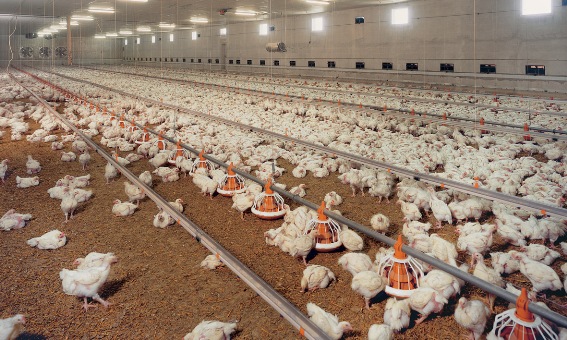

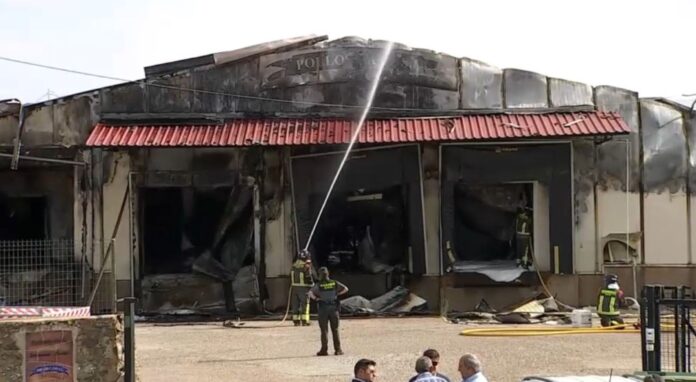
A large-scale fire swept through one of the slaughterhouse buildings at Pollos Cano, located in Salvatierra de los Barros (Badajoz), in the early hours of 25–26 June 2025, incinerating around 20,000 already-slaughtered birds and causing significant material damage, though with no human casualties. The company, one of the municipality’s main economic drivers, slaughters approximately 5 million chickens per year and now faces a complex process of damage assessment, production reorganisation, and reconstruction.
A key company in Extremadura’s broiler industry
In the early hours of the morning, just after one o’clock, a fire broke out in the slaughterhouse building at Pollos Cano — a facility covering approximately 4,000 m² — prompting a rapid response from the emergency services of the province of Badajoz. The flames spread quickly through the interior of the premises, fuelled by the thermal load of the equipment and the presence of already-processed product, generating a dense column of smoke visible from several kilometres away.
According to initial reports released by regional media, no injuries were recorded among the workforce or the emergency response teams, as the fire started during night-time hours in an area where no workers were present at the time. Nevertheless, it is estimated that around 20,000 poultry carcasses ready for distribution were completely destroyed, representing a significant immediate economic impact for the company.
Pollos Cano, a family-owned company headquartered in Salvatierra de los Barros and founded 30 years ago, is a benchmark in broiler growing, slaughter, and processing in Extremadura, with a modernised slaughterhouse, a turnover of approximately €20 million, and an annual slaughter capacity of around 5 million birds. The company integrates other facilities, including farms and a feed mill, giving it a pivotal role in Extremadura’s broiler industry.
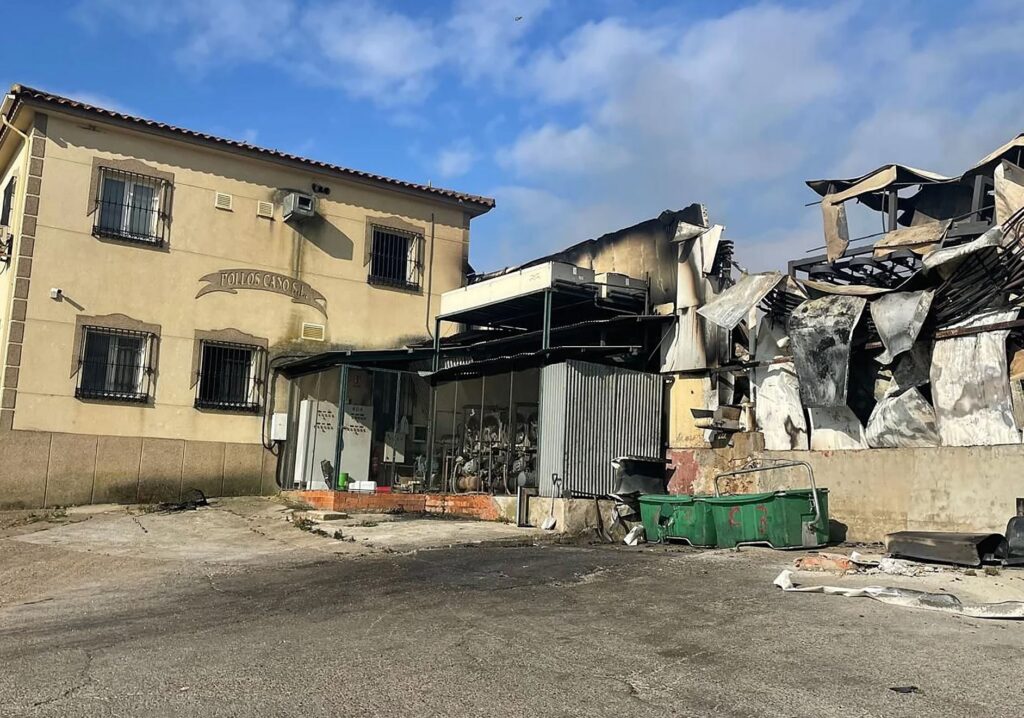
Initial reports indicate that the fire originated in the slaughterhouse area, although the exact cause is being investigated by technical services and the competent authorities. Firefighting teams worked for several hours to bring the blaze under control and prevent it from spreading to other buildings and critical infrastructure within the company, which would have had even more serious consequences for the continuity of operations.
Within the surrounding area, expressions of support for the company and its employees have multiplied, with public statements from neighbouring local councils and local organisations highlighting the importance of Pollos Cano as a generator of employment and added value in the region. Regional and provincial authorities have emphasised the need to support the company throughout the reconstruction process, both technically and financially, in order to accelerate a return to normal production levels.
At the same time, the incident once again brings to the fore the importance of risk management and fire prevention in agri-food facilities, particularly in a context where the Spanish poultry sector is showing signs of recovery and growth in 2025, with increases in both production and consumption following years of high volatility. The modernisation of infrastructure, the review of emergency plans, and investment in advanced detection and compartmentalisation systems are emerging as strategic elements for strengthening the resilience of the poultry industry against high-impact events such as those experienced by Pollos Cano.
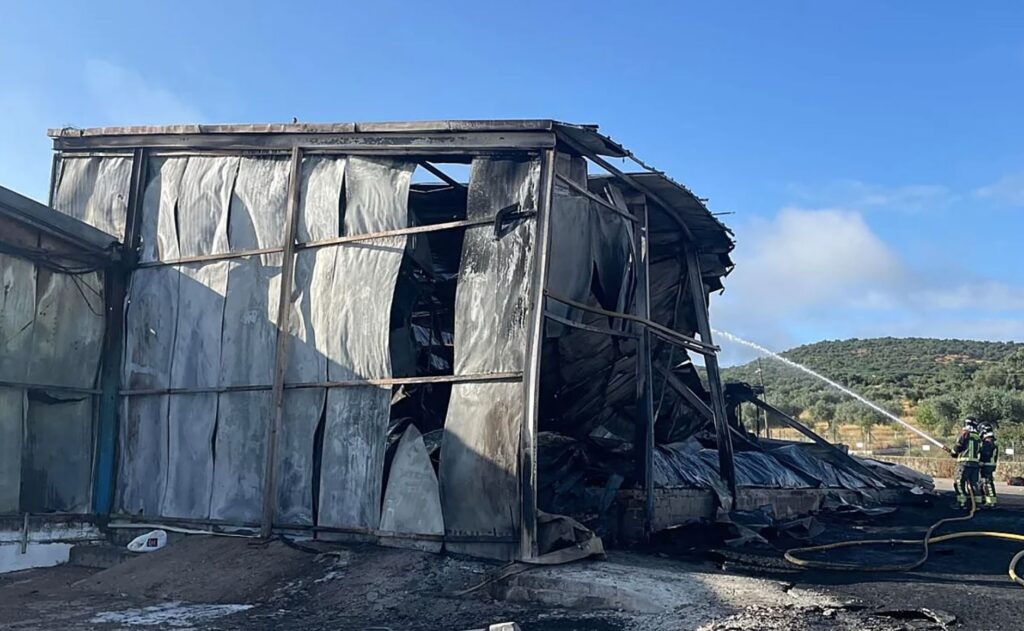
The importance of fire prevention
The Pollos Cano case illustrates how a single incident can place strain on the poultry meat supply chain at a regional level, affecting everything from integrated production operations to retail distribution. In the coming months, the company’s ability to reorganise its production flows, draw on alternative slaughterhouse capacity, and activate reconstruction investment will be critical to minimising the impact on integrated producers, employees, and customers — in a year that, in other respects, looks favourable for the Spanish poultry sector.
For further information:
-. Pollos Cano
-. Fires in the poultry industry