
News · Heat wave in France
Analysis | June 30, 2026 | NeXusAvicultura
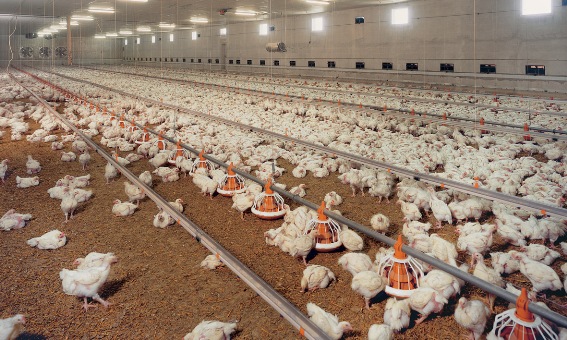
Summer has barely just begun and the heat wave episode across Europe in late June is claiming close to 1% of France’s national flock, saturating the collection and disposal system for dead birds and forcing carcasses to be buried on the farms themselves while chicken supply becomes strained.
French poultry farming is going through one of its darkest weeks. The heat wave episode that has been hitting Europe in the last week of June, with thermometers exceeding 40°C across much of the territory, has left a trail of mortality in the poultry farms of the Greater West. According to initial estimates from the trade associations, between 2 and 3 million birds may have died from the heat, which would equal around 1% of the national flock. Normandy, Brittany, and Pays de la Loire — densely populated poultry regions — account for the bulk of the excess mortality, which has exceeded normal mortality rates by 1,200% in certain regions.
And although the official count of losses remains open. “The official count is still ongoing, in order to get accurate information about the consequences,” explains Yann Nédélec, director of ANVOL, the meat poultry trade association, the figures are staggering. The impacts on mortality and economic losses will become clearer in the coming weeks. For now, the Ministry of Agriculture places the total balance below 1% of the national flock, although the figure is provisional and could be revised upward.
“All rearing methods — conventional, organic, and Label Rouge — ARE BEING affected, and although the heat wave doesn’t discriminate between farming systems, everything points to legal requirements needing to be relaxed to allow greater humidification, ventilation, etc. in the more alternative models.”
French Bretagne, epicenter of an unprecedented catastrophe
Brittany has borne the brunt of it. According to the Ministry of Agriculture, dead birds in the region total more than 6,600 tons during the heat wave week, a figure that, on its own, is close to 1% of France’s annual poultry production. In some farms in Côtes-d’Armor, up to 10,000 animals were lost in a single night. In Morbihan, 160 farmers have been affected by the excess mortality, according to prefect Michaël Galy.
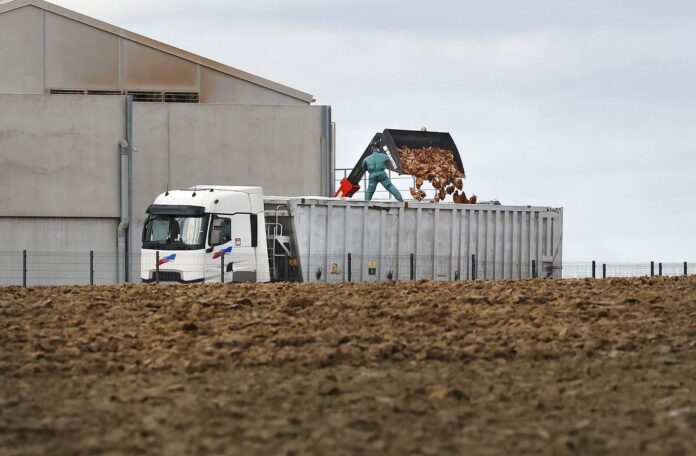
More than 6,600 tons of dead birds in Brittany alone. Carcass disposal cannot keep up, and authorities are authorizing burial of the carcasses on the farms themselves.
Logistical collapse and emergency measures
The avalanche of carcasses has collapsed the equarrissage chain (*) (the system for collecting and processing dead animals). Under normal conditions, deceased animals are reported and removed by the authorized company, but its capacity has been completely overwhelmed. Faced with the impossibility of absorbing such a volume all at once, the prefects of Morbihan, Finistère, and Côtes-d’Armor adopted exceptional measures to allow, subject to authorization, direct burial on the farms.
In Finistère, the prefecture specified that 208 poultry or pig farms resorted to this solution, with a total of 561 tons of animals buried: 167 burials already carried out and 41 being organized. The procedure was technically supported — a hydrogeologist was mobilized throughout the weekend to advise on the choice of land — with a dual objective: guaranteeing public health and protecting the water resource. The measure was not limited to Brittany: in Normandy, the Manche prefecture also authorized on-site burial after several days above 40°C.
Nouvelle-Aquitaine also hit hard: more than 300 tons in Deux-Sèvres
The phenomenon overwhelmed the Greater West. The Deux-Sèvres prefecture reported on June 29 excess mortality exceeding 300 tons of carcasses, spread across several dozen farms, after 182 tons pending treatment had already been reported on June 27. Here too, the usual removal capacities quickly reached their limit, and a site was authorized for the emergency burial of up to 150 tons of animals daily. The mass burial has raised suspicions about possible groundwater contamination.

The NeXus Summary Sheet
| Episode | Heat wave (week 26 / late June 2026), with highs above 40 °C |
| Estimated mortality | Between 2 and 3 million birds (≈ 1% of the national census) — provisional estimate |
| Most affected regions | Brittany, Normandy, and Pays de la Loire (Greater West); also Nouvelle-Aquitaine |
| Brittany | +6,600 t of dead poultry; up to 10,000 birds/night in Côtes-d’Armor; 160 poultry farmers in Morbihan |
| Deux-Sèvres | +300 t of carcasses across several dozen farms |
| Carcass management | Rendering (“Equarrissage”) saturated; emergency burial authorized (Morbihan, Finistère, Côtes-d’Armor, Manche, Deux-Sèvres). Finistère: 561 t buried across 208 farms |
| Affected models | Conventional, organic, and Label Rouge (all) |
| Market | Slaughterhouses with product shortages; slowdown at Rungis; chicken supply tension |
| Precedent | 2003 heat wave: 5 million birds died (2% of the census) |
| Official sources | Ministère de l’Agriculture, ANVOL, prefectures of the Greater West and Deux-Sèvres |
2003 as a mirror and climate change as the backdrop
The inevitable precedent is 2003: that historic heat wave killed five million turkeys and chickens in France, 2% of the national census. Two decades and three years later, with a mortality rate that is once again counted in the millions, the lesson is that extreme heat episodes have stopped being exceptional and have become a recurring risk. Constructive and equipment-related adaptation of the poultry house stock (encompassing under the word “poultry house” industrial poultry sheds, tunnel-type sheds, and even simple shelters)—ventilation, evaporative cooling, misting, wall and roof insulation, etc.—, the revision of legal requirements in extensive systems, and mastering bird management during increasingly frequent and prolonged heat waves have ceased to be optional measures.
Because heat does not act alone: high summer temperatures also trigger the emission of harmful gases inside the shed, a factor that aggravates heat stress and should not be overlooked, as we detail in our analysis on the effects of harmful gases on poultry farms. The June 2026 heat wave leaves behind—and it isn’t over yet—a dramatic short-term toll; but its true cost may be measured in how it forces us to rethink, from the ground up, the climate resilience of poultry farming in central and northern Europe (Mediterranean and southern Europe already has decades of experience with facilities and management practices adapted to extreme temperature peaks).

In 2003, five million birds died from heat in France, 2% of the census. Two decades later, the figure is once again counted in the millions.
(*) Note: What is the translation of the French word “equarrissage”?
In the context of animal production, the term “equarrissage” refers to the processing and disposal of animal carcasses (livestock, poultry, etc.) that have died on farms, at slaughterhouses, or in the field, in order to avoid health, environmental, and public health risks.
What does equarrissage involve?
Health regulation: In the EU and other countries, it is strictly regulated by standards such as Regulation (EC) 1069/2009 (on animal by-products not intended for human consumption).
Collection and transport: Carcasses are collected and transported to specialized plants or authorized areas (if this is not possible, it may be authorized on the farm itself)
Treatment: Methods applied include:
a) Burial (in authorized areas and, in some cases, on the farm itself, always under strict regulations).
b) Incineration (controlled burning).
c) Processing into animal meal (for non-food use, such as fertilizers or biofuels).
d) Composting (in some cases, under strict regulations).
To learn more:
-. Environmental comfort in poultry farming
Want to stay one step ahead in poultry farming?
Subscribe for free to our eNewsletter and receive a weekly selection
of the best information to anticipate trends, stay up to date, and improve as a poultry professional.
NeXusAvicultura: Vision, Judgment, Quality, and Context.