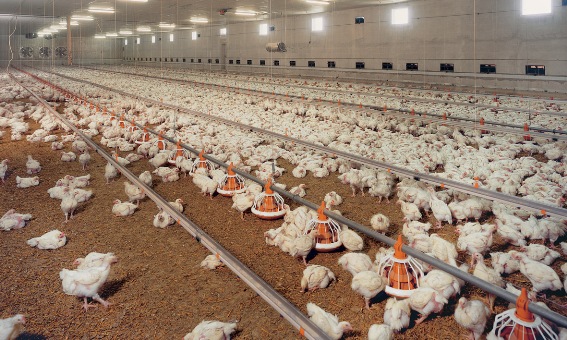


The European Union has launched its new legislation to reduce pollutant emissions from industry, including mining, and those which, in the EU’s view, are generated by intensive livestock farming of poultry and the pig sector.
The new Industrial Emissions Directive entered into force on 4 August 2024, and Member States now have a period of 22 months to transpose its provisions into their national legislative frameworks.
This regulation is the EU’s main instrument for making poultry and livestock farming more sustainable, regulating pollution from industrial and agri-industrial installations involving substances such as nitrogen oxides, ammonia, mercury, methane and carbon dioxide, which will be required to obtain emission permits from member countries, provided they meet the required standards. The objective is to reduce emissions of these “key” air pollutants by 40% by 2050 compared to levels recorded in 2020.
The directive adjusts certain thresholds for animal rearing, covering intensive operations with 300 head for pigs and 280 for domestic poultry (300 for laying hens) and 350 animals for mixed farms, with rules that will be applied progressively from 2030 onwards, beginning with the largest farms.
Extensive farms and the rearing of animals for domestic use are excluded, as is cattle farming — a decision that drew criticism from environmental organisations such as Greenpeace, which noted that farm animal rearing is responsible for 54% of methane emissions, primarily from cattle.
Conversely, it does cover “the extraction and processing of non-energy minerals produced on an industrial scale, such as iron, copper, gold, nickel and platinum”, and opens the door to including other industrial minerals should the European Commission put forward a proposal to that effect.
It also urges Member States to establish “effective, proportionate and dissuasive penalties for those who breach the measures adopted to implement the Directive”, fines which must take into account the severity and duration of the infringement, whether it is recurrent, and the people and environment affected. In the case of the most serious infringements, penalties must amount to “at least 3% of the operator’s annual turnover in the EU”.