
ADOPTION OF PREVENTIVE MEASURES IN SPECIAL RISK AND SURVEILLANCE ZONES IN SPAIN IN RESPONSE TO THE INCREASED RISK FROM THE EVOLVING EPIDEMIOLOGICAL SITUATION
Madrid, (05/11/2025). The Spanish Ministry of Agriculture has issued a notice on 5 November 2025 in response to the increase in Highly Pathogenic Avian Influenza (HPAI) outbreaks in Europe, in both poultry and wild birds. In Spain, 14 outbreaks have been detected in poultry and 68 in wild birds. Due to the deteriorating situation and the forecast drop in temperatures, the risk for Spain has increased. Therefore, from 10 November 2025, preventive measures under Order APA/2442/2006 are being activated. These measures include, among others, the prohibition of outdoor poultry rearing in those localities listed in ANNEXES II and III of said Order and the tightening of exemptions.
As can be seen by consulting the Annexes II and III of Order APA/2442/2006 in the Official State Gazette (BOE), the criterion for including certain municipalities as risk zones is their proximity to wetlands and stopover sites along migratory bird routes.
1. Update on the epidemiological situation of Avian Influenza (AI) in the EU.
From 1 July to 5 November 2025, a total of 139 Highly Pathogenic Avian Influenza (HPAI) outbreaks in poultry, 708 in wild birds and 33 in captive birds have been reported in the EU through ADIS, with the following distribution by country and subtype:
Table of confirmed HPAI outbreaks in poultry by country and subtype, 2025–2026 season.
(Up to 5 November 2025) (Source: ADIS)
| Country | H5N1 |
| Germany | 59 |
| Belgium | 2 |
| Bulgaria | 6 |
| Denmark | 5 |
| Slovakia | 1 |
| Spain | 14 |
| France | 10 |
| Hungary | 1 |
| Italy | 16 |
| Lithuania | 1 |
| Norway | 1 |
| Netherlands | 3 |
| Poland | 17 |
| Portugal | 1 |
| United Kingdom (Northern Ireland) | 1 |
| Sweden | 1 |
| Overall total | 139 |
Table of confirmed HPAI outbreaks in wild birds by country and subtype, 2025–2026 season.
(Up to 5 November 2025) (Source: ADIS)
| Country | H5Nx | H5N1 | H5N5 | H7Nx | Overall total |
| Germany | 306 | 306 | |||
| Austria | – | 13 | 13 | ||
| Belgium | 3 | 21 | 24 | ||
| Czech Republic | 2 | 2 | |||
| Denmark | – | 13 | – | 13 | |
| Slovenia | 1 | 1 | |||
| Spain | – | 68 | 68 | ||
| Finland | 1 | 1 | 2 | ||
| France | 103 | 103 | |||
| Hungary | 4 | 4 | |||
| Ireland | 6 | 6 | |||
| Iceland | 1 | 4 | 5 | ||
| Italy | 14 | 14 | |||
| Latvia | 6 | 6 | |||
| Lithuania | 5 | 5 | |||
| Luxembourg | 2 | 2 | |||
| Norway | 13 | 24 | 4 | – | 41 |
| Netherlands | 63 | 63 | |||
| Poland | – | 4 | 4 | ||
| Portugal | – | 19 | 1 | 20 | |
| United Kingdom (Northern Ireland) | 1 | – | 1 | ||
| Romania | 1 | 1 | |||
| Sweden | 4 | 4 | |||
| Overall total | 17 | 681 | 9 | 1 | 708 |
Table of confirmed HPAI outbreaks in captive birds by country and subtype, 2025–2026 season.
(Up to 5 November 2025) (Source: ADIS)
| Country | H5N1 |
| Germany | 6 |
| Belgium | 1 |
| Czech Republic | 4 |
| Denmark | 1 |
| Slovakia | 2 |
| Spain | 5 |
| France | 4 |
| Ireland | 2 |
| North Macedonia | 1 |
| Netherlands | 3 |
| Portugal | 3 |
| Sweden | 1 |
| Overall total | 33 |
Map 1 shows the location of each HPAI outbreak reported since 1 July 2025, differentiated by subtype and type of bird affected.
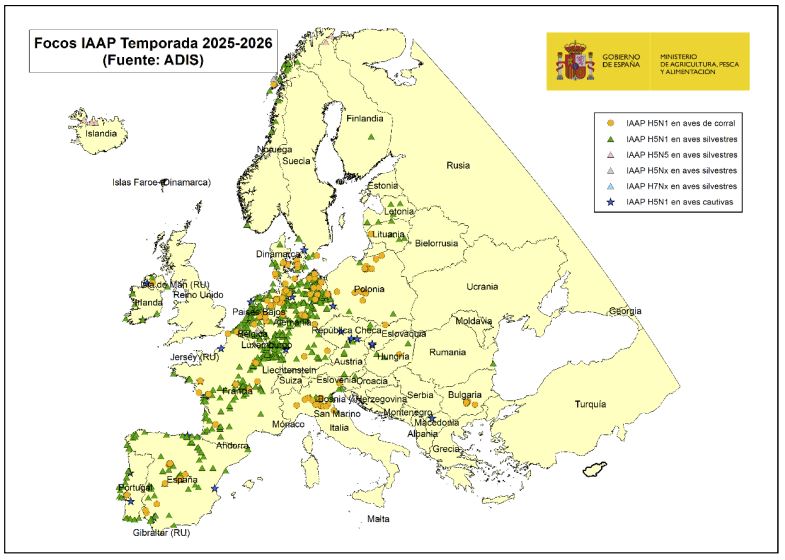
Map 1: AI outbreaks in Europe, 2025–2026 season (up to 5 November 2025) (source: ADIS)
In recent months, HPAI outbreaks have been detected in poultry, captive birds and wild birds, mainly in central and northern Europe as well as on the Iberian Peninsula. In particular, in recent weeks there has been an increase in the number of detected cases, both in wild birds and in poultry, indicating a worsening trend with a consequent increase in risk for Spain.
The following shows the weekly progression of HPAI outbreaks in poultry and non-poultry birds (including wild birds) reported through ADIS in the current season to date, in the European Union and in Spain (Tables 1 and 2).
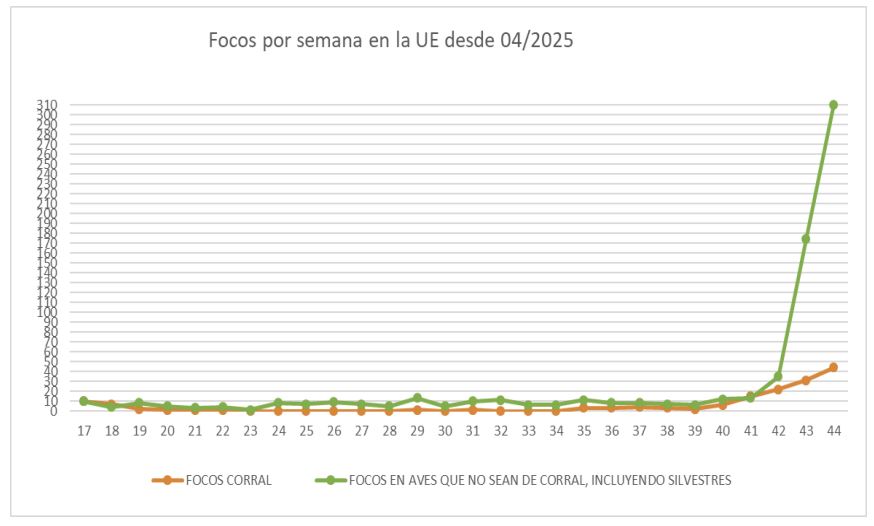
Table 1: Weekly progression in the EU of HPAI outbreaks in poultry and non-poultry birds (including wild birds) in the current 2025–26 season (up to week 44 – 27 Oct to Sun. 2 Nov – 2025)
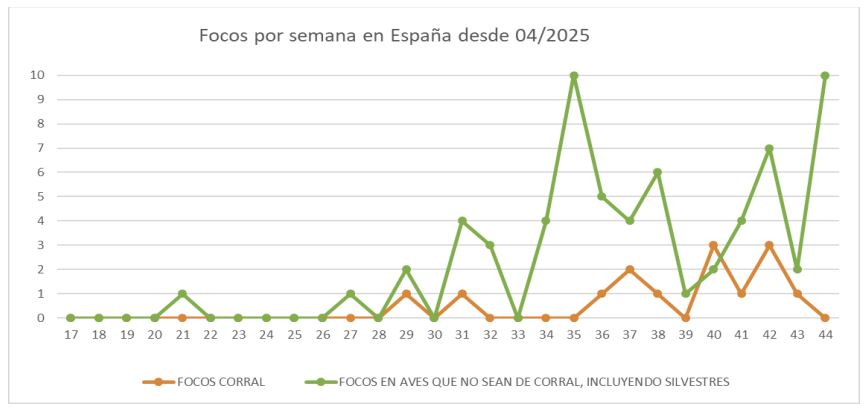
Table 2: Weekly progression in Spain of HPAI outbreaks in poultry and non-poultry birds (including wild birds) in the current 2025–26 season (up to week 44 – 27 Oct to Sun. 2 Nov – 2025)
2. Weekly risk assessment at comarca level based on the AI virus incursion and survival risk assessment model developed by the MAPA.
The risk assessment model developed by the MAPA, which estimates the comarca-level risk of AI virus incursion and survival over time, is updated weekly and is based on:
a) the location of positive case notifications in Europe,
b) movements of at-risk wild birds from affected areas of Europe,
c) the seasonality of wild bird movements in Spain, and
d) temperatures in Spain, which affect the virus’s survival capacity — increasing as temperatures fall.
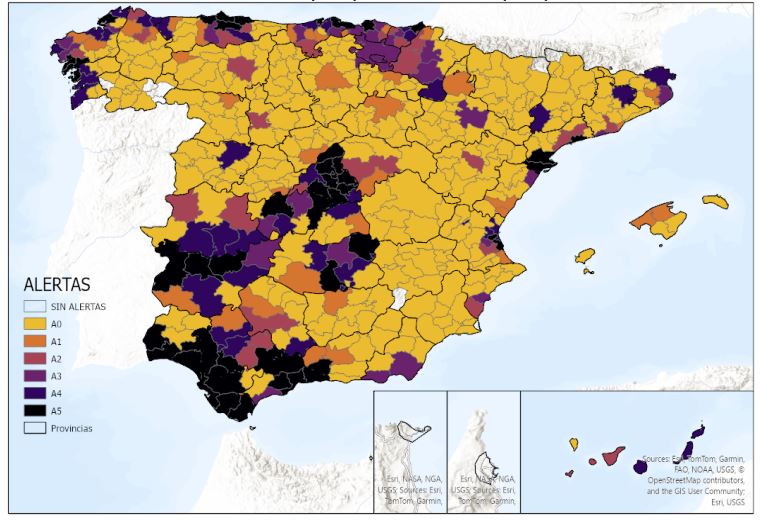
This model has confirmed the trend observed in previous weeks and, for the last week of October 2025, has resulted in a significant increase in risk, evidenced by a rise in the number of municipalities at high and very high risk levels (darker-shaded comarcas on Map 2). In many cases, these municipalities are also included in the special risk zones and special surveillance zones set out in Annexes II and III of Order APA/2442/2006.
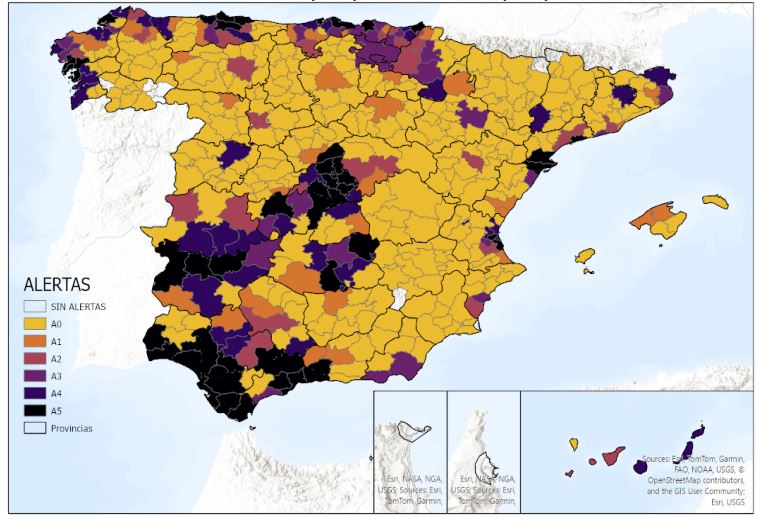
Map 2: Weekly comarca-level risk map of AI virus incursion and survival in Spain according to the risk assessment model developed by the MAPA. (Up to 5 November 2025) (source: MAPA)
3. Increase in the risk level in Spain and activation of Order APA/2442/2006.
The increase in cases reported in both wild birds and domestic poultry in the European Union and in our geographical area over recent weeks, combined with the forecast temperature drop in Spain in the coming weeks and the model-based comarca-level risk maps for virus presence, make it advisable to raise the national risk level and apply risk mitigation measures. This precautionary approach is ultimately the purpose of activating Order APA/2442/2006.
For the reasons set out above, it is considered necessary to adopt the following measures through the entry into force of the Order in relation to the special risk zones of Annex II and the special surveillance zones of Annex III, with effect from 10 November 2025 inclusive:
- Revocation of the exemption authorisations established under Order ARM 3301/2008 to the biosecurity measures set out in Article 5.1 of Order APA/2442/2006.
- In particular:
- a) The use of birds of the orders Anseriformes and Charadriiformes as decoys is prohibited.
- b) The rearing of ducks and geese together with other poultry species is prohibited.
- c) Outdoor poultry rearing is prohibited in municipalities in the vicinity of risk areas such as wetlands and stopover sites along migratory bird routes listed in the Official State Gazette (BOE) in the Annexes II and III of Order APA/2442/2006. However, where this is not possible, the competent authority may authorise the keeping of poultry outdoors, provided that — where feasible — bird netting or any other device preventing the entry of wild birds is installed, and that feed and water are provided inside the buildings or under a shelter that prevents wild birds from gaining access and avoids contact between wild birds and feed or water intended for poultry.
- d) Watering poultry from open water sources accessible to wild birds is prohibited, unless such water is treated to ensure inactivation of any possible avian influenza virus.
- e) Outdoor water containers required for animal welfare purposes for certain poultry shall be adequately protected against wild waterfowl.
- f) The presence of poultry or other captive birds at animal gathering centres as defined in Article 3.7 of Law 8/2003 of 24 April on Animal Health — including livestock shows, fairs, exhibitions and cultural events — as well as any outdoor gatherings of poultry or other captive birds, is prohibited.
- However, the competent authority of the Autonomous Community or the Cities of Ceuta and Melilla, in matters of animal health, may authorise such gatherings provided that a risk assessment yields a favourable outcome.
Zones in the rest of the national territory:
Competent authorities in these zones are urged to take general information and awareness-raising measures to strengthen passive surveillance and biosecurity to the greatest extent possible.
Source:
-. MAPA (MINISTRY OF AGRICULTURE, FISHERIES AND FOOD, DIRECTORATE-GENERAL FOR AGRI-FOOD PRODUCTION HEALTH AND ANIMAL WELFARE. SUB-DIRECTORATE-GENERAL FOR ANIMAL HEALTH, ANIMAL HYGIENE AND TRACEABILITY.
C/ Almagro 33, 28010 MADRID, TEL: 913478295 www.mapa.gob.es sganimal@mapa.es
Tracking of Avian Influenza cases on poultry farms in Spain in 2025:
-. 1st outbreak of 2025 (18 July, Extremadura): Alert over an Avian Influenza outbreak on a 7,000-turkey farm in Extremadura
-. 2nd outbreak (28 July, Toledo): Second AI outbreak detected, this time in breeder flocks in Toledo
-. 3rd outbreak (1 Sept., Huelva): The spectre of H5N1 returns to Andalusia: 8,500 turkeys culled due to Avian Influenza in Huelva.
-. 4th outbreak (8 Sept., Guadalajara): Spain records its fourth AI outbreak of 2025, this time on a breeder farm in Guadalajara
-. 5th outbreak (9 Sept., Huelva): H5N1 positive confirmed on the 8,400-bird poultry farm in Valverde del Camino, Huelva, Andalusia
-. 6th outbreak (19 Sept., Valladolid): H5N1 AI detected on a 760,000-layer farm in Valladolid
-. 7th, 8th and 9th outbreaks (1 Oct., Valladolid and Madrid): 552,000 laying hens affected by three new AI outbreaks in Madrid and Valladolid
-. 10th outbreak (6 Oct., Valladolid): Tenth Avian Influenza outbreak detected in Spain. Over 800,000 laying hens to be culled.
-. 11th outbreak (13 Oct., Valladolid): Eleventh Avian Influenza outbreak detected in Spain on a 66,000-layer farm.
-. 12th outbreak (15 Oct., Valladolid): 315,000 new laying hens affected in the latest outbreak
-. 13th outbreak (16 Oct., Toledo): 112,000 laying hens in Yeles, Toledo
-. 14th outbreak (20 Oct., Valladolid): 54,000 broiler chickens in Valladolid
No new outbreaks have been recorded on poultry farms since 20 October (updated as of 5 Nov. 2025)
For further information:
-. Avian Influenza on NeXusAvicultura