
Avian Influenza reaches critical levels in Spain: preventive measures come into force on 20 January
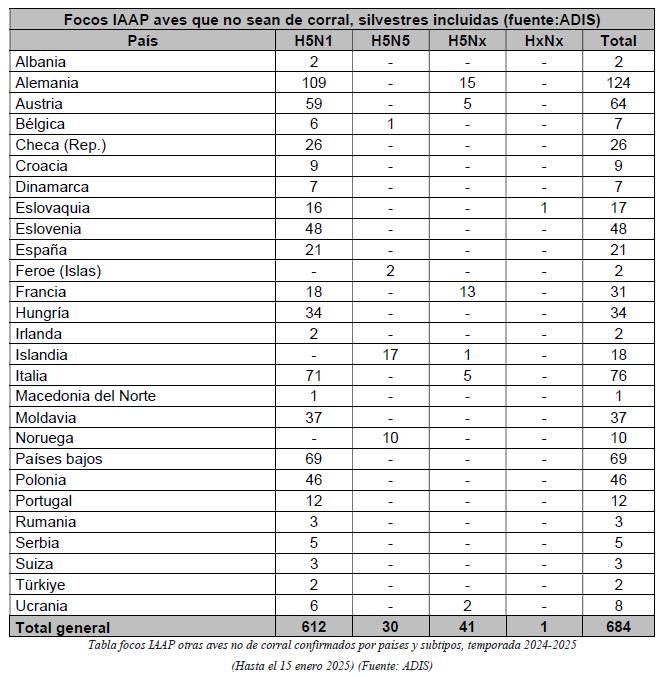
Highly pathogenic avian influenza (HPAI) has reached a critical point in Europe, with 341 outbreaks in poultry and 684 in wild birds from July 2024 to 15 January 2025.

In Spain, although there has not been a single case in poultry, 21 cases have been detected in wild birds; this, together with the January avian influenza case at a laying hen farm in Portugal, and the two late-December cases in France, has led the Ministry of Agriculture, Fisheries and Food (MAPA) to declare a HIGH risk level, activating new preventive measures from Monday 20 January 2025.
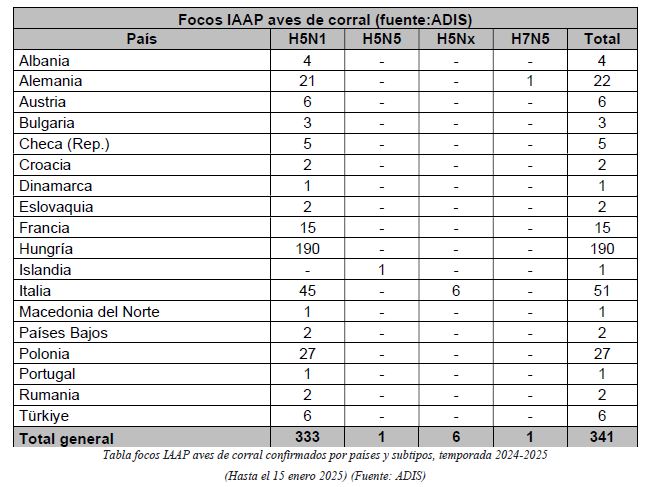
The recent evolution of HPAI in Europe shows a worrying increase in outbreaks, particularly in neighbouring countries such as France and Portugal. This situation, combined with the onset of winter and the presence of migratory birds, heightens the risk of virus incursion and survival in Spain. According to MAPA, a significant increase has been identified in the number of municipalities at high risk level, located in areas of special surveillance and risk.
What key preventive measures will be applied from 20 January?
- Ban on free-range poultry keeping, except under strictly controlled biosecurity conditions.
- Restrictions on the presence of birds at public events, such as livestock shows and exhibitions.
- Strengthening of passive and active surveillance, particularly in high-risk areas.
These actions aim to prevent the introduction and spread of the virus, protecting both domestic birds and the Spanish poultry sector, a key industry within the Spanish agri-food sector.
MAPA (the Ministry of Agriculture of the Spanish Government) has therefore decided to activate the provisions already set out in Ministerial Order APA/2442/2006; looking at the detail, the following Biosecurity measures come into force from Monday 20 January 2025:
a) The use of birds of the orders Anseriformes and Charadriiformes as decoys is prohibited.
b) The rearing of ducks and geese together with other species of poultry is prohibited.
c) Free-range poultry keeping is prohibited. However, where this is not possible, the competent authority may authorise the keeping of poultry outdoors, provided that, where feasible, bird-proof netting or any other device preventing the entry of wild birds is installed, and that birds are fed and watered inside the facilities or under a shelter that prevents wild birds from gaining access and avoids contact between wild birds and feed or water intended for poultry.
d) Watering poultry from water reservoirs accessible to wild birds is prohibited, unless such water is treated to ensure the inactivation of any possible avian influenza viruses.
e) Outdoor water reservoirs required on animal welfare grounds for certain poultry species shall be adequately protected against wild waterfowl.
f) The presence of poultry or other captive birds at animal assembly centres as defined in Article 3.7 of Law 8/2003 of 24 April on Animal Health, including livestock shows, fairs, exhibitions and cultural events, as well as any outdoor gathering of poultry or other captive birds, is prohibited.

The remaining measures set out in the Order will not be applied for the time being, although this could be reviewed in the coming weeks depending on how the epidemiological situation evolves.
The stakes are high
The situation in Europe could deteriorate at any moment. Of the affected countries, Hungary leads in outbreak numbers with 190 foci in poultry. In Spain, 21 cases have been recorded in wild birds — a figure that, while limited, reflects the country’s vulnerability. Risk models indicate that low temperatures could favour the persistence of the avian influenza virus across Europe, demanding immediate action.
The economic impact on the poultry sector could be significant if outbreaks reach commercial premises. For this reason, MAPA urges the reinforcement of biosecurity across all production units, as well as the promotion of information and awareness among producers.
For further information:
-. Ministry of Agriculture
-. Official MAPA communiqué of 16 January 2025
-. Avian Influenza on NeXusAvicultura.com