
Avian health · Newcastle Alert · Valladolid · July 6, 2026
MAPA confirms this Monday, July 6, two new outbreaks in the province of Valladolid. The one in Megeces—a pullet rearing operation vaccinated with a single dose—marks the debut of a production category that had remained untouched throughout the entire wave that began in December 2025.
Two more outbreaks in the Olmedo region
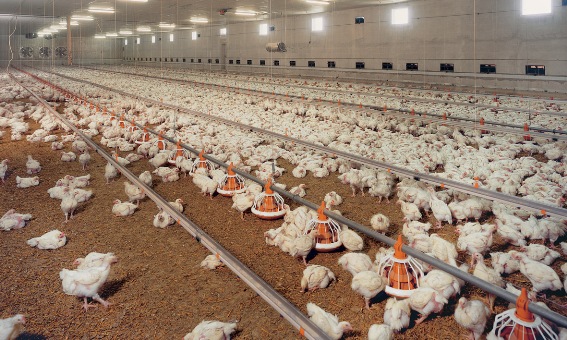
The veterinary authorities of the Junta de Castilla y León reported today two new outbreaks of Newcastle disease in the province of Valladolid, both in the Olmedo region. The first, on a broiler farm in Íscar (about 38,000 birds, unvaccinated), very close to previous outbreaks in the same municipality; the second, on a pullet rearing farm in Megeces (about 181,000 pullets), located about 9 km away. With these, Valladolid now totals 13 outbreaks, and Spain 23 since December 2025.
For the first time in the entire wave,
the virus does not strike laying hens or broilers,
but pullets:
the very future of egg-laying.
Pullet rearing, a link untouched until now
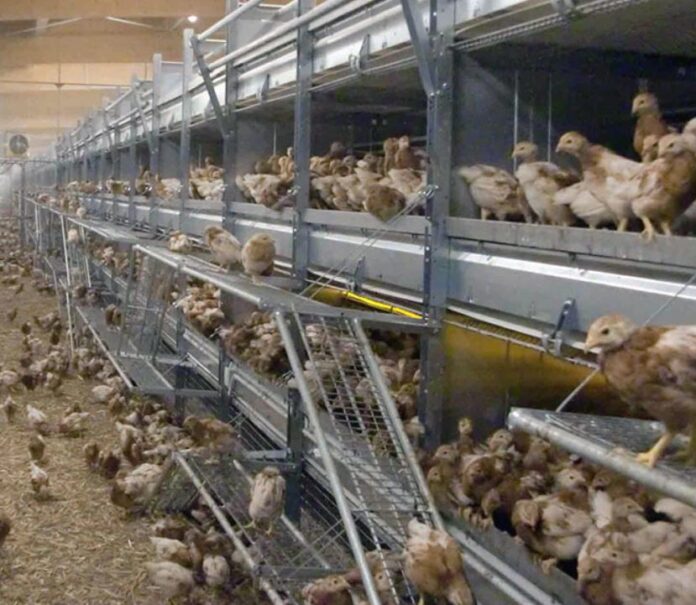
This is where the true novelty lies. The previous 22 outbreaks of the 2025-2026 wave had affected broilers, laying hens, or breeders, but never a pullet rearing farm. The Megeces outbreak is the first to hit the link that raises future laying hens. This is no minor nuance: compromising pullet rearing not only reduces eggs today, but also strains the replenishment of tomorrow’s laying flock, and it does so precisely when avian flu is keeping supply and prices under pressure across Europe.
23 outbreaks and 1.33 million birds: the Newcastle wave no longer spares any stage of the production cycle.
Vaccinated with a single dose
The Megeces farm had been vaccinated against Newcastle, though with only a single dose, and even so it recorded a mortality increase of 0.97% that triggered suspicion on July 3. The Íscar farm, on the other hand, was unvaccinated (+1.3% mortality). The Central Veterinary Laboratory of Algete confirmed a velogenic strain in both cases by PCR. The episode once again puts biosecurity and vaccination at the center of debate, and whether we are providing sufficient vaccine titration: it reduces clinical signs and viral shedding, but does not prevent infection, as we already analyzed in “Newcastle disease or the vaccination dilemma”.
The Megeces farm was vaccinated
With a single dose.
The national picture: 23 outbreaks and 1.33 million birds
With the updated data, the wave has accumulated 23 outbreaks —10 in the Valencian Community (genotype VII.1.1) and 13 in Valladolid (VII.2)— and close to 1.33 million birds affected: 48% laying hens, 38% broilers and, as of today, 14% pullets. Ten of these outbreaks have been declared on vaccinated farms. The starting point of this update in Castilla y León was set at the outbreak at the 300,000-laying-hen farm in Olmedo and its geographic origin at the jump from the Mediterranean arc to Castilla y León.

Source: MAPA
Compromising pullet rearing not only subtracts eggs today; it strains the replenishment of tomorrow’s laying flock.
Two independent outbreaks
Partial sequencing at the Algete LCV confirms that the virus circulating in Valladolid belongs to genotype VII.2, different from the VII.1.1 found in Valencia, which reinforces the theory of two independent introductions with no epidemiological link between the two outbreaks. Within the 3 and 10 km radii there are 31 and 20 registered commercial farms, all of them already included in restriction zones from previous outbreaks. It is worth remembering that the disease poses no risk to human health and that the consumption of eggs and poultry meat is entirely safe.
The NeXus Fact Sheet updated July 6, 2026
| UPDATE FACT SHEET | July 6, 2026 · MAPA / RASVE |
| Outbreaks reported today (July 6, 2026) | 2 (Íscar and Megeces, Valladolid) |
| New development | 1st outbreak on a PULLET REARING farm of the entire wave |
| Megeces (pullet rearing) | ≈181,000 pullets · vaccinated (1 dose) · +0.97% mortality |
| Íscar (broilers) | ≈38,000 broilers · unvaccinated · +1.3% mortality |
| Genotype | VII.2 (different from Valencia’s VII.1.1) |
| Confirmation | PCR — velogenic strain · Algete LCV |
| Total outbreaks in Spain | 23 (10 Valencian Community + 13 Valladolid) |
| Birds affected (cumulative) | ≈1,327,219 · 48% laying hens / 38% broilers / 14% pullets |
| Restriction | 3 and 10 km radii · 31 and 20 commercial farms |
Timeline of Newcastle disease outbreaks in Spain:
After more than three years (since 2022) without any Newcastle case in Spain, the situation has become complicated since this disease resurfaced in December 2025 in Valencia. Below is the list of outbreaks updated as of July 6, 2026:
- The origin (Outbreak 1): The disease reappeared in Spain in late December 2025 in the municipality of Llutxent (Valencia), on a farm with 15,000 chickens, breaking the disease-free status that Spain had maintained since 2022.
- The expansion (Outbreaks 2, 3, and 4): On January 2, 2026, three new secondary outbreaks were confirmed in the same municipality, affecting farms with censuses of 28,500, 16,500, and 20,100 birds. The investigation pointed to geographic proximity and ties between owners as transmission factors.
- The fifth case (January 20, 2026) on a farm with 75,000 broilers.
- Sixth outbreak (March 9, 2026) in Terrateig, affecting a single house of 27,000 hens in a poultry complex.
- Seventh outbreak (April 9, 2026) on a farm with 26,300 broilers and eighth outbreak (April 10, 2026) on a farm with 32,000 laying hens. Both in Ráfol de Salem.
- Ninth outbreak (April 28, 2026) on a farm with 38,900 broilers in Ráfol de Salem.
- Tenth outbreak (May 8, 2026) on a farm with 20,040 laying hens in Castelló de Rugat (official statement).
- Eleventh outbreak (June 15, 2026) on a farm with 24,000 43-day-old broilers in Aldea de San Miguel, Valladolid (official statement).
- Outbreaks 12, 13, 14, and 15 on June 22, 2026, in Valladolid, affecting a total of 117,150 laying hens and 9,000 broilers.
- Outbreak number 16 on June 30, 2026 in Olmedo (Valladolid) affects a farm of 300,000 laying hens (official statement).
- Outbreaks 17, 18, and 19 from July 1, 2026 have affected a total of 301,196 birds (141,592 laying hens at the farm in Íscar, plus 40,000 chickens in San Vicente del Palacio and another 119,605 broilers in Cogeces del Campo) (official statement of July 1).
- Outbreaks 20 and 21 from July 3, 2026 have affected a farm of 31,100 chickens in Íscar, and another of 25,242 broilers in Cogeces del Campo) (official statement of July 3).
- Outbreaks 22 and 23 from July 6, 2026 have affected a farm of 181,000 pullets in Megeces and another of 38,000 chickens in Íscar. (official statement of July 6).
To learn more:
-. What is Newcastle Disease?
-. National Newcastle Surveillance Program 2026. (14-page PDF from MAPA published in May 2025)
-. Main page of Newcastle Disease Control from MAPA
-. Newcastle Disease Newcastle Disease on NeXusPoultry
Do you want to stay one step ahead in poultry farming?
Subscribe for free to our eNewsletter and receive a weekly selection
of the best information to anticipate trends, stay up to date, and improve as a poultry farming professional.
NeXusAvicultura : Vision, Criteria, Quality and Context.