
· The Ministry of Agriculture estimates that each year a Spaniard consumes 16.6 kg of ready meals
· Half of our lunches and 79% of weekday dinners consist of a single course
From the Mediterranean diet to the ready meal: in Spain we are eating ever more prepared food, to such an extent that household consumption figures today bear little resemblance to those of barely 20 years ago. In the space of two decades, demand has experienced runaway growth, now standing at nearly 17 kg per person per year. The sector estimates that in 2023 alone, Spanish households consumed 742,300 tonnes of such products.
A voracious appetite for convenience foods. That is the conclusion reached by the EFE news agency after analysing data from the Food Consumption Panel. According to its analysis, per capita consumption of ready meals in Spain has already reached 16.6 kg per year, far — very far — from the figures of just one or two decades ago. Furthermore, EFE estimates that since 2004 consumption of convenience foods in the country has surged by no less than 514.8%, with almost uninterrupted growth.
What do the data show? That the increase in demand for ready meals has been dramatic. The latest report from the Ministry of Agriculture (MAPA) shows that between March 2023 and March 2024, per capita consumption in Spanish households was 16.57 kg, above the 16.47 kg recorded in the equivalent period between 2022 and 2023, and considerably higher than the 12.2 kg of a decade ago (2013–2014). Looking further back, the increase is even more striking: at the close of 2004, MAPA data show annual per capita consumption of 9.9 kg.
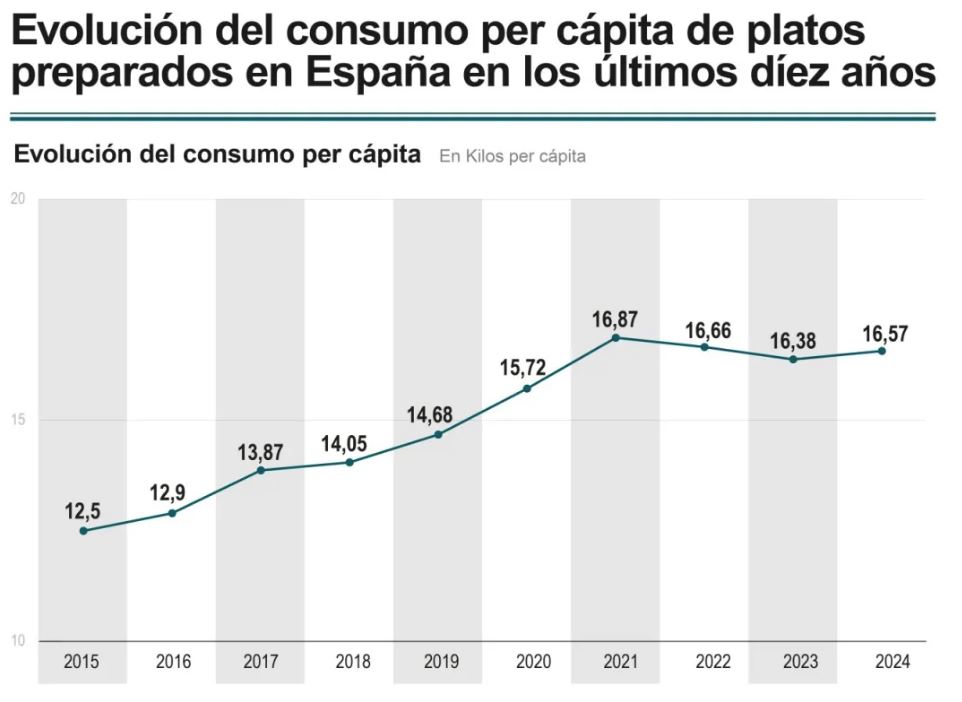
Less food, more ready meals. The latest MAPA report is notable both for its figures and for the picture it paints. At the close of 2023, purchases of ready meals and overall food products were moving in opposite directions: the former grew by 1.5% while the latter fell by 0.4%.
“The ready meals category is gaining ground in Spanish households, with a 9.8% increase in volume when comparing the scope against 2019,” states the MAPA analysis. The study estimates that, on average, each Spaniard consumed 16.77 kg of ready meals last year, 8.3% more than in 2019, including canned and frozen prepared foods, soups, creams, pizza, pasta products and chilled omelettes, among others.
“The ready meals category is gaining ground in Spanish households, with a 9.8% increase in volume when comparing the scope against 2019,” the MAPA analysis further notes. The study estimated that, on average, each Spaniard consumed 16.77 kg of ready meals last year, 8.3% more than in 2019. Under that label, the ministry includes canned and frozen prepared foods, soups, creams, pizza, pasta products and chilled omelettes, among others.
But what are we consuming? MAPA specialists note “significant growth” in canned, soup and cream ready meals, “with double-digit variations” between 2013 and 2023. Prepared omelette products doubled in volume, and pizza products also recorded an increase, albeit a more modest one, of “only” 9.3%.
Among the most popular convenience food products, soups and creams stand out, accounting for 36% of total volume, followed by frozen products (15.9%) and other options such as pizzas (13.5%) and chilled omelettes (3.5%). By region, consumption is highest in Catalonia, Madrid, the Balearic Islands and the Valencia Community.
New times… New habits — which is the explanation MAPA finds for the growing prominence of convenience foods. “It is clear that our consumption today differs from that of 2019, and this is reflected in the way we cook during the week,” states the 2023 trends report.
“Home-cooked meals are the ones showing the greatest decline in consumption occasions over the long term, and Spanish households are increasingly opting for culinary aids such as pre-made sauces and packaged stocks, or consuming more ready meals — dishes that simply need to be heated and are ready to serve.”
The pursuit of “practicality and convenience”. In that same vein, MAPA also identifies another clear trend: it is increasingly common for meals to consist of a single course. “In the pursuit of simplification, the single-course meal is today more prevalent than it was in 2019, for both lunch and dinner. Half of the weekday lunches we eat are single-course, and in the case of dinners, 7 out of 10 occasions involve just one course.”
More than 740,000 tonnes. Another useful source is the sector’s own trade association, ASEFAPRE, which represents the leading manufacturers and published its 2023 review some months ago. To summarise, it highlights a telling figure: last year Spanish households consumed 742,377 tonnes of ready meals, equivalent to 16.3 kg per capita per year.
The preferred option according to its analysis is pizza, with 132,905 t, followed by pasta-based dishes (95,162 t) and meat-based products or poultry-derived products (70,999 t). With regard to product type, ASEFAPRE’s tables reveal that chilled products lead sales, at least in volume terms, with more than 343,800 t.