
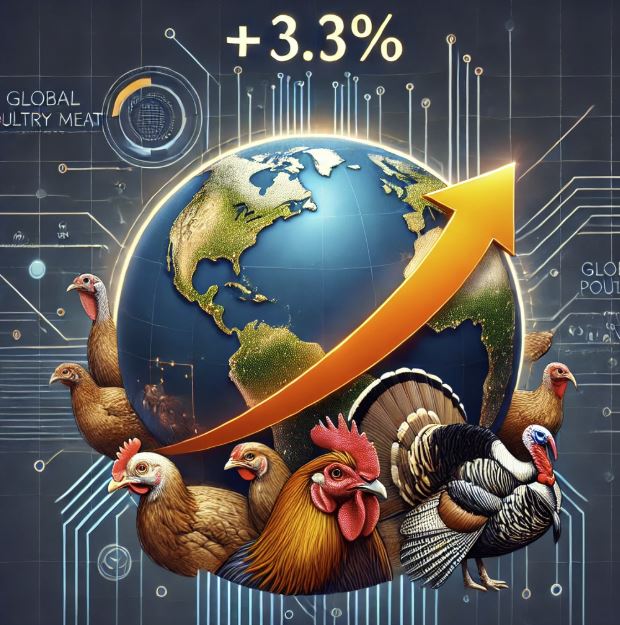
Sustained growth in world poultry meat production of 3.3% per year
At a global scale, poultry meat has consolidated its position as the leading source of animal protein, having reached 139 million tonnes (Mt) in 2022. It is followed by pig meat (123 Mt) and, further behind, beef (76 Mt). Since 2000, the poultry sector as a whole has shown an average annual growth rate of 3.3%, a figure that far exceeds the 1.4% recorded for pig meat and the 1.2% for beef, according to figures published by the FAO.
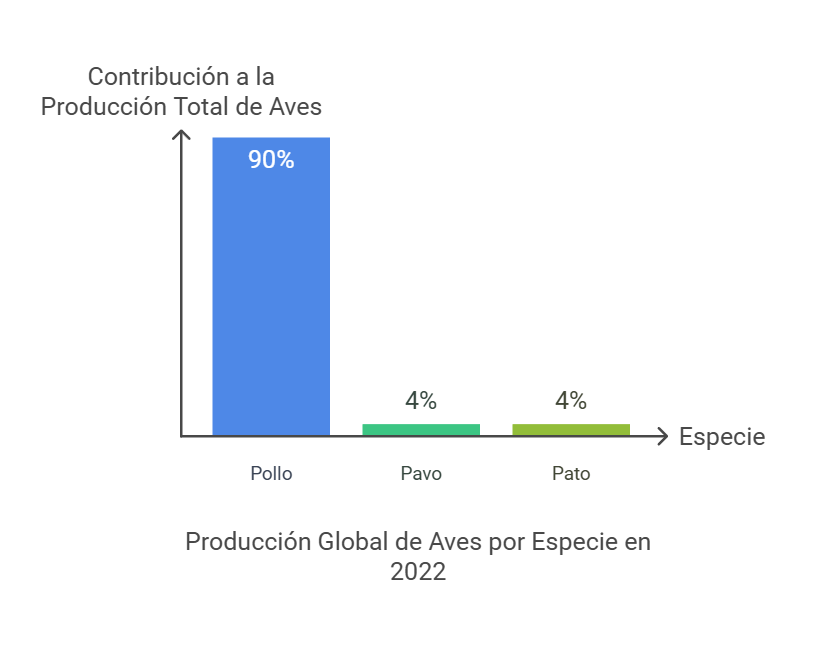
Although the category of “poultry meat” encompasses several species, broiler chicken stands out as the primary driver of this expansion: in 2022, it accounted for approximately 90% of global poultry meat production. Turkey and duck production each represent around 4% and have shown appreciable increases over the past decade, albeit on a smaller scale. Among the key factors that have driven the remarkable success of poultry production are price competitiveness, the absence of religious dietary restrictions, and the relative ease of scaling up production.
Current landscape of global production
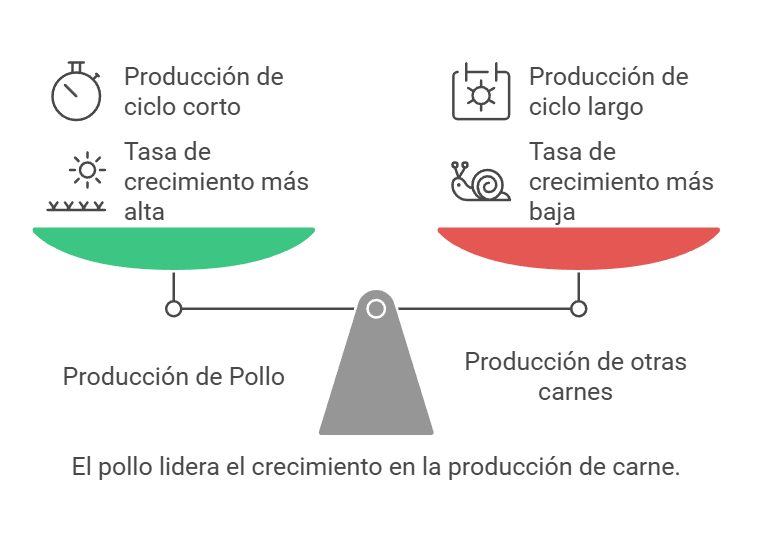
In 2022, the countries with the highest volumes of poultry production were the United States (22.8 Mt), China (21.8 Mt), Brazil (14.8 Mt) and the European Union (13.7 Mt). The joint OECD-FAO projections for 2022–2032 indicate that poultry will continue to be the main driver of growth in global meat production, accounting for half of the estimated increase over that period. This momentum is largely attributed to the short production cycle, which allows for agile responses to demand fluctuations, as well as to ongoing advances in genetics, health management and feed efficiency.
Countries with surpluses of feed grains (such as the United States and Brazil) present a highly favourable environment for rapid growth in poultry production. In Asia, the outbreak of African swine fever has curtailed pig meat production, thereby creating opportunities for diversification and expansion of the poultry sector, particularly in China in recent years.

Concentration of international trade among a small number of exporters
World trade in poultry meat (excluding intra-EU trade) accounts for approximately 11% of global production and is almost entirely dominated by chicken meat. In 2022, 15.4 Mt of chicken meat were traded internationally. Brazil stands as the leading exporter (4.45 Mt), followed by the United States (3.32 Mt), the EU (1.63 Mt), Thailand (1 Mt) and Turkey (0.8 Mt).
It is worth noting that the prominence of certain emerging exporters has grown substantially in recent years, as is the case of Ukraine, Turkey and Russia, whose exports have more than doubled since 2010. Furthermore, the unit value of exports varies according to the composition of the products traded: the United States ships lower-priced cuts with lower added value, whereas Thailand focuses on high-value processed or cooked preparations, destined primarily for the European Union and Japan.
In general, chicken meat continues to function as a global commodity, meaning that leading exporters typically possess competitive production costs derived from the availability of key feed ingredients (maize and soybean) and low-cost labour. Regarding import destinations, a lower degree of concentration is observed. In 2022, the largest importers were Japan (1.1 Mt), the United Arab Emirates (700,000 t), Saudi Arabia (615,000 t), China (645,000 t) and Angola (345,000 t). Russia, meanwhile, has drastically reduced its external purchases since 2014, having become a net exporter.
Key conditioning factors in the recent global market
- Several avian influenza outbreaks affecting numerous countries.
- The “fraca” meat scandal in Brazil, which had a negative impact on inspection and certification systems.
- Notable fluctuations in the prices of poultry feed inputs.
- African swine fever, first detected in China in August 2019 and subsequently spreading across Southeast Asia, which triggered a decline in pig meat production and a shift in demand towards poultry.
According to the joint OECD-FAO outlook, total global meat exports are expected to grow by around 3% by 2032, albeit at a somewhat more moderate pace than in the previous decade. Poultry would absorb two thirds of the increase in meat imports, raising its share to 40% of global imports by 2032.
European production: growth in the eastern region and segmentation in the west
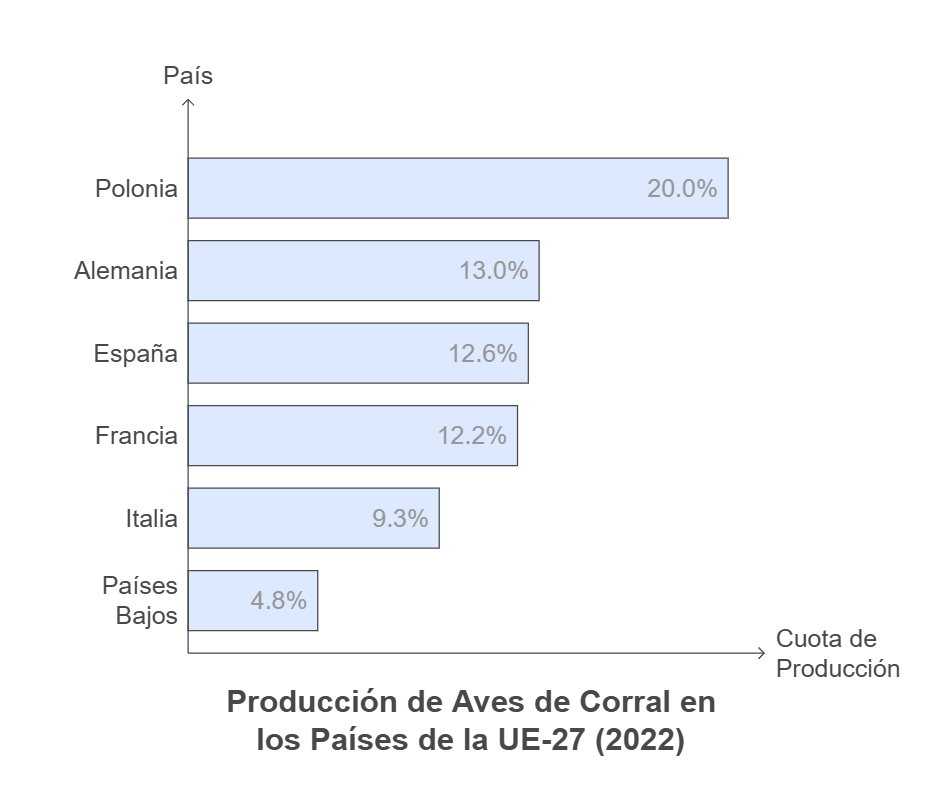
In this highly dynamic global context, the European Union’s share of international poultry trade has declined over recent decades. Even so, the Institut Technique de l’Aviculture (ITAVI) estimates that the EU-27 produced 12.9 million tonnes of poultry meat in 2022 (data derived from Eurostat and national statistics). More than half of production is concentrated in Poland (20.0%), Germany (13.0%), Spain (12.6%), France (12.2%), Italy (9.3%) and the Netherlands (4.8%). Chicken accounts for approximately 82% of the total, while turkey represents 12.8% and duck 2.3%.
In the EU-27, the average annual growth in poultry meat production over the past decade (2012–2022) has been 3.0%. Poland stands out with annual growth of +7.2%, having nearly doubled its output over that period. Other countries recording significant increases include Spain (+18%), Hungary (+16%) and Belgium (+80%). By contrast, France has recorded a decline of 9% over the past decade. It should also be noted that, in much of the former EU-15, growth is constrained by increasing societal demands regarding animal welfare, the reduction of antibiotic use, and the replacement of GM feed ingredients, among other requirements.
Trends in production volume in the EU-27 (in thousands of tonnes carcass weight equivalent)
| 1,000 tcwe | 2019 | 2020 | 2021 | 2022 | 2023* | % 22/21 | % 23*/22 |
|---|---|---|---|---|---|---|---|
| Chicken | 10,916 | 11,115 | 10,735 | 10,639 | 11,002 | –0.9% | +3.4% |
| Turkey | 1,889 | 1,917 | 1,791 | 1,660 | 1,638 | –7.3% | –1.3% |
| Duck | 470 | 386 | 382 | 298 | 340 | –22.0% | +14.2% |
| Total | 13,516 | 13,639 | 13,072 | 12,988 | 13,335 | –0.6% | +2.7% |
*Estimate
In line with production trends, the EU-27 maintains a net export surplus both in volume (1,895,000 t exported versus 740,000 t imported in 2022) and in value. However, a qualitative analysis of trade flows reveals that imports, originating mainly from Brazil, Thailand and Ukraine, consist primarily of higher value-added products (fillets or cooked preparations). Conversely, EU exports tend to consist of cuts with lower demand on the Community market (wings, necks, etc.) and are typically destined for countries in Africa and Asia.
Over the past five years, extra-EU sales grew at an annual rate of 4.6%, while imports remained almost stable, with a slight increase of 0.6% over the same period. This trend is attributable, among other factors, to the decline in purchases from Brazil (following the “fraca” meat scandal) and to the opening of tariff quotas with other countries (Chile, Ukraine, etc.). Nevertheless, the proportion of imports from Brazil has recovered, rising from 27% of the total in 2019 to 35% in 2021, reclaiming its position as the EU’s main supplier, which it had lost in 2017. In 2022, the reduction in domestic supply in Europe and the tariff liberalisation for Ukraine reinforced purchases from the latter country, which now accounts for 19% of imports.
Consumption trends and market segmentation in Europe
Per capita consumption of poultry meat in the EU-27 stands at approximately 23.4 kg per year. In general, consumption growth in Western Europe has for decades been subject to societal debates on environmental issues, animal welfare, public health and the potential “industrialisation” of livestock farming. This environment has, on the one hand, encouraged the adoption of vegetarian and flexitarian dietary patterns and, on the other, sustained poultry meat consumption, which is perceived as a more affordable option with fewer cultural restrictions.
In France, for example, household demand has been in decline for some time, while food service and processed products drive the bulk of consumption. In 2020, the COVID health crisis temporarily altered this trend, curtailing out-of-home dining and boosting domestic consumption; however, in the long term it is expected that pre-pandemic patterns will gradually re-establish themselves.
This social context is reflected in growing market segmentation, particularly in north-western Europe (United Kingdom, Germany, the Netherlands), with the rise of higher-welfare chicken lines (reduced stocking densities and growth rates, sometimes with outdoor access). France, with more than 15% of its production under Label Rouge or organic certification schemes, remains the benchmark for free-range production.
In developed economies — including the EU — two apparently divergent forces are acting on poultry supply:
- Growing demand for ready-to-eat products, derived mostly from standard poultry, meeting convenience and price requirements.
- Emerging demand for differentiated products, focused on higher animal welfare standards, naturalness and local provenance.
Although both forces coexist, it remains difficult to determine which of the two will carry greater weight in shaping the future of the European poultry market.
References:
- Food and Agriculture Organization of the United Nations (FAO).
- Organisation for Economic Co-operation and Development (OECD).
- Institut Technique de l’Aviculture (ITAVI).
- Eurostat.