

As awareness of animal welfare continues to grow, consumers are increasingly willing to pay more for products that meet their expectations of responsible animal stewardship. Robert Yaman, Chief Executive Officer of Innovate Animal Ag, highlights a crucial shift in consumer expectations around food, particularly within the egg category. This heightened awareness is not merely a passing trend, but a profound change in the way people approach their food choices, pushing the industry to innovate and adopt practices that meet these evolving animal welfare standards.
In the United States, 65% of Americans believe that food companies should find new ways to ensure the humane treatment of farm animals, and 50% are willing to pay a premium for such products. Similarly, in Europe, 60% of respondents in a recent Eurobarometer survey expressed their willingness to pay more for humanely produced items.
However, translating consumer sentiment into purchasing behaviour remains a challenge for food companies. The industry continuously seeks ways to meet these expectations without imposing substantial price increases. A new technology in egg production, known as in ovo sexing, could offer a solution that addresses both ethical concerns and economic considerations.
One of the unfortunate realities of the egg industry has historically been the practice of “male chick culling”. The low cost of poultry meat and chickens today is partly due to the development of specialised breeds optimised to produce each product as economically as possible.
An unintended consequence of this is that male chicks from laying breeds have no economic value. They do not lay eggs and cannot be used for meat because they are scrawny and grow very slowly. As a result, egg producers must pay highly skilled workers — professional chick sexing teams — to inspect every chick hatched for egg production, identifying which are females to be sent to the farm and which are males to be immediately culled.
This process not only requires scarce and hard-to-find labour, but also raises significant ethical concerns among consumers. Surveys indicate that 73% of US egg buyers and 75% of European citizens believe the industry should find alternatives to this practice.
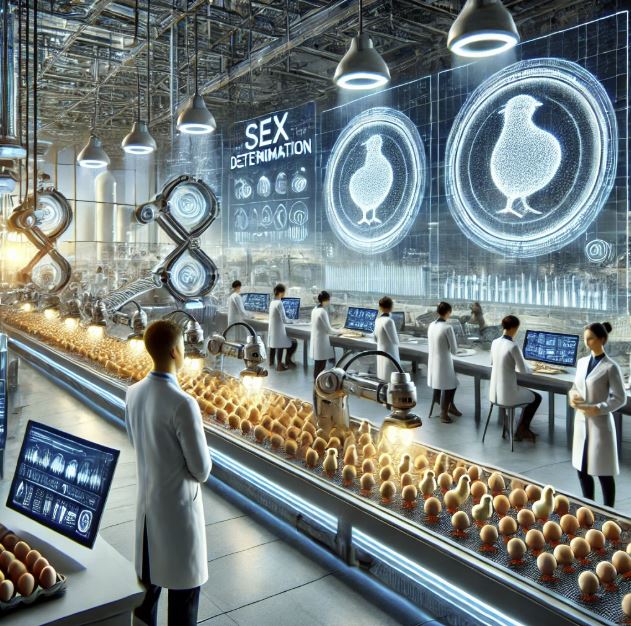
This has been a necessary evil in the egg sector — until recently. A new technology called in ovo sexing is now available, using advanced biotechnology to examine the interior of fertile eggs as they develop. Eggs that would hatch as males can be removed before the embryo has the capacity to feel pain, enabling egg producers to raise only females and effectively eliminating the need to cull male chicks.
Solutions for ethical egg production
There are multiple approaches to sexing an egg, and numerous technology companies are competing to develop the best solution. Some companies use imaging diagnostic techniques, such as hyperspectral imaging or magnetic resonance imaging, to examine the interior of the egg at the developing embryo stage, while other technologies take a small fluid sample from each egg to look for sex identification markers.
In ovo sexing technology has gained significant traction in Western Europe, now accounting for 20% of the market. The technology was initially prominent in Germany and France due to regulatory bans on chick culling, but has since been adopted in countries such as Norway and Switzerland, which have no government-mandated prohibitions. Recently, three major US egg companies have also announced plans to implement this technology in their operations this year.
There will therefore be a window of opportunity in which egg marketers, foodservice providers and retailers can use this technology as a strong brand differentiator, giving their egg products a much-needed edge for consumers seeking high-welfare products. A similar dynamic will unfold in other countries as the technology proliferates worldwide.
Transforming the food industry
Business leaders in the food industry must consider return on investment. It may seem crass to think in these terms when it comes to animal welfare, but it is an important reality of food production. The rapid growth of cage-free egg production in recent years provides an interesting comparison. In the United States, cage-free production has increased from 6% to 40% over the past decade, while in the United Kingdom it has grown from 25% to 80% over 25 years.
“Cage-free” eggs can add 8 to 9 cents in additional cost per egg, compared to one cent or less in additional production cost per egg from an in ovo sexed hen. Given that consumer attitudes towards chick culling are similar to those regarding caged housing (85% and 84% of Americans consider these practices unacceptable, respectively), in ovo sexing may offer a greater return on investment. If cage-free production is worthwhile, in ovo sexing is likely to be as well.
As the food industry continues to navigate the balance between consumer expectations, ethical considerations and economic viability, technologies such as in ovo sexing offer promising solutions that are better for animals, producers and consumers alike. For egg producers, foodservice providers and retailers, early adoption of this technology could serve as a strong brand differentiator, attracting consumers seeking higher-welfare egg products at a reasonable cost.
To learn more:
-. In Ovo Sexing at NeXusAvicultura.com