

By NeXusAvicultura
The primary sector and big capital do not always sit at the same table, but when they do, the lessons on profitability, biosecurity and business models are invaluable. In a recent meeting that has captured the sector’s attention, businessman and millionaire Jose Elías sat down with Josep, a broiler farmer from Tarragona, to analyse without filters the reality of poultry rearing in Spain.
What began as a business curiosity turned into an unfiltered conversation between a poultry industry professional and a newcomer about the opportunities and risks of modern poultry farming. Below, we break down the key points of this discussion between Josep, a lifelong poultry farmer, and businessman José Elías, who asks questions, learns and weighs up whether or not to enter the poultry sector.
1. The health reality: A fortress of a sector
One of the first points addressed in the video published on YouTube on 10 July 2025 was the extreme sanitary regulation that governs the sector. Far from the bucolic or careless image sometimes projected, poultry farming today is a high-precision, tightly controlled industry.
Josep highlighted the severity of the protocols for diseases such as avian influenza and Salmonella. A positive detection does not simply mean treating the animal, but rather the closure of the perimeter and the total depopulation of the holding to prevent spread [01:30]. This level of sanitary risk compels farms, both old and new, to maintain constant audits and rigorous disinfection protocols, where even a positive environmental sample (without affecting the meat) can halt the intake of new stock [03:08].
2. The model debate: Integrated or independent?
The heart of the conversation centred on profitability. Two contrasting visions were discussed: the contract integration model and the open market or independent model.
- The integrated model (“The Hotel”): José Elías, with his financial perspective, analysed the integrated model, in which the farmer provides the facilities and labour while the integrating company supplies the birds and feed. Josep described it colloquially as “a hotel”, where the poultry farmer is paid per bird place and for the care provided, ensuring more stable but limited profitability, in the region of €0.50–€0.70 per bird [26:19].
- The independent model: José Elías’s real ambition lies not in managing a single farm but in scaling up. Josep explained that operating independently (buying the day-old chick and feed, and selling at spot market prices) significantly increases risk but also potential profit, with margins that can double during favourable market conditions [28:34]. However, this model requires substantial working capital to cover upfront costs before the birds are sold at 30–40 days of age.
3. Facilities: New-build or refurbished?
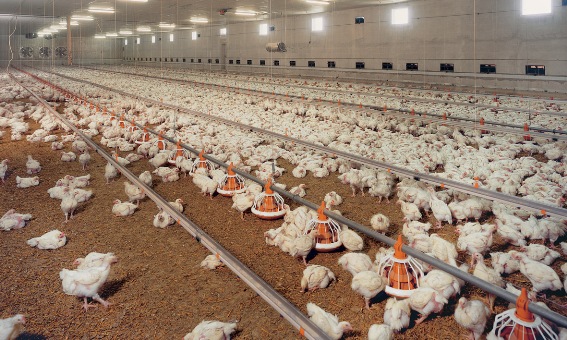
For a poultry farmer starting out or looking to expand, infrastructure investment is critical. The discussion weighed up the difference between taking over older, existing holdings (lower cost, faster amortisation, but greater manual labour and lower stocking density) against constructing state-of-the-art houses.
Modern poultry houses, with sandwich-panel insulation and automated ventilation, allow for optimal efficiency and higher stocking densities, but their cost is substantial (upwards of half a million euros per house for large capacities) [20:05]. José Elías, drawing on his background in construction, suggested that self-building could reduce these costs by up to 30%, presenting a competitive advantage from the outset [19:26].
4. Debunking consumer myths
At NeXusAvicultura we always advocate for accurate information. During the meal, the opportunity was taken to dispel urban legends that damage the product’s image:
- Hormones: This is an old and tiresome myth, yet there are still a few people who believe it. Josep was categorical in confirming that the accelerated growth of broilers (100g per day in the final stages) is the result of genetic selection, excellent husbandry and nutrition — not hormones or illegal additives [24:25].
- Food safety: The quality and safety of domestic chicken meat was reaffirmed; it is subject to controls that, in the event of an infringement, carry immediate criminal liability [25:22].
5. The vision for the future: Scaling the business
The meeting concluded with a real-time negotiation. Elías’s proposal is clear: to professionalise the sector by separating the role of the shareholder (who provides the capital) from that of the manager/operator (who holds the know-how).
For the business to be attractive to major capital, a single farm is not enough; a scalable model (30 or 40 farms) is needed to justify the corporate structure [41:15] — something the poultry integrators discovered decades ago. Josep, for his part, is seeking the stability and financial capacity to leave behind the volatility of rental arrangements and focus on what he does best: rearing top-quality broilers.
This meeting demonstrates that Spanish poultry farming has grown in appeal and is at a turning point. The entry of high-level business profiles could modernise and scale the sector, provided that the expertise of technical staff and the good stockmanship of the poultry farmer are respected — for no matter how advanced the technology, broiler houses still require a professional poultry farmer, with a solid variable remuneration package, for optimal performance. As they aptly summed up: the business is not just about owning the farm; it is about having the operation and the financial resilience to weather the market cycle.
For more information:
-. Company news at NeXusAvicultura
Want to stay one step ahead in poultry farming?
Subscribe free to our eNewsletter and receive a weekly selection
of the best information to anticipate trends, stay up to date and develop as a poultry industry professional.
NeXusAvicultura: Vision, Insight, Quality and Context.