
In-depth analysis | Technology & Animal Welfare | May 2026
PRECISION POULTRY FARMING · SPECIAL REPORT
A comprehensive review from the University of Georgia maps how artificial intelligence use in poultry, computer vision, robotics, IoT and — increasingly — bioacoustics are transforming every link of the production chain. The promise is real. So are the data, ethical and adoption barriers still standing in the way.
A sector under pressure, a technology coming of age
Few industries face a productivity equation as demanding as global poultry. The FAO projects a 14% rise in worldwide meat consumption by 2030, with poultry meat absorbing a disproportionate share thanks to its comparatively low environmental footprint and production cost. Producers are expected to deliver more protein, with fewer resources, under tighter welfare scrutiny and amid an increasingly endemic avian influenza pressure on both meat and egg supply chains.
Against that backdrop, a feature article published in April 2026 in Animal Frontiers — the journal of the American Society of Animal Science and an EAAP-invited contribution — offers one of the most systematic maps to date of how artificial intelligence is being deployed across precision poultry farming (PPF). Signed by Bidur Paneru, Anjan Dhungana, Samin Dahal and Lilong Chai, of the Department of Poultry Science at the University of Georgia, the review is essentially a state-of-the-art audit, and a roadmap, of the technologies our industry will be working with — or competing against — for the rest of this decade.
“The integration of AI with sensor networks and predictive analytics enables real-time, data-driven management — and changes what ‘good husbandry’ looks like in a commercial poultry house.”
The argument running through the paper is straightforward: traditional husbandry, anchored in subjective human observation, no longer scales to the size, density and biosecurity demands of modern poultry operations. Sensor networks, bioacoustics, computer vision, machine learning, deep learning, IoT, edge computing, robotics and natural language processing are the toolkit being assembled to close that gap.
The question is no longer whether they work — many of them, in research conditions, clearly do — but how they translate into reliable, ethical and economically viable solutions for commercial farms.
Poultry’s quiet revolution:
artificial intelligence moves from research lab to ALL THE POULTRY CHAIN — but not without a fight
The toolbox: what precision poultry farming actually means today
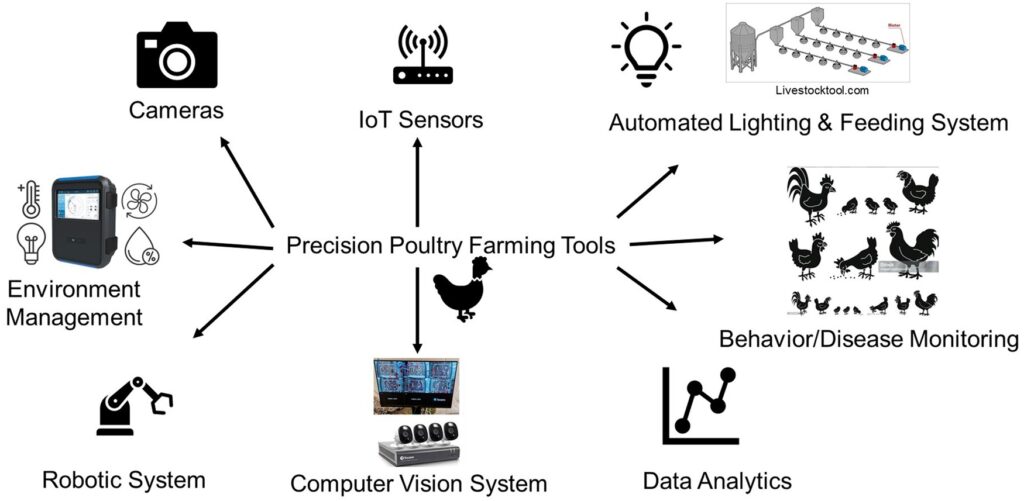
Precision Poultry Farming is shorthand for a stack of technologies that, integrated, allow real-time monitoring and evidence-based decision-making across the entire production chain — from breeders and hatcheries to broiler houses, layer barns, processing and even waste management.
The Georgia team groups the relevant tools into seven families:
artificial intelligence in the broad sense;
machine learning (ML);
deep learning (DL);
computer vision;
robotics;
the Internet of Things combined with edge computing;
and natural language processing (NLP).
Each layer plays a specific role. ML algorithms learn from historical data — feed intake curves, environmental readings, behavioural patterns — to flag anomalies. Deep Learning -DL-, a subset built on multi-layered neural networks, handles high-dimensional inputs such as images and audio, and is the engine behind most of the vision and vocalisation systems described later in the article. Computer vision turns cameras into 24/7 observers. IoT sensors stream the raw data; edge computing keeps latency low and protects against connectivity failures in rural sites. Robotics moves from analysis to action — collecting floor eggs, removing dead birds, navigating among live flocks. NLP, less obvious in a poultry context, is increasingly used to mine veterinary clinical reports and free-text health records, converting narrative data into structured intelligence.
Table 1 · Core AI technologies relevant to poultry production
| Technology | What it does | Poultry-sector use cases |
| Artificial Intelligence (AI) | Enables machines to learn, reason and solve problems. | Disease diagnosis, behavioural analysis, performance optimisation. |
| Machine Learning (ML) | Algorithms that learn from data without explicit programming. | Feed consumption trends, anomaly detection in bird behaviour. |
| Deep Learning (DL) | Neural networks with multiple layers, used on images and audio. | Posture and behaviour assessment, vocalisation analysis. |
| Computer Vision | Interpretation of images and video by machines. | Flock movement, crowding, physical anomalies, individual tracking. |
| Robotics | Autonomous or semi-autonomous physical machines. | Floor-egg collection, dead-hen removal, in-house navigation. |
| IoT + Edge computing | Networked sensors with local processing. | Real-time temperature, humidity, ammonia, feed and water monitoring. |
| Natural Language Processing (NLP) | Computational processing of human language. | Mining clinical veterinary reports and free-text health records. |
Source: Paneru et al., Animal Frontiers, 16(2), 2026, adapted for NeXusPoultry.com
YOLO and the rise of behavioural intelligence
The single most visible trend in PPF research over the past three years has been the explosion of object-detection models — and within them, the YOLO (You Only Look Once) family — applied to chicken behaviour. The review compiles a remarkable list of validated use cases on cage-free (CF) laying hens: dustbathing (Sozzi et al., 2022; Paneru et al., 2024a), perching (Paneru et al., 2024b), feather pecking (Subedi et al., 2023), piling behaviour (Bist et al., 2023a), mislaying (Bist et al., 2023c), automatic detection of dead hens (Bist et al., 2023b) and even footpad dermatitis scoring using deep learning combined with thermal imaging (Bist et al., 2024).
The applications extend beyond cage-free systems. YOLO-based detection is now reported in caged housing, broiler houses and free-range systems, with the bibliometric analysis presented in the paper showing identification/counting/tracking, behaviour detection and disease/pathogen/wild-bird detection as the three dominant research categories between 2015 and 2024. The pattern is consistent: where a behaviour can be visually defined and labelled, a YOLO variant can be trained to flag it — typically at precisions well above 90%.
“Where a behaviour can be RECOGNIZED BY SENSORS, visually defined and labelled, a deep-learning model can be trained to flag it — typically at precisions well above 90%. The bottleneck is no longer the algorithm. It is the dataset.”
From the flock to the bird: individual tracking arrives
Computer vision is also moving from group-level observation to individual-bird tracking. High-resolution cameras combined with object detection, pose estimation and segmentation — including foundational models such as the Segment Anything Model (SAM) applied to poultry science (Yang et al., 2023) — now allow researchers to follow a single hen’s locomotion non-invasively (Yang et al., 2024) and quantify activity, clustering and atypical movement patterns that correlate with health and welfare problems. The implication for breeders, hatcheries and welfare auditors is significant: individual-level data, the gold standard in livestock welfare science, is starting to be available at scale.
Disease prediction: from environmental cues to fecal-image diagnostics
Two complementary lines of work converge here. The first uses classical ML — decision trees, support vector machines, random forests — fed with multivariate sensor data (temperature, ammonia, body temperature, movement) to anticipate respiratory infections or heat stress before clinical signs appear. The second relies on deep learning to interpret images and video. A recently published web-based pipeline (Dhungana et al., 2025) combines YOLO11n for object detection on PCR-verified fecal images with EfficientNet-B0 for classification, reporting 99.12% accuracy and processing times of 25.8 ms per image — within range for near real-time, on-farm monitoring.
The Georgia team is careful, however: dataset diversity is still limited. Robustness across breeds, housing systems and geographies — what AI researchers call ‘generalisation’ — remains the open question that separates a high-performing prototype from a deployable commercial product.
“The integration of AI with sensor networks, bioacoustics, computer vision and predictive analytics enables real-time, data-driven management — and changes what ‘good husbandry’ looks like in a commercial poultry house.”
Bioacoustics: the listening industry, from hatchery to processing plant
Vocalisation analysis occupies a comparatively small section in the Animal Frontiers review — but its industrial implications stretch far beyond what the paper explicitly covers. Chickens vocalise continuously and informatively across their whole life cycle. Acoustic monitoring combined with AI is already opening four distinct operational windows, each at a different point of the production chain. NeXusAvicultura has been tracking these developments of bioacoustics in the poultry chain with particular attention; an ongoing example is the joint work of Grupo AN on broiler bioacoustics.
The Georgia team highlights one technical reference that shows where the field is technologically: the light-VGG11 convolutional neural network developed by Mao et al. (2022), which automatically detects chicken distress calls from barn recordings with over 94% precision, recall and accuracy, while running 55% faster than the original VGG11. Recent advances in NLP have also been adapted to bioacoustic data, translating vocal signals into structured formats that can be cross-referenced with environmental and behavioural metrics.
“Hens, chicks and embryos talk all the time. The question is whether the industry is listening — and at which points of the production chain the listening pays off.”
1 · In the hatchery: embryos already vocalising
Chicken embryos begin emitting clicking sounds, and respond to external auditory cues, several days before external pipping. Real-time acoustic monitoring of setters and hatchers can therefore be used to estimate hatch windows, identify late or weak hatchers, and adjust pull times to optimise chick quality. This is not yet covered in the Animal Frontiers review — its scope ends at the house — but it represents one of the fastest-growing extensions of AI-driven bioacoustics in commercial practice, especially relevant in single-stage incubation environments where synchronisation matters.
2 · In transport: comfort calls vs. distress calls in day-old chicks
Day-old chicks vocalise distinctively when comfortable (short, soft, regular peeps) and when cold, hungry or distressed (longer, more intense, irregular calls). AI models trained on these acoustic signatures can monitor temperature-controlled trucks in real time and trigger HVAC adjustments before clinical signs appear. The metric that matters commercially is dead-on-arrival (DOA) rates; the metric that matters in welfare audits is the proportion of journey time chicks spend within thermoneutral comfort. Both can in principle be tracked through onboard acoustic sensors.
3 · On the farm: from respiratory disease to heat stress
This is the area best documented in the literature. Increased alarm or distress vocalisations correlate with fear, overcrowding or thermal discomfort. Beyond welfare flags, characteristic acoustic signatures of respiratory disease — rales, snicks, gasps associated with infectious bronchitis, Newcastle disease, mycoplasma or even subclinical avian influenza — can be detected by trained models earlier than human observation typically allows. As we covered in our reporting on Grupo AN’s bioacoustic project, sensors placed inside houses extract frequency, bandwidth, vocalisation rate and energy-centre metrics that, combined with farmer and veterinary inputs, feed prediction models for both welfare and production indicators.
4 · In the processing plant: pre-slaughter welfare and meat quality
Acoustic monitoring of lairage areas is increasingly used as a non-invasive welfare audit tool: vocalisation density and frequency profiles correlate with bird stress before stunning, which in turn affects meat quality parameters and is a growing focus of retailer and regulatory welfare standards. Continuous, automated acoustic monitoring offers a defensible, time-stamped record of how birds are handled in the most critical hours of their commercial lives — exactly the kind of evidence-based traceability that processors are being asked to produce.
Table 2 · AI-driven bioacoustics across the poultry production chain
| Stage | Acoustic signal | Operational use of AI |
| Hatchery | Embryonic clicks; vocal response to external cues. | Hatch-window optimisation; identification of weak/late hatchers; pull-time decision support. |
| Transport (day-olds) | Comfort peeps vs. cold/hunger distress calls. | Real-time HVAC adjustment in chick trucks; DOA reduction; welfare auditing of transport. |
| Broiler / layer house | Distress calls; rales, snicks, gasps; flock vocal density. | Early respiratory disease detection; heat stress and overcrowding alerts; welfare scoring. |
| Processing plant (lairage / stunning area) | Vocalisation density and frequency profiles. | Pre-slaughter stress assessment; automated welfare audits; meat-quality risk monitoring. |
Compiled by NeXusAvicultura, building on Paneru et al. (2026) and complementary applications documented in commercial practice.
“Bioacoustics is the most underexploited horizontal capability in modern poultry: cheap to deploy, non-invasive, and applicable from the hatchery to the processing plant.”
Robots in the laying house: the floor-egg problem
Cage-free systems have multiplied a long-standing operational headache: floor eggs. The review summarises a series of milestones in robotic floor-egg collection. Li et al. (2021) equipped a robot with a YOLO V3 vision system and a two-finger gripper, achieving over 93% detection accuracy and 92–94% picking success on both white and brown eggs.
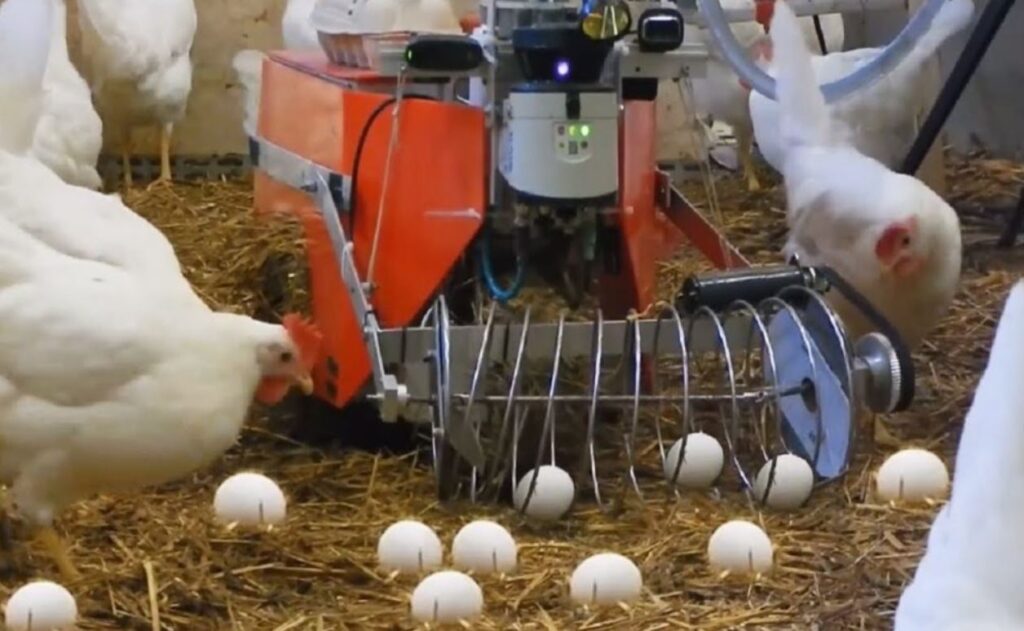
The much-cited PoultryBot, developed by Vroegindeweij et al. (2018), navigated over 3,000 metres autonomously through a commercial house among live birds, but its actual collection performance was more sobering: only ~46% of eggs picked correctly, ~37% partially or incorrectly collected, and ~16% missed.
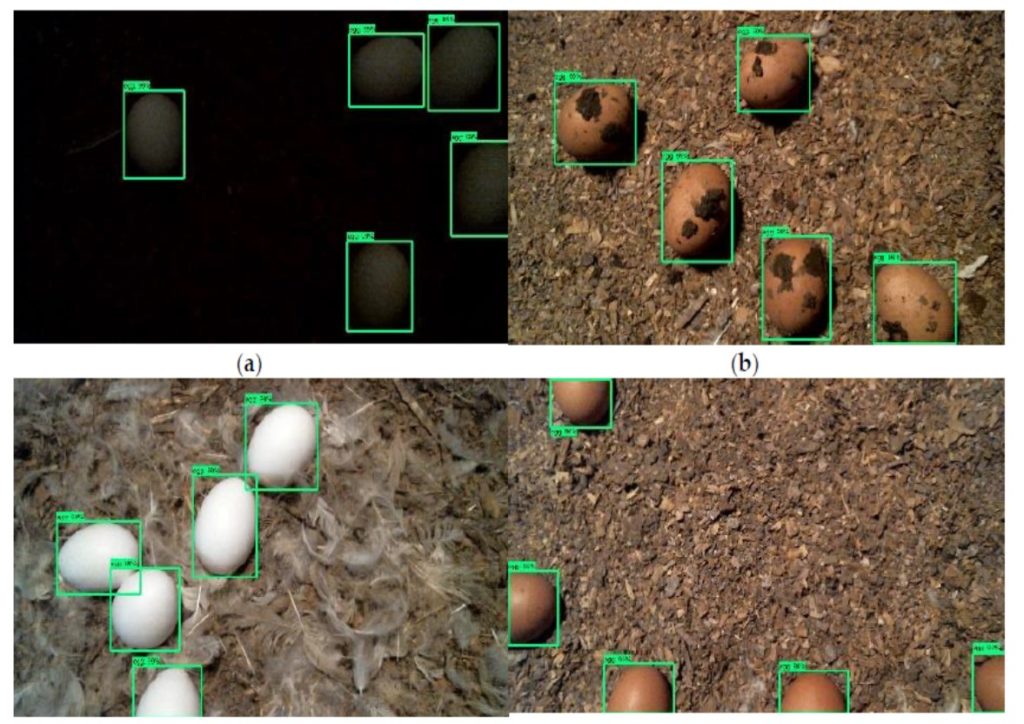
Chang et al. (2020) reported recognition accuracies of 94.7–97.6% on free-range farms.
More recently, Yang et al. (2025) deployed a quadruped ‘robot dog’ platform running YOLOv8 to detect floor eggs and dead chickens with around 90–91% precision.
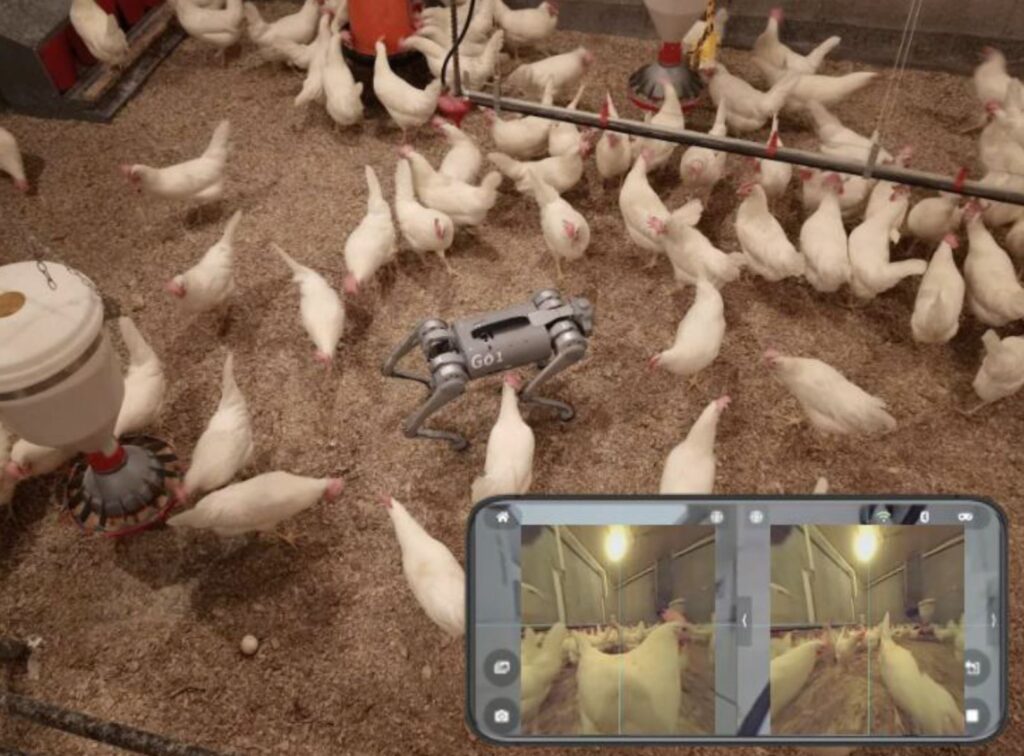
The collective signal is that detection is essentially solved; reliable, large-scale autonomous collection in real commercial conditions is not. That is the gap robotics suppliers, integrators and equipment manufacturers — including players covered regularly in our pages — are now competing to close.
Climate control: from fixed setpoints to predictive analytics
Traditional climate management still relies heavily on rule-based schedules and fixed setpoints. AI-driven systems combine ML models with real-time sensor streams to actively forecast deviations and adjust ventilation, heating, cooling, humidification, lighting and feeding before bird comfort is compromised. The review cites Chaganti et al. (2022), whose neural-network ensemble models achieved R² values of 0.999 for heating and 0.997 for cooling load prediction — accuracy levels that, in principle, allow evaporative cooling and airflow systems to anticipate, rather than react to, heat-load events.
Smart lighting tuned to growth stage, circadian rhythm and activity levels is reported to improve feed intake, reduce aggression and enhance reproductive performance in layers (Astill et al., 2020). On the feeding side, predictive models combining body weight, feed intake and metabolic data — already validated in adjacent species — open the door to truly precision feeding integrated with IoT-enabled feeders (Durand et al., 2023; Zuidhof et al., 2017).
The hard part: data, ethics, adoption
The review is unusually honest in cataloguing what is not yet working. Three barriers stand out.
Data availability and quality
Most published PPF datasets are small, fragmented, and collected under specific experimental conditions. Sensor data is heterogeneous, formats inconsistent, values frequently missing. Standardisation and interoperability between platforms remain weak. Proprietary ownership and privacy concerns constrain cross-industry collaboration. Without robust, open, multi-farm and multi-breed datasets, model generalisability — and therefore commercial reliability — will continue to fall short.
Ethics and the risk of depersonalised animal care
The paper notes a counterintuitive risk: over-reliance on automation can distance farm managers from direct interaction with their birds, potentially reducing empathy and missing subtle signs of distress that no sensor will catch. Surveillance-based systems also raise privacy and public-acceptability concerns, and behavioural-manipulation tools (automated lighting, sound stimuli) must be carefully evaluated to avoid compromising natural behaviour and psychological well-being (Croney and Anthony, 2010; Papakonstantinou et al., 2024).
“Over-reliance on automation can distance farm managers from their birds. The most promising AI deployments will be those that augment, not replace, the veterinarian-stockperson relationship.”
Technical and adoption barriers
Many farms — particularly in rural or resource-limited settings — lack the connectivity, low-latency networks and scalable cloud infrastructure required for continuous AI-driven operations. Edge computing partially addresses the connectivity problem but is itself expensive to deploy at scale. Deep-learning models remain largely ‘black boxes’, with limited interpretability, which hampers trust in high-stakes decisions such as ventilation control or disease triage. And generalisation across breeds, housing systems and seasonal conditions still requires local calibration that is, in commercial terms, non-trivial.
The “take home message” at a glance
| Title | Artificial intelligence in precision poultry farming: opportunities, challenges, and future features |
| Authors | Bidur Paneru, Anjan Dhungana, Samin Dahal, Lilong Chai |
| Affiliation | Department of Poultry Science, College of Agricultural and Environmental Sciences, University of Georgia (USA) |
| Journal | Animal Frontiers, Vol. 16, No. 2 — April 2026 |
| Type | Feature article (EAAP-invited submission) |
| DOI | 10.1093/af/vfag004 |
| Funding | USDA-NIFA AFRI (2023-68008-39853), Georgia Research Alliance, UGA Institute for Integrative Precision Agriculture |
| Key technologies covered | AI, ML, DL, computer vision (YOLO family, SAM), IoT, edge computing, robotics, NLP, bioacoustics |
| Main application areas | Behaviour and welfare monitoring; individual-bird tracking; disease prediction; vocalisation analysis; robotic egg collection; predictive climate control |
| Headline finding | AI is technologically ready across most PPF use cases; the binding constraints are data quality and standardisation, ethical design, and farm-level adoption — not algorithmic performance. |
The roadmap ahead: what serious AI in poultry will look like
The Georgia team identifies three priorities for the next research cycle. First, the creation of standardised, open, interoperable datasets covering multiple farms, breeds and environments, with shared annotation protocols and privacy-preserving sharing frameworks. Second, welfare-centred AI design — longitudinal studies on how continuous monitoring and automated decision-making actually affect bird stress, abnormal behaviours and farm-worker engagement, plus transparent audit tools that allow stakeholders to interrogate AI-driven recommendations. Third, structured cost-benefit analyses across different farm sizes, production systems and regions, so that adoption decisions can be made on commercial evidence rather than vendor narratives.
Put differently: the next phase of PPF will be judged less on detection accuracy in lab conditions and more on whether models hold up across the messy diversity of real commercial operations — and on whether the gains in efficiency genuinely translate into better welfare, healthier flocks and resilient, traceable supply chains.
For poultry veterinarians, poultry farmers, poultry decission makers, integrators and equipment suppliers, this “state of the art” artificial intelligence use in poultry review is more useful as an operational checklist than as a research paper. Several practical conclusions follow.
AI-driven behaviour and vocalisation monitoring is mature enough to deliver real welfare and productivity gains, particularly in cage-free layer systems and large broiler operations. Disease-detection pipelines are credible at the prototype stage and are likely to reach commercial deployment within the next 2–3 years, especially for respiratory diseases where acoustic signatures are well characterised. Robotic floor-egg collection is technologically close but operationally not yet bankable at scale. Predictive climate control offers the most immediate and least disputed return on investment. And, perhaps most importantly, bioacoustics is the underexploited horizontal capability: cheap to deploy, non-invasive, applicable from the hatchery to the processing plant — and a natural fit for a sector facing endemic avian influenza pressure and increasingly demanding welfare standards.
Federico Castelló
Founder at NeXusPoultry.com
Primary source :
-. Paneru, B., Dhungana, A., Dahal, S., & Chai, L. (2026). Artificial intelligence in precision poultry farming: opportunities, challenges, and future features. Animal Frontiers, 16(2), 41–50.
Published by Oxford University Press on behalf of the American Society of Animal Science. Open Access under Creative Commons CC BY-NC 4.0. Manuscript invited by the EAAP (European Federation of Animal Science). Sponsored by USDA-NIFA AFRI (2023-68008-39853), Georgia Research Alliance, and the University of Georgia’s Institute for Integrative Precision Agriculture.
To know more:
-. Artificial Intelligence applied to poultry