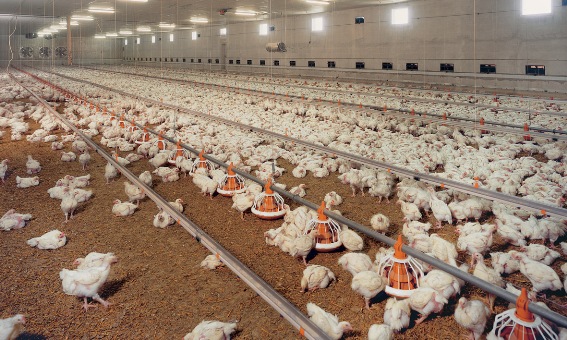


The Maïsadour Cooperative will finance the construction of new poultry farms with €7.5 million. The funds will come from this private company’s own resources and will cover up to 40% of the investment.

Demand for poultry meat has increased, but new poultry farmers are lacking, more farms are needed, and generational succession must be secured
To revive poultry production and meet consumer demand, the French cooperative Maïsadour is launching an unprecedented financial support plan. By subsidising the construction of poultry houses, it hopes to attract new poultry farmers.
For a long time, broiler growers — the driving force behind farms in the Landes — have been facing difficulties. Between avian influenza outbreaks that have discouraged some producers and weakened local brands in supermarkets, an ageing producer demographic that is failing to rejuvenate, and post-COVID inflation that has pushed facility costs up by more than 50%, production capacity has declined significantly in south-west France.
At the same time, poultry consumption is rising: more than 10% in 2024. Yet it is not French poultry farmers who are benefiting, as half of the volume consumed in France now comes from imports.
To regain market share, all poultry groups in south-west France have announced recovery plans. The Maïsadour cooperative presented its own on 19 June, before around 200 people gathered at the farm of Bernard and Thibaut Tauzia in Campagne, announcing a budget of €7.5 million in subsidies for the construction of new poultry farms.

Patrick Faget, Director of the Livestock Division: “This plan reflects our commitment to acting concretely and immediately to support our farmers, while building a long-term vision for the supply chain. It is a real lever for reviving investment in our regions and ensuring lasting food sovereignty, in line with consumer expectations.“

Background and objectives
In autumn 2024, the Maïsadour cooperative’s Board approved an initial plan to improve farmer remuneration, particularly in the production of IGP Landes chicken raised in “cabanes” (free-range shelters). This plan included additional premiums aimed at meeting supply chain targets and securing the volumes required by the slaughterhouses.
In 2025, Maïsadour is continuing its commitment to the poultry sector by launching a new development plan. The cooperative aims to accelerate the creation of poultry facilities by offering direct grants for the installation of all types of buildings (a standard poultry house of 1,350 m², a free-range house of 400 m², and a shelter or “cabane” for total freedom meat bird rearing), relying on its subsidiary Elevage Service for the construction of these new buildings. This programme is intended to meet the immediate production needs of the Fermiers du Sud-Ouest processing sites (Maïsadour’s poultry division).

Without local poultry farmers, the entire poultry supply chain falters
“The sector is at risk in the region,” explains Michaël Dolet-Fayet, President of Maïsadour’s poultry division and of Fermiers du Sud-Ouest (FSO). We need volumes quickly to allow our facilities to return to their normal profitability. Over the years the industry has been structured to integrate all links in the chain, from egg to plate. When production falters, the entire supply chain is affected, from the breeding centre to the poultry farmers and feed manufacturers. To name but a few, FSO’s five slaughterhouses employ 772 people. A breakdown in the production chain would have dramatic consequences for employment.
This (private) support from the Cooperative is additional to other (public) aid that future new poultry farmers may receive
With grants of up to 40% of the investment, Maïsadour intends to build 215 new meat poultry farms broken down as follows:
-. 150 farms for total freedom rearing (cabanes pour de l’élevage en totale liberté)
-. 50 free-range units (bâtiments plein air) and
-. 15 standard broiler farms by 2029. The remaining investment required to set up the farm could also be reduced for new poultry farmers, since this private cooperative subsidy can be combined with other public support measures, such as PCAE (*) grants, young farmer grants, or additional financing through on-farm photovoltaic installations.
(*) Plan de Compétitivité et d’Adaptation des Exploitations Agricoles, funded by Europe, the Ministry of Agriculture and the Region
Alexandre Lafaille, Head of Poultry Production Development: “Today we are in a position to support the establishment of new farmers under very favourable conditions. This is a genuine opportunity for young people looking to set up or diversify their operation. The cooperative model offers long-term vision, a network, and guaranteed commercial outlets.“

The subsidy also covers new poultry farmers who opt for large-scale complexes to produce standard broilers.
Beyond the size of the financial package, what is unprecedented in Maïsadour’s announcement is the development of standard broiler production. In the homeland of premium poultry — which launched France’s first Label Rouge in 1965 — the rearing of “everyday chicken” has long been overlooked. Yet it is clear that consumption growth is being driven primarily by demand for standard broilers, which are far cheaper than their labelled counterparts. To remain competitive, the cooperative has no choice but to diversify.
“The three rearing models are complementary and make it possible to meet consumer expectations,” says Christophe Bonno, Managing Director of Maïsadour. “Free-range rearing in total freedom shelters with an IGP Landes chicken delivers an iconic product acclaimed in France and abroad. Free-range rearing in 400 m² buildings, under Label Rouge and IGP Landes and Périgord designations, reconciles animal welfare with quality production. As for standard everyday broiler rearing, in a 1,350 m² house, it meets consumer expectations at an affordable price.”

The broiler sector is putting up money and expertise. Now all that remains is for the bureaucracy to cut its processing times.
But what seems straightforward on paper is far less so in practice. Despite the support offered by Maïsadour — which, in addition to financial assistance, supports project leaders at every stage (design, file preparation, regulatory procedures, production start-up and securing commercial outlets) — new poultry farmers, or existing ones wishing to expand, still face major obstacles. Delays in the processing of building permits and the complexity of the required declarations are hampering the progress of many projects. The average time to complete a 400 m² free-range house or a standard unit can be as long as 18 months.
“There is an urgent need to adapt measures to allow projects to succeed,” insists Daniel Peyraube, President of Maïsadour. “We will only succeed if everyone plays their part. The State, local authorities, banks, technical partners, manufacturers, cooperatives and consumers all have a role to play. Reviving the poultry sector is a collective issue of food sovereignty, territorial development and farm income. Only together can we move forward.”
Michaël Dolet-Fayet, President of Maïsadour’s Poultry Division and Fermiers du Sud-Ouest: “Raising poultry is not merely a livestock activity: it is a profession of passion, rigour and tradition. Our poultry farmers have developed over decades a unique expertise, with exemplary rearing conditions and small free-range shelters found nowhere else in the world.“
Financial support and facilities
Maïsadour offers a package of measures to support farmers who are setting up or diversifying:
- Fixed installation grant, paid from the construction phase of the building.
- Price supplement throughout the entire amortisation period, to ensure stable income.
- Personalised support from cooperative technicians (design, administrative procedures, start-up, technical monitoring).
- Secure contracts with guaranteed commercial outlets through Fermiers du Sud-Ouest.
- Focus on facilitating farm succession, with structured pathways for young farmers and support for those wishing to transfer their holdings.
Summary of the plan envisaged for 2029
Maïsadour is reinforcing its AMBiTiON 2030 strategy by focusing on three rearing systems:
- “Total Freedom” shelters: the renowned IGP Landes chicken, an iconic and exportable production system.
- Free-range rearing (Label Rouge): quality and animal welfare.
- Standard production: to meet volume markets, as broiler chicken remains the most in-demand product.
In addition, they are streamlining administrative procedures (such as advance planning permits), working with financial institutions, and securing offtake through a robust integration contract.
| Rearing system | Number of farms required | Additional poultry places to be created: | i.e. |
| Total freedom rearing (Élevage liberté) | 150 new shelters | 450,000 | 12 shelters per farmer |
| Standard rearing (broiler chicken) | 15 new broiler meat complexes by 2029 | 3 million | 200,000 standard broilers per new broiler farmer |
| Free-range rearing (Élevage plein-air) | 50 new farms | 700,000 | 3 free-range houses per farm and per farmer |
A model for other European broiler integrators to follow in order to secure their local supply chain?
Maïsadour is presenting a comprehensive and ambitious plan to revitalise poultry production in the region: from grants and technical support to guaranteed contracts and an emphasis on generational continuity. The objective is to strengthen food sovereignty, improve farmer profitability and respond to consumer expectations regarding quality and animal welfare.
According to Agrodistribution, Maïsadour expects to increase its poultry production by 25%, rising from 15 million birds (today) to 19 million by 2029. This increase will be concentrated mainly in standard production, alongside the “Total Freedom” and free-range rearing operations.
For further information:
-. Une mobilisation collective pour l’avenir de la filière volailles. Face à une consommation de volailles en forte croissance et à une production nationale en recul, le Groupe Coopératif Maïsadour déploie un plan de relance inédit pour soutenir la filière volaille, les éleveurs et renforcer la souveraineté alimentaire française.