

Food prices have undergone a significant slowdown, reaching in September 2024 a year-on-year increase of 1.8%, the lowest since October 2021, according to Spain’s INE (National Statistics Institute). This decline in food inflation represents a relief for producers, including poultry farmers, who have faced a prolonged cycle of rising input costs that affected both production and the end consumer.
The seven-tenths-of-a-point reduction in food prices has been driven, in part, by falling petrol prices and stability in electricity costs. Although overall prices moderated by 1.5%, food products continue to play a key role, particularly for the livestock sector, where input costs are decisive for profitability.
So far in 2024, the food sector has seen a gradual slowdown in prices, after having reached a peak of 16.6% in February 2023. For livestock producers, this respite in production costs, although not uniform across all products, is a positive signal. However, significant increases in certain key inputs persist. For example, olive oil still shows a year-on-year increase of 10.3%, although it has been declining after having reached a 70% rise in March.
On the other hand, products such as ovine and caprine meat have seen increases of 11.2%, reflecting how certain livestock sub-sectors are still facing pressures. In addition, other products such as cocoa and powdered chocolate, relevant to specialised food production segments, have risen by 12%.
Although the general trend points towards a slowdown in prices, forecasts indicate a slight uptick in October due to the reintroduction of VAT on basic foodstuffs, such as eggs. This measure could once again impact production costs in the livestock sector, particularly for those producers who, through large retail chains, are unable or unwilling to pass this higher VAT on to the final retail price.
This improves an outlook that was “complicated” for poultry farmers at the start of 2024 and that some forecast as “almost apocalyptic” at the outset of the Russian invasion of Ukraine. Furthermore, some moderation and even slight reductions in feed raw material costs are also anticipated towards the end of 2024. Planning and efficient resource management will continue to be essential to address the challenges that remain.
For further information: Consumer Price Index (CPI). September 2024
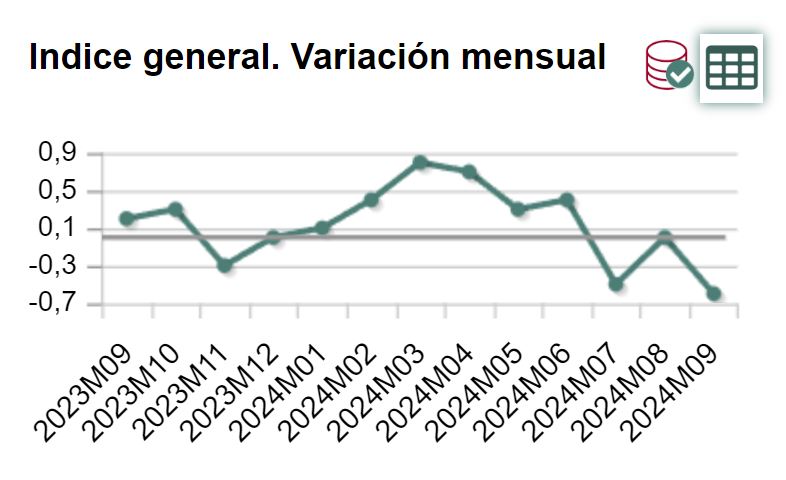
The annual rate of change of the CPI for September stood at 1.5%, eight tenths of a point below that recorded in August. The annual rate of underlying inflation fell by three tenths of a point, to 2.4%. The monthly change in the general index was -0.6%.