
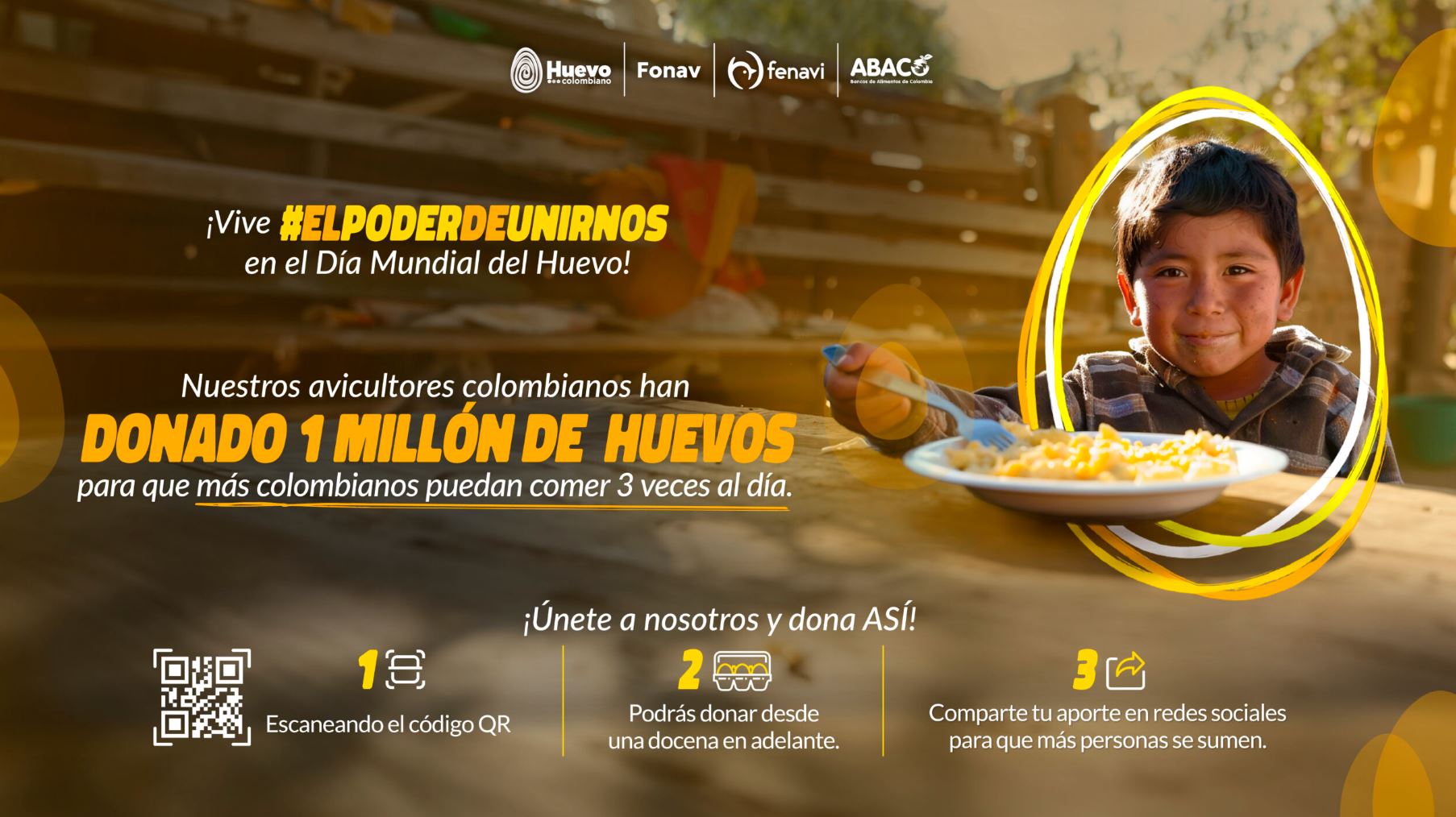
On the occasion of World Egg Day 2024, on 12 October, Colombian poultry farmers donated one million eggs through food banks to help nourish vulnerable populations.
The food was delivered to low-income families as part of a solidarity effort, through the Association of Food Banks (ABACO).
According to the industry association (Fenavi), World Egg Day is not only a celebration of this essential food, but also an opportunity to highlight its fundamental role in nutrition and “is an invitation to unite as a country in the fight against food insecurity”.
The aim is to join forces to combat hunger and food insecurity and, to this end, poultry farmers, together with Fenavi, have donated one million eggs to be distributed to Colombian families with limited financial resources. This campaign by Fenavi’s Egg Programme aims to mobilise all Colombians in a collective action to donate and make a difference in the lives of millions of vulnerable people.
The executive president of Fenavi, Gonzalo Moreno, stated that “we want to transform ‘individual’ power into ‘collective’ power, benefiting the most vulnerable, driven by the solidarity of Colombians. By improving people’s nutrition, we nourish Colombia’s potential. We know that the egg empowers, but when we unite, that power multiplies and reaches those who need it most”.
For his part, Juan Carlos Buitrago, director of the Colombian Food Bank network, highlighted the importance of the “The Power of Coming Together” campaign in light of the alarming figures on hunger and food insecurity in the country.
Currently, 392,000 children suffer from chronic malnutrition, an irreversible condition that affects their physical and cognitive development. Furthermore, according to ABACO’s research group, the country has 5,129,574 people who suffered chronic malnutrition in early childhood and today bear its consequences: they are less intelligent and poorer as a result of hunger. So far in 2024, 171 children under the age of five have died from causes associated with malnutrition. These figures underscore the urgency of joining forces to combat malnutrition and ensure a healthier future for coming generations.
Celebration
World Egg Day was founded in Vienna in 1996, when it was decided to celebrate the value and benefits of egg consumption, observed on the second Friday of October. Its aim is to promote the consumption of eggs, a nutritious and affordable food that can form part of a healthy and balanced diet as a source of protein, vitamins and minerals, as well as for its versatility, as it can be prepared in many different ways. In Colombia, the goal of the 2024 celebration is to join forces to combat hunger and food insecurity through a key tool such as the egg, to fight chronic malnutrition, being a nutritious, affordable and easy-to-prepare food.
Egg consumption in Colombia has increased steadily in recent years, and in 2023 it stood at 323 units per capita, significantly higher than the 228 units recorded ten years ago. This growth reflects an ongoing commitment to the nutrition of the population.