
The animal welfare entity self-styled Observatorio de Bienestar Animal (OBA), formerly known as Equalia, has accused LIDL, stating that more than 71% of chicken samples from the Lidl supermarket chain contain antibiotic-resistant bacteria, following analysis of trays from establishments in Spain, Germany, Italy, Poland and Great Britain.
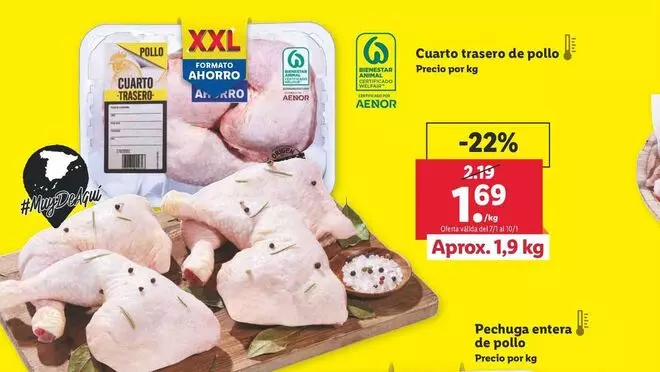
A total of 17 of the 24 Spanish samples, purchased in Valencia, Barcelona and Madrid, were contaminated. The products were chicken leg quarters, chicken breast, chicken drumsticks, split chicken wings without tips, and whole chicken carcass.
Furthermore, according to OBA, 38% of the samples analysed tested positive for listeria and 83% for diarrhoeal pathogens such as E. coli and Campylobacter. According to OBA, the alert has been brought to the attention of the Ministries of Consumer Affairs and Agriculture.
Although Lidl has denied these accusations, many consumers of this product are asking themselves what truth there may be in them.
To address this, Miguel Ángel Lurueña, Doctor in Food Science and Technology, has published an explanation on the social media platform ‘X’ @gominolasdpetro (formerly known as Twitter).
Lurueña begins by providing information about the study from which the conclusions were drawn, noting that it was carried out by OBA, which conducted microbiological analyses on chicken samples from various Lidl stores in different European countries. “In the case of Spain, 24 samples were studied, purchased from this chain’s supermarkets in Madrid, Valencia and Barcelona, of which 17, that is, 71%, were contaminated with pathogenic bacteria such as Campylobacter or E. coli.”
The expert explains that, whether or not the information is accurate, what must be taken into account is that “it is not uncommon for chicken meat to be contaminated with bacteria such as Campylobacter. This is not a matter concerning one company, but rather the entire food chain,” he says, adding that “among the pathogenic bacteria that can be found in chicken, some are resistant to antibiotics.”
He also recalls that antibiotic use has been more tightly regulated in recent years and that efforts are currently being made to tackle this problem, which causes the deaths of thousands of people every year, because when people fall ill through exposure to these bacteria, they develop infections that do not respond to antibiotic treatments,” Miguel Ángel explains.
Finally, Miguel Ángel sets out some of the recommendations to bear in mind when handling food in order to avoid all these problems:
- “Wash hands and utensils thoroughly, before and after handling raw chicken. Do NOT wash the chicken.”
- “Keep raw chicken separate from ready-to-eat foods (and dirty utensils away from clean ones).”
- “Cook thoroughly until well done (and reheat leftovers properly).”
- “Refrigerate raw chicken (and leftovers). Freezing does NOT eliminate bacteria.”
- “Observe use-by dates and discard if not in good condition.”
LIDL’S RESPONSE TO THESE ACCUSATIONS
Lidl, in response to this study, has issued a statement asserting that “ensuring the quality of our products is a priority for Lidl, extending this to our own processes to guarantee that products are maintained in the best possible condition from the supplier through to the end customer.”
The chain states that it carries out “exhaustive quality controls throughout the entire supply chain through independent and accredited bodies. In fact, such is our priority that our purchasing policy (including that for meat products) sets more stringent limits than the legal requirements themselves.”
Accordingly, it considers that “the bacteria that fresh chicken meat may contain are not a consequence of the rearing methods of our suppliers in particular, but rather represent a general challenge for the entire poultry meat industry. Furthermore, on all our packaging we always transparently specify that the product must be thoroughly cooked before consumption and that hygiene standards must be observed during the process.”
Lidl adds that all its suppliers hold internationally recognised certification credentials, such as International Food Standard (IFS) or British Retail Consortium (BRC), which certify the highest quality standards, and food safety in particular. Furthermore, “both authorities and health services also carry out checks on all our suppliers and on the poultry meat we sell in our stores,” it emphasises.
Regarding the Observatorio de Bienestar Animal study, Lidl states that “this is not the first time this organisation has levelled an accusation through the media without first verifying its information with us.” “In fact, its last two complaints proved to be false, and on this occasion, we hold analytical certificates — carried out by Lidl and our suppliers through accredited laboratories — that categorically contradict the information in their study.”
The supermarket chain points out that this analysis forms part of a campaign that “seeks to discredit our company’s image with false and/or unverified information. All the more so given that the products supposedly analysed in this study are produced by suppliers who supply chicken meat to the vast majority of Spanish retail chains.”
Lidl states that it reserves the right to take legal action against this association in defence of its honour and reputation. “For some time now, this entity has been waging a campaign against Lidl with the sole objective of pressuring us to join the European Chicken Commitment (ECC). As a company that leads by example in animal welfare, both in Spain and across Europe, we support all initiatives in favour of this cause, including the objectives championed by the ECC — which we share and are already working towards — however, we can only commit to those measures that we are confident we can realistically fulfil, both in terms of implementation and timescales, in each of our markets,” it adds.
The company states that “in order to fully meet the requirements of the European Chicken Commitment by 2026, a broad alliance across the entire chain is needed, encompassing the retail sector, producers, the poultry industry and NGOs, among others. This has been communicated by the Lidl group to the international representatives of the European Chicken Commitment (Open Wing Alliance), with whom several conversations have been held over the course of these months.”