
Poultry Nutrition · Gut Health · 114th PSA Congress
The 114th Annual Meeting of the Poultry Science Association brought together five presentations to reopen an old question: is dietary fiber simply feed filler, or a functional component that poultry science still doesn’t know how to measure—or formulate with—precisely?
Scientific analysis · NeXusPoultry 114th PSA Annual Meeting · Raleigh, North Carolina (USA) ·
An Old Suspicion in a New Light
The title of this session already posed the provocation: «A new focus on fiber in poultry: Is it a nutrient or antinutrient?». Throughout five presentations, specialists from industry and academia agreed on an uncomfortable starting point: for a long time fiber was considered an antinutritional factor—due to its limited digestibility and its capacity to hinder nutrient absorption—but recent research recognizes that it provides functional benefits. The condition for harnessing them, the speakers warned, is twofold: knowing how to measure fiber and formulating with it precisely.
From Antinutritional Factor to Functional Component
This paradigm shift is the common thread of the symposium. Caitlin Evans and Tara York (AB Vista) recalled that fiber, once viewed only as a hindrance, is now recognized for concrete functional benefits: better intestinal integrity, greater digestive health, and superior digestive efficiency.
Amy Petry (University of Missouri) and Natalie Morgan (Curtin University, Australia) went further by pointing out an inconsistency in current practice: in monogastric diet formulation, dietary fiber is not adequately accounted for, because historically only its antinutritional effects were considered, and inaccurate fiber values are still being used. And yet, recent research has demonstrated advantageous effects of fiber on feed digestion, health, and behavior. The paradox, they acknowledged, is that fiber remains one of the most difficult nutritional components to define, analyze, and apply effectively.
Carrie L. Walk (AB Vista) provided the necessary counterpoint: the beneficial effects of fiber are not unequivocal. Fiber also behaves as an antinutrient, with impacts on digesta viscosity, nutrient entrapment—which reduces digestibility—and dilution of the diet’s nutrient density. Much of the confusion, she noted, stems from the very complexity of fiber and the lack of precision in using the term «dietary fiber».
For decades fiber was treated as feed filler. Poultry science now reclaims it as a functional component… provided we know how to measure it and formulate with it.

The Problem Starts in the Lab: Why Fiber Is Poorly Measured
To make the most of fiber, Evans and York insisted, it must first be properly characterized in ingredients, and that’s where the first obstacle appears. Poultry diets are based mainly on grains and plant-based ingredients, each with diverse fiber fractions, making it increasingly important to distinguish and measure those fractions.
The traditional method, crude fiber (CF), quantifies the insoluble components —cellulose and lignin— but does not account for hemicellulose or soluble fiber, which can lead to underestimating the total fiber content. Neutral detergent fiber (NDF) and acid detergent fiber (ADF) offer a more detailed assessment: NDF measures the total cell wall fraction (cellulose, hemicellulose, and lignin) and ADF captures only cellulose and lignin. But both, while better describing structural fiber, fail to capture the soluble fiber components, which are precisely the ones most likely to influence digestion in poultry.
The most comprehensive alternative is total dietary fiber (TDF), which encompasses both the insoluble fraction (cellulose, hemicellulose, and lignin) and the soluble fraction (pectins, β-glucans, and oligosaccharides). This broader classification offers a much greater insight into the effects of fiber on gut health, fermentation, and nutrient absorption. The trade-off is practical: as the analysis becomes more comprehensive, costs and time also increase.
Walk completed the terminological map: as analytical techniques improve, so does our understanding of fiber and the major components described under that term —total, soluble, and insoluble non-starch polysaccharides (NSP), and lignin— and of their concentration in grains, protein meals, and by-product meals used in animal feed.
If only crude fiber is measured, the total is underestimated: hemicellulose and soluble fiber —the fraction most relevant to digestion in poultry— are left out of the calculation.

Insoluble versus soluble: two fibers, two behaviors
The distinction between insoluble and soluble fiber is not trivial: each behaves differently in the digestive tract. According to Petry and Morgan, insoluble fiber can act as a nutrient diluent and as a physical barrier to enzymes, but it also maintains gastrointestinal motility and digesta flow, and stimulates gizzard and proventriculus function in poultry.
Its effects go beyond digestion. Feeding insoluble fiber has been shown to reduce feather pecking and cannibalism in laying hens, induce satiety in broiler breeders under feed restriction, and improve nutrient digestibility and performance in broilers.
Soluble fiber, on the other hand, has a high water-holding capacity and, in excess, increases digesta viscosity; but it can also be fermented by beneficial microbiota, producing valuable short-chain fatty acids (SCFAs) and improving microbiota composition. Walk summarized the balance: beneficial effects of fiber have been observed on microbial fermentation, gizzard function, intestinal morphometry, immune function, satiety, and behavior in laying hens, breeders, and broilers.

From pigs to poultry: a lesson with nuances
The title of Petry and Morgan’s presentation —«From pigs to poultry»— sums up one of the most compelling ideas of the symposium: what has been learned in swine can guide poultry production. Their research in pigs underscores the importance of understanding the type of fiber, its origin, and the context, and of adjusting it to the animal’s physiological stage and production environment; poultry nutritionists could leverage these ideas to advance the use and study of fiber in favor of productivity, animal welfare, and sustainability.
In pigs, the inclusion of fermentable fiber sources has been shown to increase satiety, improve insulin sensitivity, reduce mortality associated with lameness in sows housed in pens, and decrease negative hunger-related behaviors during gestation. Increasing fiber intake has also been shown to relieve constipation, shorten the duration of farrowing, reduce stillbirths and pre-weaning mortality in the peripartum period, and increase milk production during lactation. Similarly, both in layers and broilers, an improvement in performance has been observed when supplementing low-fiber diets with fermentable fiber, attributed to modulation of the gut microbiota.
But the presenters avoided easy enthusiasm: fiber is not universally beneficial. Recent studies in the United States indicated that including fiber-rich ingredients in transition piglet diets under enteric disease pressure did not consistently improve performance, fecal scores, or gut health. Similarly, a recent review of broiler breeder responses to fiber revealed variable responses, with cases of worse performance or no response at all when feeding fiber-rich diets. The conclusion, for Petry and Morgan, is that a cross-species approach is needed to better understand and optimize the use of fiber in monogastric diets.
Fiber is not universally beneficial: under enteric pressure, fiber-rich diets produced variable responses—and, in some cases, worse performance.
Fiber and microbiome: between promise and «hype»
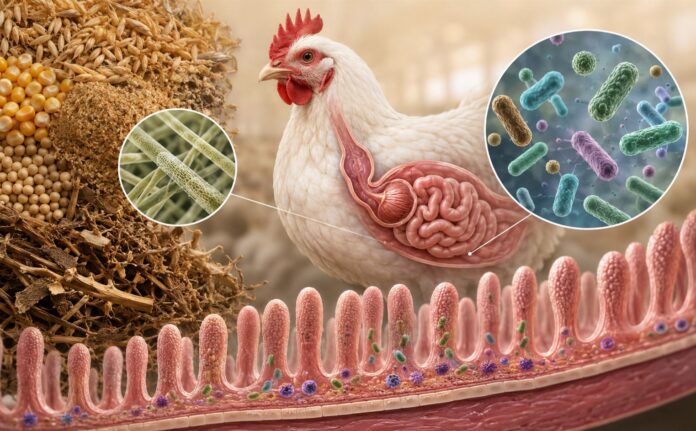
If there is one aspect that currently concentrates expectations about fiber, it is its ability to modulate the microbiome. Tim Johnson (University of Minnesota) addressed the topic head-on—his presentation was literally titled «What’s all the hype?»—and combined enthusiasm with caution. He reminded the audience that efficient animal production depends on the overall maintenance of health and a balanced gastrointestinal tract, and that this balance rests on a healthy microflora. More than 1,000 bacterial species coexist in the gut of production animals, naturally balanced under normal conditions; however, in modern production, the establishment of a healthy microbiome is often hindered by confinement and by the lack of beneficial microbes that are naturally present during development. Hence the frequent use of additives to promote their establishment.
The fibers used in animal production comprise diverse combinations of monosaccharides that form oligosaccharides, designed to feed specific microbes capable of breaking down these sugars. The idea is to develop fibers that promote the expansion of specific groups of beneficial bacteria, which favors the competitive exclusion of potential pathogens; at the same time, these bacteria stimulate the immune system and produce byproducts such as short-chain fatty acids, which the host uses and which accelerate energy utilization. There are even indications that these interactions could influence the gut-brain axis and have physiological effects.
Here, however, Johnson marked the limits of current knowledge. It is generally assumed that dietary fibers and other prebiotics favor the establishment of beneficial bacteria such as Lactobacillus and bifidobacteria, and there is evidence supporting that theory; but there is less evidence about the side effects of fibers on the microbiome.
Distinguishing between truly commensal and beneficial bacteria and those opportunistic ones that can worsen disease problems is complicated: Escherichia coli, he recalled, comes in many forms, from beneficial to lethal. There is little or no evidence at the bacterial strain level regarding the specificity of dietary fibers, and in general, these should not be specific to particular strains within the same species.
His conclusion was a call for research: more high-resolution microbiome studies are needed —including functional ones— and platforms that allow evaluating multiple products in different combinations are urgently required. The potential of using fibers to modulate the microbiome is immense, he stated, but the current landscape of peer-reviewed publications hinders the true dissemination of knowledge in this field.

Measuring intestinal integrity: from invasive method to biomarker
If fiber acts on gut health, the inevitable question is how to measure that health. Michael Kogut (USDA-ARS) focused his presentation on intestinal integrity or, more precisely, on intestinal homeostasis: the state in which the host’s physiological functions operate normally. This homeostasis is maintained by the intestinal ecosystem —the elements of the gut itself and its interactions with the microbiota— and requires barrier and regulation mechanisms, given the enormous number of immune cells that coexist with trillions of beneficial commensal microorganisms.
The central role falls on intestinal epithelial cells (IECs), which physically segregate commensal bacteria and integrate microbial signals, and which form a physical and biochemical barrier against commensal and pathogenic microorganisms. Intestinal integrity depends on this barrier function; but numerous environmental, infectious, and non-infectious stress factors can break down these barriers and compromise it.

The good news, according to Kogut, is methodological. Over the past decade, the assessment of intestinal permeability has evolved from invasive techniques toward non-invasive biomarkers, with a particular effort to identify reliable markers capable of evaluating that permeability in blood and feces —among the descriptors of his work is calprotectin—. The pending issue: there is still no consensus on which are the best analysis methods or on their accuracy.
Connecting the dots: NIR, enzymes, and precision formulation
Carrie Walk was responsible for bringing the pieces together. She began with a historical note: dietary fiber was first described in 1953, in relation to toxemia of pregnancy in women between 1940 and 1950. Interestingly, today we continue to find connections between fiber and reproductive performance: in sows, for example, fiber has been linked to satiety, insulin sensitivity, reduced constipation and farrowing duration, and improved milk production during lactation.
The real leap, however, is instrumental. Both Evans and York, as well as Walk, pointed to near-infrared spectroscopy (NIR/NIRS) as a fast and economical alternative to traditional wet chemistry for characterizing fiber. Walk was specific: using an accurate, reliable, and cost-effective NIR to measure NSP and lignin content in ingredients would enable precise, real-time formulation, adjusting ingredient concentrations to provide beneficial fractions in the diet and, additionally, improving enzyme efficacy and usage recommendations.
The ultimate goal is a “made-to-order” fiber. Diets could be formulated by incorporating ingredients or additives with specific fractions of NSP or oligosaccharides to promote beneficial bacterial fermentation and gut function through short-chain fatty acids, and to minimize proteolytic fermentation and the growth of pathogenic bacteria. This would be complemented by non-invasive biomarkers, which could provide information on the effects of fiber fractions on gut integrity, nutrient utilization, and immune function and resilience, especially under enteric challenges such as coccidiosis, E. coli, and Clostridium perfringens.
Walk’s synthesis was also shared by the other fiber experts: as our ability to measure fiber and its fractions improves, so will our ability to harness its beneficial effects, mitigate the harmful ones—with optimal formulations, exogenous enzymes, and additives—and maintain gut homeostasis and function for optimal performance.
NIR could turn fiber into a made-to-order formulable ingredient: measuring NSP and lignin in real time to boost beneficial fermentation and curb pathogen growth.
Nutrient or antinutrient? The answer lies in precision
The question in the title did not receive a resounding YES or resounding NO answer, and perhaps that is the answer. From the five presentations emerges a nuanced consensus: fiber is neither a simple nutrient nor a mere antinutrient, but both, depending on the type, origin, dose, and context. What determines which way the balance tips is, above all, the ability to measure it rigorously—from crude fiber to TDF and NSP, ideally via NIR—and to formulate accordingly, with enzymes, additives, and biomarkers.
The symposium left both certainties and homework. On one hand, a well-managed fiber strategy can improve feed efficiency, gut health, and the sustainability of poultry production. On the other, its benefits are not unequivocal, microbiome science still needs high-resolution functional studies, and the measurement of gut integrity still lacks consensus. Between promise and caution, fiber ceases to be a feed residue and becomes a demanding lever of precision poultry nutrition.
| Analysis methods cited | Crude fiber (CF); neutral detergent fiber (NDF); acid detergent fiber (ADF); total dietary fiber (TDF); non-starch polysaccharides (NSP) and lignin; near-infrared spectroscopy (NIR/NIRS). |
| Key concepts | Gut integrity and homeostasis; intestinal epithelial cells (IEC); short-chain fatty acids (SCFA); competitive exclusion; non-invasive biomarkers. |
Source:
Poultry Science Association. 114th PSA Annual Meeting Abstracts. Raleigh, North Carolina (USA), July 14–17, 2025. Presentation block: “A new focus on fiber in poultry: Is it a nutrient or antinutrient?”:
- 573S · Evans, C.; York, T. Maximizing the benefits of fiber in poultry nutrition: insights and ingredient evaluation. AB Vista.
- 574S · Petry, A.; Morgan, N. From pigs to poultry: The evolution of fiber in monogastric nutrition. University of Missouri; Curtin University.
- 575S · Johnson, T. Fiber and the microbiome: What’s all the hype? University of Minnesota.
- 576S · Kogut, M. Intestinal integrity and key biomarkers for performance. USDA-ARS.
- 577S · Walk, C. L. Fiber and performance: Connecting the dots for optimal performance. AB Vista.
To learn more:
-. Fiber in poultry farming
-. Poultry diets at NexusAvicultura