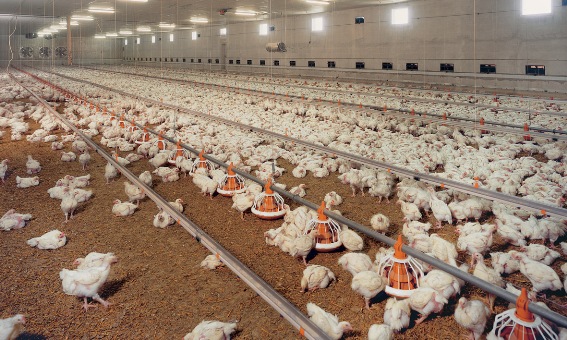

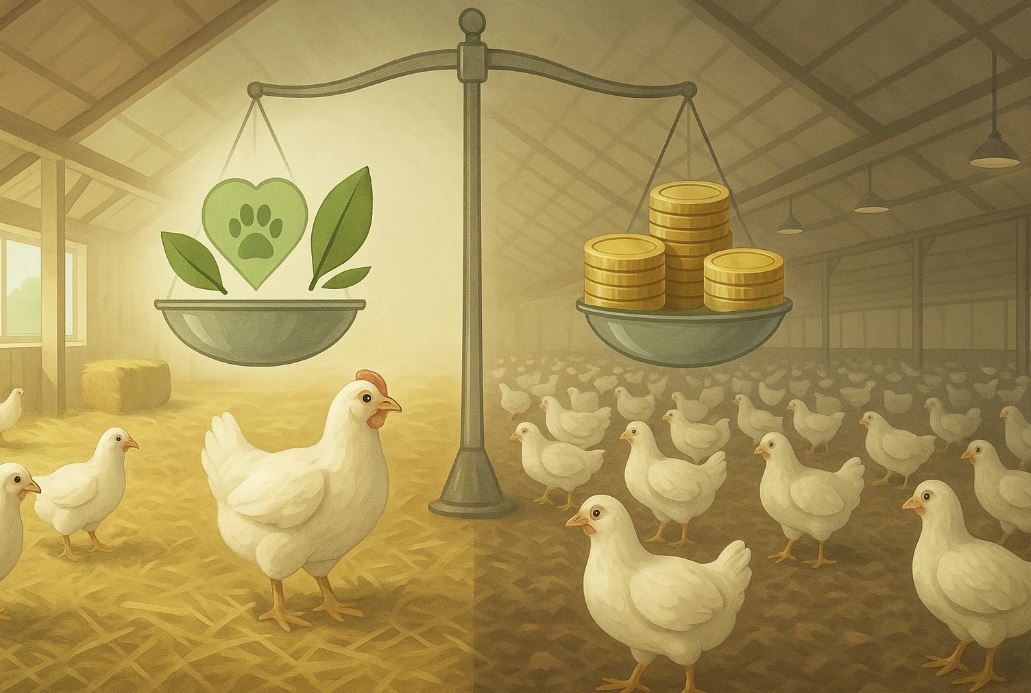
This May, Compassion in World Farming has published its SUSTAINABILITY REPORT for BROILER CHICKENS — the question is: who pays the enormous additional cost that full implementation would entail?
The animal welfare organisation CIWF (Compassion in World Farming) has just published, in May 2025, its “White Paper” on what it considers to be the ideal model of sustainability in broiler chicken production. This report describes a holistic approach to sustainable broiler production encompassing the CHICKENS themselves, the PLANET, and PEOPLE. It examines the potential impacts of transitioning to higher-welfare systems and the available mitigation strategies, as well as the benefits of these systems from the broader sustainability perspective.
What CIWF may have overlooked are the two most important dimensions of sustainability: business sustainability — farmers, integrators and retailers must make a living — and the sustainability of the consumer’s own wallet.

The difficult challenge of meeting the sustainability demands of animal welfare lobbies while maintaining a reasonable retail price for the end consumer
The European poultry industry faces a crossroads: the growing demand for sustainability from animal welfare organisations, which self-appoint themselves as representatives of consumers and pressure European regulators for full implementation. This pressure is in direct conflict with the complex reality of production costs. While there is a consensus on the need to move towards a model that is more respectful of animal welfare, the environment and people, the transition is not without significant economic challenges, which could have a direct impact on the final price of chicken and other poultry products for the consumer.
Sustainability in poultry production is a holistic concept that includes animal welfare as a fundamental pillar.
The recent report, “Sustainability of Broiler Production“, produced by Compassion in World Farming Food Business, breaks down the components of this equation. Sustainability, defined as a holistic concept encompassing environmental responsibility, economic viability and social equity, including animal welfare as a fundamental pillar, poses specific challenges for the sector. Although broiler production has a comparatively lower environmental footprint than other livestock sectors, this has often been achieved through an intensification that, in CIWF’s view, has compromised bird welfare.
Adopting the full requirements of the Better Chicken Commitment (BCC) may improve welfare, but will most certainly SUBSTANTIALLY increase the price paid by the consumer.
Adopting criteria such as those of the Better Chicken Commitment (BCC), which promotes slower-growing breeds and lower stocking densities on farms, would, according to CIWF, represent a substantial improvement for billions of chickens. However, this transition inevitably entails an increase in certain costs. Slower-growing breeds require more time and therefore more feed to reach slaughter weight, and feed accounts for more than 70% of the greenhouse gas (GHG) emissions from poultry production, particularly when reliant on non-sustainable soya that contributes to deforestation.

The CIWF report itself acknowledges that not all sustainability measures carry the same economic cost. There are mitigation strategies with a relatively low cost or even ancillary benefits. These include optimising poultry diets to the specific requirements of the breed used, the use of local and sustainable protein sources (reducing dependence on imported soya), more efficient manure management (CIWF insists on the use of manure for biogas but overlooks the high technical complexity this entails in poultry production), and full utilisation of the carcass to reduce waste (something already being done). Improved flock health and reduced mortality in higher-welfare systems may also partially offset some cost increases.
The additional costs could drive up the price of poultry products for European consumers, CAUSING COUNTRIES OUTSIDE THE EU TO FLOOD EUROPE WITH THEIR CHICKEN MEAT.
However, other interventions, while desirable from a welfare or environmental standpoint, entail a far greater outlay. A widespread transition to significantly slower-growing breeds or a drastic reduction in stocking densities would require more housing, more land and more feed per unit of meat produced. Large-scale implementation of alternative feed ingredients, such as insects or algae, while promising, still faces barriers of cost, scalability and consumer acceptance.
Sustainability is necessary, but the first sustainability that must be secured is that rearing POULTRY in Europe can continue to be a “MODUS VIVENDI” FOR THE FARMER AND THE ENTIRE ASSOCIATED INDUSTRY.
These additional costs, if not carefully managed and equitably distributed across the value chain, “could translate” — in CIWF’s words — “will certainly translate” — in NeXusAvicultura’s view — into a higher final product price. For the European consumer, this would mean substantially more expensive chicken at the supermarket. While there is a segment of consumers willing to pay more for higher-welfare products, a widespread price increase could affect accessibility to a fundamental source of protein.
A widespread price increase could affect the affordability of chicken as a fundamental source of protein.
The CIWF report concludes that achieving a truly sustainable broiler production model requires an integrated approach that addresses all components of sustainability, ensuring the ethical treatment of both people and animals. The key will lie in identifying and implementing the most efficient and relatively low-cost practices, without sacrificing necessary advances in animal welfare, and in fostering a fair supply chain that does not disproportionately burden either the producer or the consumer. Sustainability is necessary, but its implementation must be economically viable so as not to turn chicken into a luxury product.

Related news:
-. Uptake of the European Chicken Commitment “stalls” among major retailers
Further reading:
-. “Sustainability Of Broiler Production” by CIWF (May 2025, pdf 23 MB)
-. SUSTAINABILITY on NeXusAvicultura
-. The “European Chicken Commitment” on NeXusAvicultura