The Comunitat Valenciana declares a health emergency over Newcastle Disease
The Pleno del Consell of the Comunitat Valenciana on 30 January 2026 formally approved the declaration of emergency to carry out urgent health measures aimed at the prevention and control of Newcastle Disease. This pathology, characterised by being highly contagious, affects both wild and domestic birds and prompted an immediate response following the confirmation of a positive Newcastle case on 29 December in the municipality of Llutxent, and four further secondary outbreaks in nearby farms. The aim of these new measures is to prevent the emergence of additional secondary outbreaks in the Comunitat Valenciana.
Emergency action plan and allocated budget
To address this health threat, the Regional Ministry of Agriculture, Water, Livestock and Fisheries has designed an emergency action plan with a total budget of €637,622. The planned interventions have a maximum implementation period of three months, with the aim of remedying existing damage and preventing the virus from spreading to other holdings.
The immediate measures include the depopulation of the affected farms and the culling of animals in strict compliance with animal welfare regulations. In addition, the culled birds will be destroyed or buried, along with feed and any other materials that may be contaminated. To ensure the effectiveness of the process, geological surveys will be carried out to identify suitable areas for excavating pits in which both animal remains and the materials and protective clothing used during operations will be deposited.
“Mandatory vaccination is a structural prevention measure that reinforces the health security of the sector.”
Enhanced biosecurity, perimeter control and the hiring of specialist cleaning teams
The containment strategy is not limited to confirmed outbreaks. The authorities have established a biosecurity reinforcement protocol within a 10-kilometre radius around the positive holdings. Within this perimeter, specific surveys will be conducted to assess the level of protection at nearby farms, and disinfectant will be applied to facilities, transport vehicles and equipment that may have come into contact with the virus.
These actions seek an “agile, swift and effective” response to safeguard the region’s poultry sector. The intervention also includes the hiring of specialist teams for the collection and management of contaminated animals and materials.
“The regulatory update will make it possible to introduce mandatory vaccination throughout the Comunitat Valenciana.”
Towards mandatory vaccination across the entire region
Beyond the temporary emergency measures, the Consell is committed to a structural solution. The Directorate-General for Agricultural and Livestock Production is processing an amendment to the Annual Zoosanitary Plan of the Comunitat Valenciana, originally approved on 8 January 2026. This regulatory update will enable the introduction of mandatory vaccination against Newcastle Disease throughout the entire territory of the Comunitat Valenciana.
The Regional Minister for Agriculture has stressed that this measure is vital to ensure the stability of an essential economic activity and to protect Valencian poultry farmers. By incorporating mandatory vaccination protocols, the aim is to raise health safety standards and prevent future outbreaks that could jeopardise animal health and the viability of the poultry sector.
“The emergency action plan has a budget of €637,622 and an implementation period of three months.”
Want to stay one step ahead in poultry farming? Subscribe free to our eNewsletter and receive a weekly selection of the best information to anticipate trends, stay up to date and grow as a poultry industry professional. NeXusAvicultura: Vision, Criteria, Quality and Context.
The Comunitat Valenciana declares a health emergency over Newcastle Disease
The Pleno del Consell of the Comunitat Valenciana on 30 January 2026 formally approved the declaration of emergency to carry out urgent health measures aimed at the prevention and control of Newcastle Disease. This pathology, characterised by being highly contagious, affects both wild and domestic birds and prompted an immediate response following the confirmation of a positive Newcastle case on 29 December in the municipality of Llutxent, and four further secondary outbreaks in nearby farms. The aim of these new measures is to prevent the emergence of additional secondary outbreaks in the Comunitat Valenciana.
Emergency action plan and allocated budget
To address this health threat, the Regional Ministry of Agriculture, Water, Livestock and Fisheries has designed an emergency action plan with a total budget of €637,622. The planned interventions have a maximum implementation period of three months, with the aim of remedying existing damage and preventing the virus from spreading to other holdings.
The immediate measures include the depopulation of the affected farms and the culling of animals in strict compliance with animal welfare regulations. In addition, the culled birds will be destroyed or buried, along with feed and any other materials that may be contaminated. To ensure the effectiveness of the process, geological surveys will be carried out to identify suitable areas for excavating pits in which both animal remains and the materials and protective clothing used during operations will be deposited.
“Mandatory vaccination is a structural prevention measure that reinforces the health security of the sector.”
Enhanced biosecurity, perimeter control and the hiring of specialist cleaning teams
The containment strategy is not limited to confirmed outbreaks. The authorities have established a biosecurity reinforcement protocol within a 10-kilometre radius around the positive holdings. Within this perimeter, specific surveys will be conducted to assess the level of protection at nearby farms, and disinfectant will be applied to facilities, transport vehicles and equipment that may have come into contact with the virus.
These actions seek an “agile, swift and effective” response to safeguard the region’s poultry sector. The intervention also includes the hiring of specialist teams for the collection and management of contaminated animals and materials.
“The regulatory update will make it possible to introduce mandatory vaccination throughout the Comunitat Valenciana.”
Towards mandatory vaccination across the entire region
Beyond the temporary emergency measures, the Consell is committed to a structural solution. The Directorate-General for Agricultural and Livestock Production is processing an amendment to the Annual Zoosanitary Plan of the Comunitat Valenciana, originally approved on 8 January 2026. This regulatory update will enable the introduction of mandatory vaccination against Newcastle Disease throughout the entire territory of the Comunitat Valenciana.
The Regional Minister for Agriculture has stressed that this measure is vital to ensure the stability of an essential economic activity and to protect Valencian poultry farmers. By incorporating mandatory vaccination protocols, the aim is to raise health safety standards and prevent future outbreaks that could jeopardise animal health and the viability of the poultry sector.
“The emergency action plan has a budget of €637,622 and an implementation period of three months.”
Want to stay one step ahead in poultry farming? Subscribe free to our eNewsletter and receive a weekly selection of the best information to anticipate trends, stay up to date and grow as a poultry industry professional. NeXusAvicultura: Vision, Criteria, Quality and Context.
Adoption of the European Chicken Commitment “stalls” among large retailers
The animal welfare organisation Compassion in World Farming (CIWF) has published its latest European ChickenTrack report in 2025, assessing the progress made during 2024 by companies across Europe towards meeting the welfare requirements of the European Chicken Commitment (ECC) or Better Chicken Commitment (BCC).
The main conclusion is clear: despite the approaching 2026 deadline set by CIWF, many companies have stalled their progress or are not making significant advances towards meeting the higher welfare requirements set by the animal welfare organisation.
“According to the animal welfare organisation, many companies are not making “significant progress” towards meeting the higher welfare requirements of the European Chicken Commitment (BCC), as revealed in the latest European ChickenTrack report.”
Adopting the ECC would entail a minimum cost increase of 37.5% that consumers are unwilling to bear (and neither are large retailers)
This “surprise” at the non-adoption or slower uptake by large retailers was entirely foreseeable, as we reported at NeXusAvicultura: a cost study published in 2024 concluded that full transition to ECC standards would result in an additional production cost of 37.5% per kilogram of meat.
In addition to a 35.4% increase in water consumption, a 35.5% increase in feed consumption, a 24.4% increase in greenhouse gas emissions per kilogram of meat produced, a 44% reduction in total meat produced compared to current production methods in EU rearing space (>30 kg/m²), and the need to construct 9,692 new poultry houses, at an estimated cost of €8.24 billion to maintain current production levels.
CIWF’s animal welfare advocates appear unwilling to accept that consumers, when they truly “vote” — that is, when they shop — are not prepared to pay more for the most affordable meat on supermarket shelves.
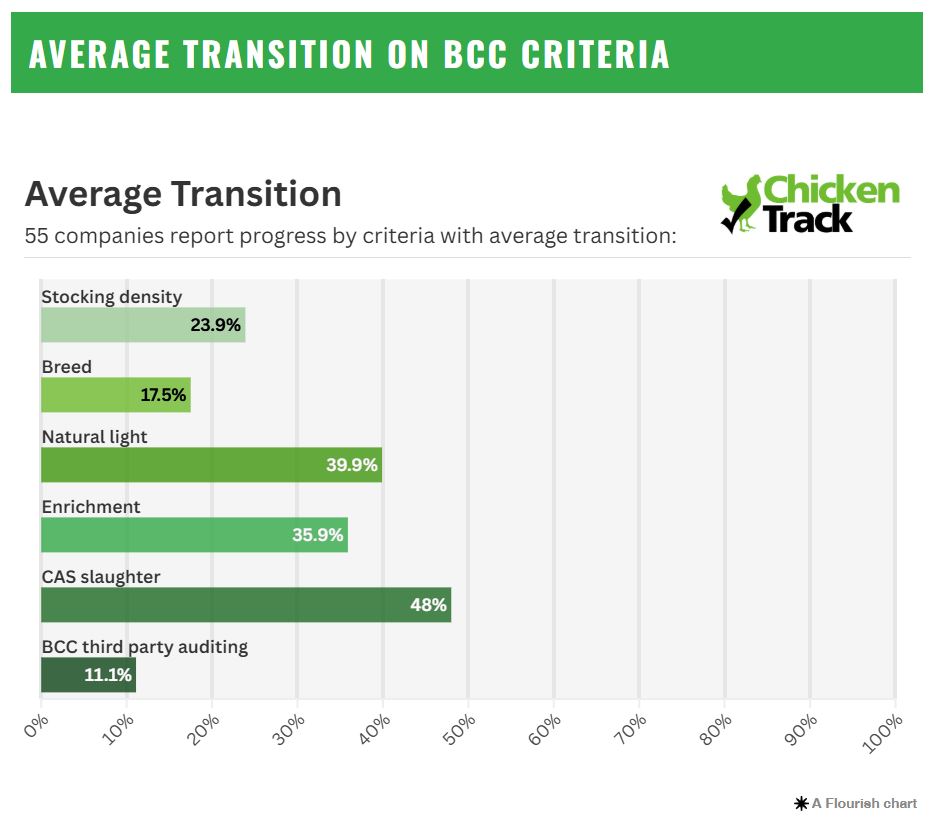
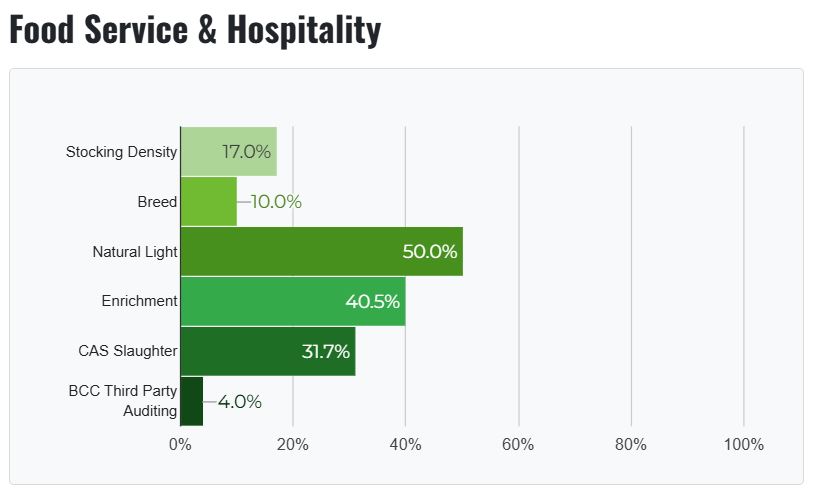
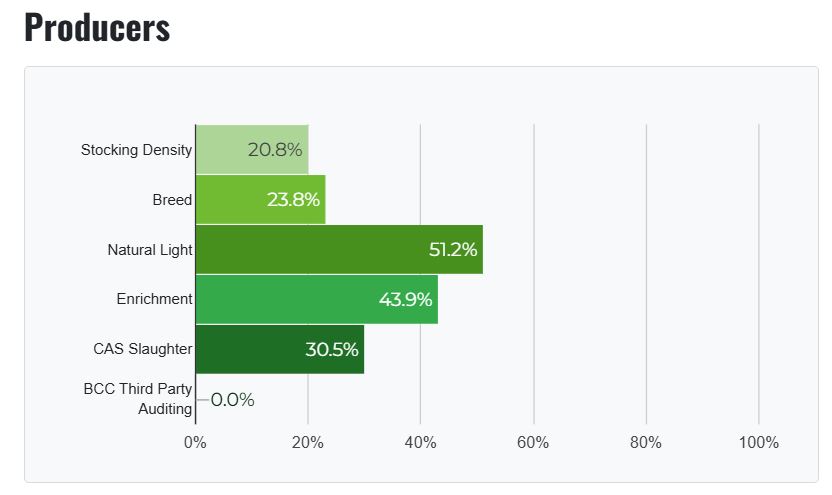
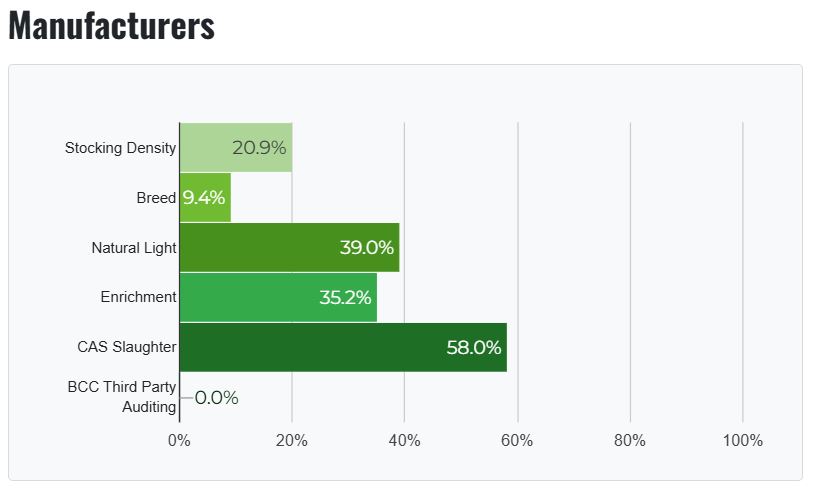
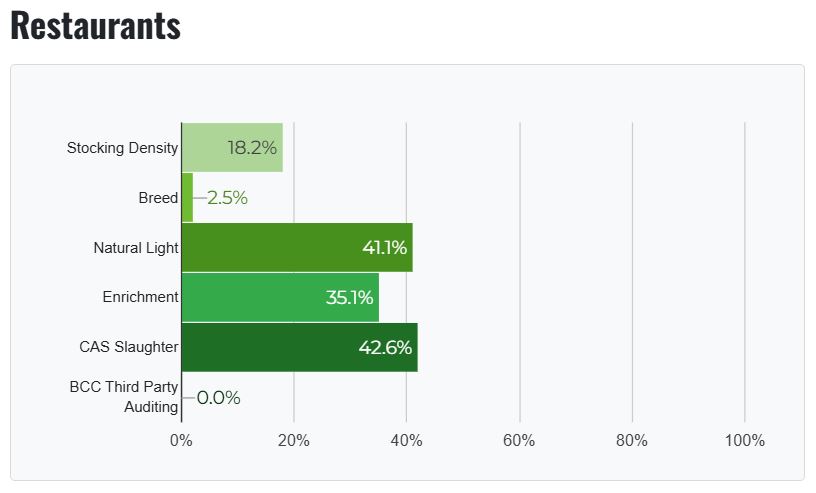
For the animal welfare organisation CIWF (Compassion in World Farming), the BCC is a framework, which it considers science-based, designed to improve the lives of millions of broiler chickens each year. It sets out five clear steps to improve chicken welfare, including providing more space (reducing stocking density), enrichment and natural light, the use of slower-growing breeds and more humane stunning methods. CIWF uses the ChickenTrack report to drive compliance, promote transparency and support the transition to higher welfare standards, holding companies accountable for their commitments.
However, the report reveals that the path to full compliance is fraught with obstacles for many companies. The complexity and costs involved in switching from fast-growing to slower-growing broiler breeds, and stocking density, remain, according to CIWF, two of the BCC production criteria that are most difficult to implement and show the lowest transition rates.
Only 2 of the 93 food companies assessed in 2024 have reported substantial progress in sourcing chickens reared to the requirements of the European Chicken Commitment
Specifically, CIWF highlights that in 2024 only two of the 93 most influential European companies reported substantial progress on stocking density, achieving 100% compliance (Schiever Distribution and Waitrose). Regarding breed transition, only Schiever Distribution reported 100% compliance.
The report highlights that a significant number of companies are falling behind, reporting less than 20% transition on key criteria of the European Chicken Commitment (ECC). This includes 30 companies on stocking density, 35 on slower-growing breeds, 17 on natural light, 20 on enrichment and 10 on stunning. Of even greater concern to CIWF is the fact that 29 of the 93 most influential companies tracked disclosed no updates on their progress.
Companies cite various challenges, such as the consequences of COVID-19, the war in Ukraine and the cost-of-living crisis, as well as inadequate supply or insufficient purchasing power as major barriers. CIWF’s interpretation is that change is not easy and requires companies to be proactive, secure investment, commit to contracts and find supply and product solutions to accelerate the transition.
From CIWF, Dr Tracey Jones, Global Director of Food Business, emphasises that “chickens are sentient beings that deserve a good quality of life”. She notes that ChickenTrack“plays a crucial role in tracking company progress”. The report presents this lack of progress as a “clear wake-up call”, urging companies to “take their commitments seriously and act decisively now”.
“29 of the 93 most influential companies tracked disclosed no updates on their progress.”
Dr Jones adds that, to make higher-welfare chicken the norm, companies are urged to “adopt the ECC and invest in meaningful change through robust action plans and transparent progress reporting”. Only when companies achieve 100% compliance will the full impact for chickens be realised.
Despite the overall challenges, the ChickenTrack 2024 report also celebrates success and recognises companies that have demonstrated strong progress. Companies such as Greggs and Premier Foods have shown significant year-on-year improvements across several criteria. Eataly in Italy has also achieved important advances, with a 90% transition on stocking density and 80% on breed. Furthermore, companies such as Marks and Spencer and Norsk Kylling have demonstrated that 100% BCC compliance is “achievable, economically viable and commercially sustainable”. Eleven companies reported on their progress for the first time this year, including four new entrants to ChickenTrack 2024 (Big Mamma Group, Les 3 Brasseurs, Taiko Foods and Yo! Sushi), which represents a crucial first step.
With the 2026 deadline that CIWF and other animal welfare organisations promoting this commitment wish to impose, the time for decisive action is now. CIWF urges companies to “reaffirm corporate commitment”, “update their business plan”, “invest in implementing” the transition, “schedule implementation” and, crucially, “report on progress as it is achieved” in order to maintain the confidence of the animal welfare lobby.
“ChickenTrack 2024 presents this lack of progress as a clear wake-up call, urging companies to take their commitments seriously and act decisively now.”
Clarification from NeXusAvicultura:
Although CIWF speaks of “deadlines”, it should be noted that at a legal level nothing has been approved by the EU to reduce current commercial stocking densities for broiler production. We trust that, despite the pressure from the extremely powerful and very well-funded animal welfare lobbies seeking to make lower broiler stocking densities mandatory, the current geopolitical context will prevail upon European legislators to apply common sense, as European consumers are in no position to absorb further price increases in their basic food basket.