
Avianza warns about recent European Commission notifications and questions Mercosur food safety standards
In recent weeks, the European Commission’s Rapid Alert System for Food and Feed (RASFF Window) has issued several alert notifications relating to poultry products originating from Brazil, reigniting concerns about food safety in Mercosur countries. These alerts include the detection of pesticide residues and chlorinated chemical compounds not permitted in the European Union, as well as the presence of pathogens such as Salmonella in meat products. Although the entry of some consignments has been blocked, it is impossible to inspect 100% of shipments originating from Brazil.
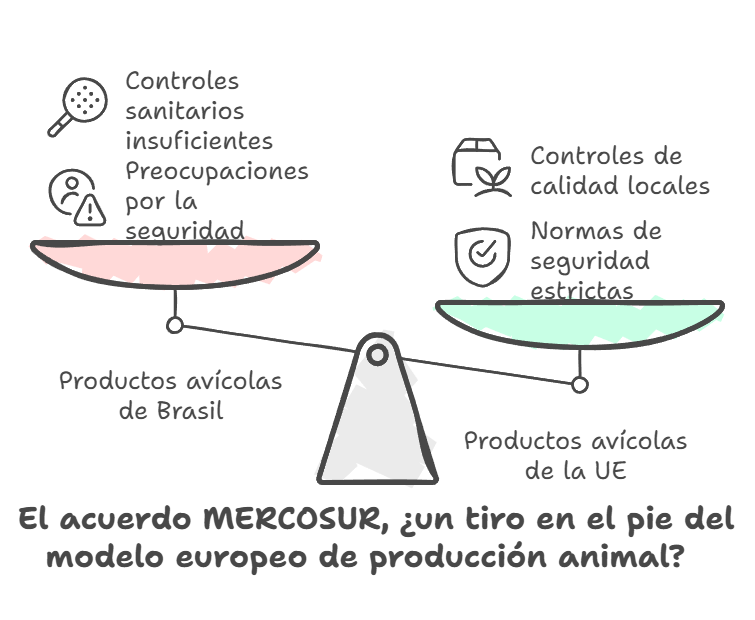
The Spanish Interprofessional Association for Poultry Meat (Avianza) highlights the importance of strengthening controls on imports from Mercosur countries, particularly at a time when trade agreements are being proposed that could increase the volume of these products on the European market. The succession of alerts issued by the RASFF highlights potential shortcomings in the food safety systems of these countries and raises significant doubts regarding the quality and compliance with EU sanitary standards of the products being exported to Europe.
The recent European Commission report, entitled “Final report of an audit carried out in Brazil from 15 April to 3 May 2024 in order to evaluate the animal health controls in place, in particular on avian influenza in relation to export of poultry, eggs and their products to the European Union“, questions the capacity of Brazilian authorities to detect avian influenza outbreaks at an early stage. According to the document, despite the system providing certain assurances regarding compliance with import requirements, surveillance for highly pathogenic avian influenza (HPAI) may not be sufficient to identify the disease in a timely manner, generating further uncertainty regarding the control of products destined for export.
Furthermore, Avianza reiterates its concern over the repercussions that the Mercosur agreement could have on the European poultry sector. According to the Rabobank report, “EU-Mercosur agreement: Implications for food and agribusiness“, the agreement would allow the entry of an additional 180,000 tonnes of poultry meat from Mercosur, representing a 58% increase in imports from that region and 20% of total poultry imports into the EU. This increase, combined with potential shortcomings in Brazilian sanitary controls, could jeopardise food safety in Europe, particularly when compared with the stringent controls met by EU producers, as evidenced by Spain’s recent declaration as free from avian influenza by the World Organisation for Animal Health.
In light of this situation, Avianza urges European authorities to assess the impact of these products on consumer health and to prioritise local poultry meat production, characterised by strict controls and quality certifications. The organisation considers it essential to protect the European poultry industry, which guarantees full traceability and complies with the most rigorous standards of animal welfare and food safety, offering consumers safe, superior-quality products.
Source:
-. Avianza
For further information: