
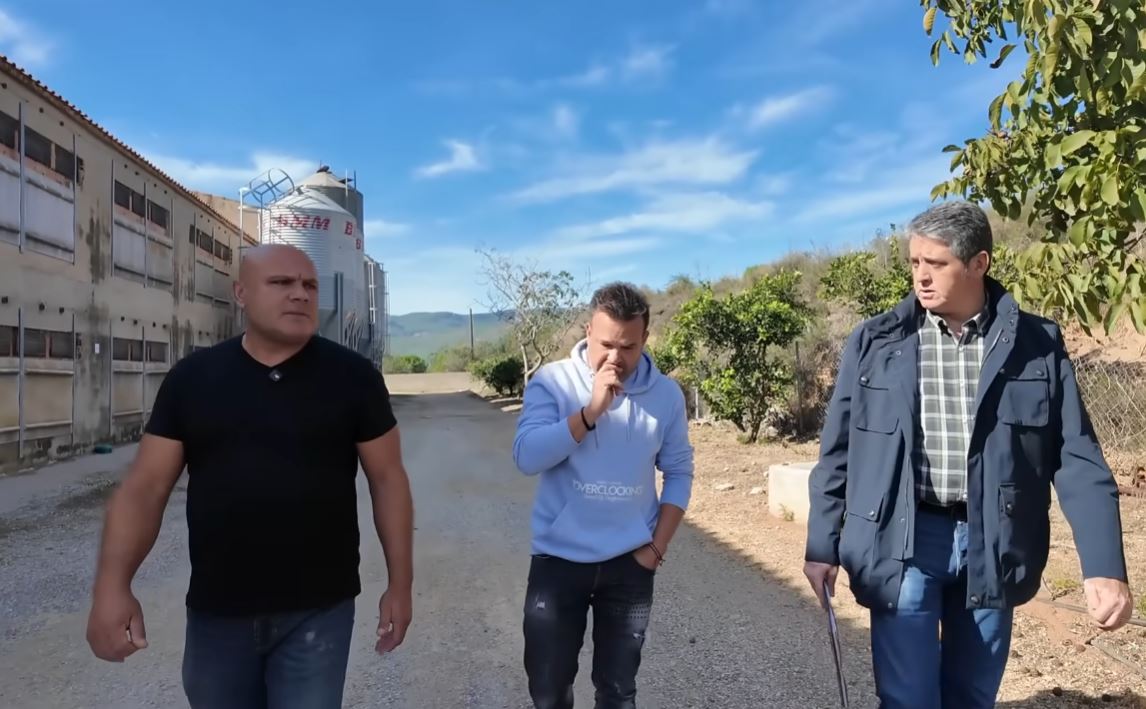
This article summarises the visit of high-profile entrepreneur Jose Elías — the brand-new owner of an ageing two-storey broiler farm in Valls (Tarragona) — together with its former owner, Josep, whom we featured in a video a few months ago, and Carles Seire, Technical Director of Comavic, to assess the substantial refurbishment work needed to modernise and remediate the facility. As seen in the video published on 14 November 2025, the farm is between 40 and 50 years old, and the primary objective of the renovation is to eliminate safety hazards, such as electrical faults that could have serious consequences for the birds.
Safety Assessment and Remediation
Upon arrival, José and his team note that the facilities are in a very poor state of repair, likening them to a “horror film” on account of the patchwork repairs throughout. The first phase of the refurbishment is external remediation. This involves stripping, rendering, patching and repainting the façades, as well as removing old, redundant elements such as broken windows. Remediation must also include masonry work in internal areas to facilitate cleaning, such as rendering and tiling certain rooms.

The helicopter debate
True to the title, one of the most curious questions of the day arises. Jose Elias, entrepreneur and millionaire, asks the technicians whether the noise from his helicopter landing could affect the animals. The answer is unequivocal: it depends on the age of the birds. If the broilers are already at an advanced stage of growth, the loud noise can startle them, causing panic piling, which could trigger a “cascade” of smothering deaths and significant flock losses. The recommendation is therefore to avoid landing at the farm when the birds are in the later stages of the production cycle. If the chicks are still young, noise is generally not a serious problem.
Electrical modernisation and automation
The electrical installation must be completely rewired from scratch. The improvements will be carried out in phases:
- Mains cables and consumer connection units (CGPs): Installation of supply cables and consumer connection units (CGPs) as an immediate priority.
- Electrical control panels and climate computers: The farm has eight obsolete climate computers (first-generation Tuffigo units) for which spare parts are no longer available; these must be replaced with newer models (Avibox). Each computer manages one house, and consolidating them would compromise flock management. The investment in a new climate computer and control panel is in the region of €5,000 to €10,000 per unit.
- Lighting and final wiring: Installation of dimmable LED lighting, followed by complete rewiring of fan motors and feeding systems.
Water systems and chlorination
The water system, including pipework and chlorination dosing pumps, is extremely old. At present, chlorination uses chlorine dioxide combined with an acid for pH regulation, injected directly into the pipe feeding the storage tank.
The primary requirement is to automate the borehole pump, which is currently operated manually. Two solutions are proposed to allow the pump to operate automatically:
- Installing float valves (ball floats) in the house header tanks so that, when full, they send a signal to shut off the borehole pump.
- The simplest and most practical option is to install a pressure vessel with a pressure switch (cut-off pressure) on the main borehole pipeline. When the tanks are full and water flow stops, pressure will build up and the pressure switch will cut power to the pump.

Heating and ventilation
The existing cross-ventilation system performs adequately, as the houses are short (35 metres in length).
Regarding heating, two types of space heaters are available: direct-fired units (less expensive, with combustion gases remaining inside the house) and sealed-combustion units (five times more expensive, with flue gases vented outside). Although direct-fired heaters produce CO2 within the house, for this type of installation and relatively small scale they are the most appropriate and cost-effective option, as the sealed-combustion equipment (at higher cost) would be underutilised. The plan is to replace the old radiant panel heaters with modern, fixed space heaters (hot-air blowers), one per house.
Long-term business vision
José is investing in the farm with a 10-year horizon, on the basis that poultry meat is the most affordable source of protein and that demand will continue to grow. He believes the poultry sector has a strong “tailwind” driven by the fitness culture and the broiler’s outstanding feed conversion efficiency.
He acknowledges that the investment (approximately €1 million, including acquisition and refurbishment costs) is being made without conventional bank financing, as the business is currently regarded as “loss-making” by lenders. The investment is being undertaken because he sees a solution to the critical generational succession problem facing the sector, where farmers’ children are unwilling to take over the business. José’s approach is to modernise the facilities in stages, investing batch by batch or every two batches, in order to prevent farms from becoming unviable in the long term.
Energy Efficiency Opportunities (CAEs)
The possibility of leveraging Energy Saving Certificates (CAEs) is also discussed. These certificates are generated by investing in upgrades that improve energy efficiency. For example, replacing ventilation fan motors to reduce electricity consumption, or implementing air-source heat pump systems, could generate CAEs that the electricity company would then purchase.
For further information on NeXusAvicultura:
-. The poultry investments of entrepreneur Jose Elías
-. Company news and investments in the poultry industry