
The new Trump administration will favour increasing processing line speeds in Poultry and Pork Plants. The measure is a boost to efficiency and accelerates automation, but casts shadows over worker safety and food safety.
The United States Department of Agriculture (USDA) announced on 17 March 2025 a landmark new directive that will allow slaughter and cut-up lines at poultry and pork processing plants to operate at higher line speeds. Agriculture Secretary Brooke Rollins made this policy change public, emphasising that the measure seeks to empower companies to operate more efficiently, while maintaining high food safety standards. This decision has created a clear divide between the meat industry, which welcomes the measure as a necessary step for competitiveness, and workers’ unions, which warn of significant risks to worker safety and food safety.
Details of the new USDA directive
The directive has instructed the USDA’s Food Safety and Inspection Service (FSIS) to extend the waivers that allow pork and poultry facilities to maintain higher line speeds. In addition, a rulemaking process will be initiated to permanently formalise these speed increases.
According to new Secretary Brooke Rollins, appointed by Donald Trump, this new policy will ensure that poultry and pork processing plants can meet demand without excessive government interference, while maintaining food safety standards. The directive aims to eliminate outdated administrative requirements, in the Trump administration’s view, that have slowed production and added unnecessary costs for American producers.
Rollins emphasised that “the United States leads the world in pork and poultry production, and we are committed to ensuring our producers remain competitive on a global scale without being held back by unnecessary bureaucracy“. She added that unnecessary red tape is being cut, empowering companies to operate more efficiently and strengthening American agriculture, all while maintaining the highest food safety standards.
A crucial aspect of the new directive is that FSIS will no longer require plants to submit redundant worker safety data. Rollins stated that extensive research has confirmed that there is no direct link between processing speeds and workplace injuries. The USDA affirmed that these reforms will strengthen US food self-sufficiency and production, reduce costs for producers, and support a more resilient supply chain.

The measure has been well received by the poultry and pork industry
The new directive has received approval from major industry associations, such as the National Chicken Council (NCC), the National Pork Producers Council (NPPC) and the Meat Institute.
The US poultry sector, through the voice of NCC President Harrison Kircher, applauded the action, which he said adheres to science-based principles and builds on 25 years of experience, studies and data on increased line speeds in chicken processing plants. Kircher noted that the current approach has created significant uncertainty for companies with waivers and a competitive disadvantage for those without them. “We appreciate the administration acting to ensure a level playing field with other countries and to help increase the global competitiveness of the US poultry industry,” he added. The NCC looks forward to providing input as the rulemaking process begins and urges the agency to work expeditiously to finalise a rule. The NCC also noted that a pilot programme under the Clinton administration allowed line speeds of up to 175 birds per minute (bpm) and that the processing (evisceration) portion that benefits from the speed increase is almost entirely automated. They stated that research has confirmed that higher evisceration line speeds at chicken processing plants do not lead to greater food safety risk.
The US chicken industry body has also reported that chicken processing plants in Canada, Belgium, Germany, Brazil and Argentina, among other countries, operate at line speeds exceeding 200 birds per minute (bpm), using the same equipment, placing the United States at a competitive disadvantage in the global market.

Regarding the pork sector, NPPC President Duane Stateler, a pork producer from McComb, Ohio, stated that “America’s pork producers thank Agriculture Secretary Brooke Rollins and the Food Safety and Inspection Service (FSIS) for this necessary action that will provide financial certainty and greater stability for pork producers“. He added that “without this programme, some pork producers could have incurred an additional loss of nearly $10 per head”. The NPPC, which has advocated for increased line speeds since 2019, looks forward to continuing to work with Rollins and FSIS to increase adoption of the New Swine Inspection System (NSIS) line speed at additional plants. The NPPC also noted that FSIS allowed six pork plants to increase line speeds beginning in November 2021 and extended that trial several times until 15 January 2025, concluding in a study that line speeds were not the primary risk factor for musculoskeletal disorders (MSDs) in these plants.
Meat Institute Executive Director Julie Anna Potts also applauded the streamlining of bureaucracy, stating that “Secretary Rollins has shown she is serious about removing bureaucratic obstacles at the USDA to ensure the efficient production of safe meat and poultry products”. “We appreciate that she has wasted no time in supporting innovation in our industry. We look forward to working with the Secretary and our livestock and poultry suppliers to bring certainty to the supply chain and allow more companies the opportunity to use this system,” she concluded.
Serious concerns over worker safety and food safety
Despite industry support, the action has raised significant concerns from organisations representing workers. Stuart Appelbaum, President of the Retail, Wholesale and Department Store Union (RWDSU), which represents more than 15,000 poultry workers at facilities in the southern United States, as well as meat packing and processing workers elsewhere in the country, expressed deep concern.
Appelbaum warned that “increasing line speeds will harm workers — it’s not a maybe, it’s a definite — and increasing production speeds will endanger the health and safety of every American who eats chicken“. He argued that “we rely on thousands of workers to safely produce the food that comes to our tables every day, and they cannot do so safely at these speeds; we learned that lesson the hard way just five years ago; let us not irreparably injure workers to learn what we already know”.
Furthermore, Appelbaum pointed out that “worker safety must be a priority, and these facilities cannot operate at these speeds without an increase in staffing, which cannot happen with the way they are currently built”. He described the issuing of waivers to a multi-billion-dollar industry without oversight to ensure it is done safely and properly as “a recipe for disaster“. The RWDSU insisted that any increase in production speed must be accompanied by an increase in staffing and stronger safety protections, neither of which is guaranteed under the current policy change.
Food safety advocates have also expressed concern, warning that faster line speeds could hamper the ability of workers and inspectors to detect contamination or defects in meat products. As production speeds increase, inspectors and workers may struggle to maintain consistent quality and cleanliness.
Potential advantages for the poultry sector
For the poultry sector, the USDA directive presents several potential advantages:
- Greater operational efficiency: Allowing higher line speeds can increase the volume of product processed in the same period of time, leading to greater efficiency in plants.
- Meeting demand: The measure seeks to ensure that plants can satisfy market demand without being constrained by previously established line speeds.
- Global competitiveness: The industry argues that faster line speeds are necessary for the United States to remain competitive globally, pointing out that other countries already operate at higher speeds.
- Cost reduction: By eliminating administrative requirements deemed outdated, a reduction in operating costs for producers is expected.
- Greater financial stability: The NPPC noted that this programme will provide financial certainty and greater stability for producers. The NCC also indicated that the measure seeks to ensure a level playing field and increase the global competitiveness of the US poultry industry.

Risks and challenges for processing plants
Despite the promoted advantages, there are significant risks and challenges for the poultry sector:
- Worker safety: The primary concern is the potential increase in musculoskeletal injuries among workers due to repetitive tasks and faster work rates. While the USDA maintains there is no direct link between processing speed and injuries, a study commissioned by the USDA itself found that 81% of workers in poultry processing plants are at high risk of musculoskeletal disorders due to repetitive tasks and fast-paced environments. The study also found a strong correlation between increased workloads and inadequate staffing levels with a higher risk of injury.
- Food safety: There is concern that faster line speeds may compromise the ability of workers and inspectors to detect contamination or defects in products.
- Labour relations: Union opposition could generate labour tensions and potential conflicts at processing plants.
- Need for greater investment: To mitigate worker safety risks at higher line speeds, it may be necessary to increase staffing levels and implement more robust ergonomic programmes, which could offset some of the expected cost savings. While the USDA has recommended that pork and poultry plants mitigate such injuries by establishing guidelines for ergonomic programmes, no specific mandatory requirements have been set out in this initial directive.

The Trump administration already attempted during its previous term to eliminate all line speed limits in processing lines
Efforts to increase line speeds are not new. The Trump administration previously attempted to completely eliminate line speed limits for pork processors, a measure that was blocked by a federal judge in 2021 following union challenges. Since then, a limited number of plants, including some in Minnesota, have been able to exceed standard speed limits under a waiver system. In Minnesota, the state took steps in 2023 to adopt its own worker protection standards at large meat and poultry plants, including mandatory ergonomic programmes and injury prevention training.
Future implications and considerations for the poultry meat industry
The USDA proposal is still in progress, and the rulemaking process will include a public comment period. However, the extension of waivers and the elimination of reporting requirements are immediate changes. The industry response, the oversight applied, and the outcomes in terms of injuries and food safety will determine the long-term impact of these changes.

For the poultry sector, it is crucial to carefully assess the potential benefits of higher line speeds against the risks to worker safety and food safety. Companies will need to consider investments in technology, automation and ergonomic programmes to ensure the safety of their workers as production speeds increase. It will also be important to maintain an open dialogue with workers and their representatives to address their concerns and ensure a safe working environment. The effectiveness of food safety measures at higher speeds will also require constant vigilance.
This measure will undoubtedly further accelerate progress towards near-total automation and robotisation of processing plants
The USDA directive to permit and promote higher line speeds at poultry and pork plants represents a significant shift with the potential to increase the sector’s efficiency and competitiveness. This measure will undoubtedly further accelerate automation and the deployment of robotics in processing plants, as well as the use of AI for faster quality assessment.
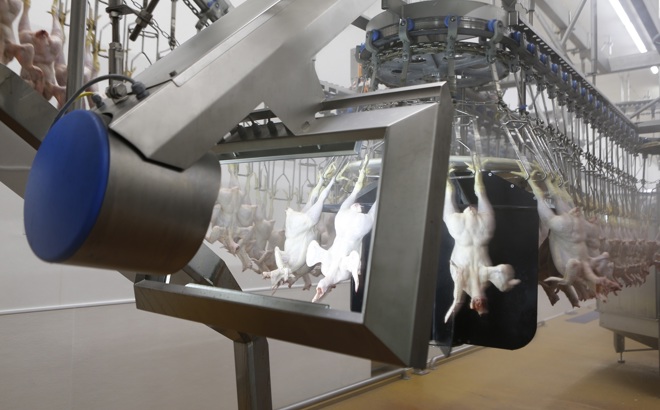
However, this measure has raised deep concern over worker safety and food safety. While the industry celebrates the reduction in bureaucracy and the opportunity to increase production, unions warn of the potential negative consequences for the health and safety of workers. The future of this policy will depend on how the industry manages the associated risks and on the oversight implemented to guarantee worker and food safety in a faster production environment.
Processing plants will need to navigate this new landscape carefully, balancing the pursuit of efficiency with the responsibility to protect their workers and consumers.
For further information:
-. Secretary Rollins Takes Action to Streamline U.S. Pork and Poultry Processing (USDA)