
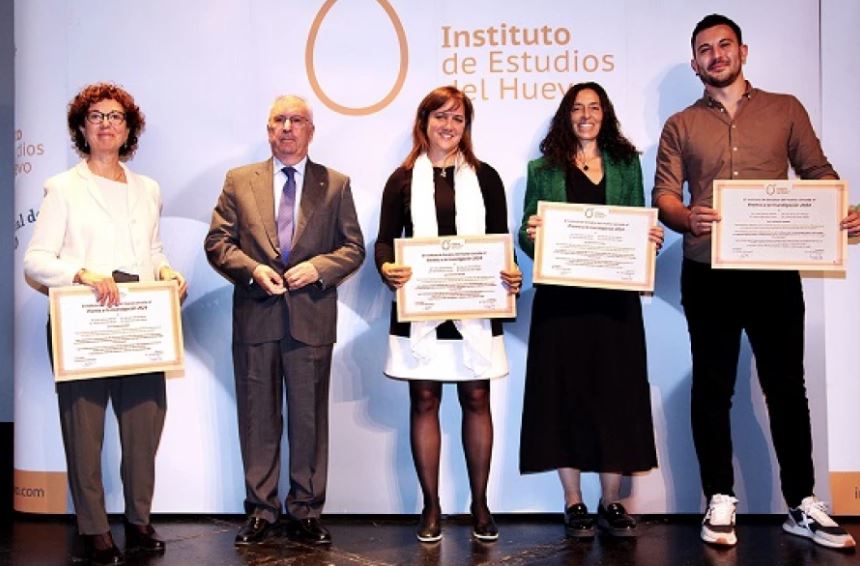
The IEH (Instituto de Estudios del Huevo) has awarded its annual research prize to a project developed by the Epidemiology and Environmental Health group at CISA-INIA, CSIC. This project evaluates in real time the risk of spread of the highly pathogenic avian influenza virus, using advanced monitoring technologies.
The award was presented at a ceremony held on 10 October 2024 at the Círculo de Bellas Artes in Madrid, coinciding with World Egg Day, and aims to support young researchers and teams working across the many areas related to the egg.
Irene Iglesias, coordinator of the award-winning project, highlighted the importance of this research, stating that avian influenza is “a threat that not only jeopardises poultry production, but also represents a growing challenge for global public health.” According to Dr. Iglesias, the real-time monitoring system “allows the disease to be anticipated, providing accurate information on its spread in wildlife, which is essential for making rapid and effective decisions.”
The project coordinator stresses that avian influenza is “a threat that not only jeopardises poultry production, but also represents a growing challenge for global public health.”
The prize, endowed with €12,000, will contribute to the continuation of this research, focused on the development of innovative digital tools for real-time spatial monitoring of avian influenza. It will also enable further progress in analysing the dynamics of the virus in both wild birds and domestic poultry.
As part of the World Egg Day celebrations, the Instituto de Estudios del Huevo also organised a symposium in which Manuel Laínez, Director of Agri-food Innovation and Development at Cajamar and former Director of INIA, highlighted the positive impact of new technologies on the poultry sector. According to Laínez, these tools have made it possible to improve the sector’s productive efficiency over recent decades, thereby contributing to greater environmental sustainability. He also emphasised that “in order to continue advancing, it is crucial to add value to all by-products generated in the egg value chain and to ensure a sustainable supply of raw materials.”
The Instituto de Estudios del Huevo is a non-profit organisation established in 1996 with the aim of supporting research, training and outreach on the egg in relation to food, nutrition, health and the factors determining quality in production and processing. It has an advisory board of experts who define its work and contribute their experience and knowledge to the achievement of the Institute’s objectives.
List of all prizes awarded by the INSTITUTO DE ESTUDIOS DEL HUEVO since 1997
1997-
“Influence of fat and fat-soluble vitamin supplementation in layer diets on the dietary value of the egg”.
Grobas Mosquera, Jesús Méndez Batán, Pilar Cachaldora Calderón, de Blas Beorlegui and Gonzalo González Mateos. Department of Animal Production. E.T.S.I. Agrónomos de Madrid. Cooperativas Orensanas (COREN, S.C.L.)
“Effect of high hydrostatic pressure on egg products: microbiological aspects”.
Eduardo Ponce and Reyes Pla. Faculty of Veterinary Science. Universitat Autònoma de Barcelona. Food Technology Department.
1998 –
“Influence of diet and layer strain on the fat composition of eggs consumed in the Community of Madrid”.
Francisco J. Sánchez-Muniz1*, Ovidio Jiménez1, M. José Gonzalez-Muñoz2, Sara Bastida1. 1Department of Nutrition and Food Science I (Nutrition). Faculty of Pharmacy. Universidad Complutense. 28040-Madrid. 2Department of Nutrition and Food Science. Faculty of Pharmacy. Universidad de Alcalá de Henares (Madrid).
Francisco J. Sánchez-Muniz. Department of Nutrition and Food Science I (Nutrition). Faculty of Pharmacy. Universidad Complutense.
1999 –
“Modulation of cell proliferation by cholesterol”.
Beatriz Ledo Trujillo. Biochemistry-Research Department, Hospital Ramón y Cajal (Madrid)
“Productive and behavioural study of two laying hen strains housed in conventional and enriched cages”.
Maria Dolores Lidón Martín
Faculty of Veterinary Science. Universidad de Zaragoza. Department of Animal Production and Food Science.
“Improvement of oxidative stability in eggs and egg products enriched with n-3 or n-6 PUFA: vitamin E vs. canthaxanthin”.
Jaume Galobart i Cots, Ana C. Barroeta Lajustícia, Mª Dolores Baucells Sánchez and Rafael Codony Salcedo.
1U.D. Nutrició i Alimentació Animals. Facultat de Veterinària. Universitat Autònoma de Barcelona. 08193 Bellaterra.
2Dep. Ciències Fisiològiques Humanes i de la Nutrició. Universitat de Barcelona.
2000 –
“Protective effect of lutein and other antioxidant agents present in the egg in an oxidative stress model in the Apo-E deficient mouse”.
Dña. Patricia Fernández Robredo. Department of Cardiology. Universidad de Navarra.
To the “Real Escuela de Avicultura” for its track record in the development of modern poultry farming in Spain, in the training of specialists and technicians, and in the dissemination of poultry science and technology.
2001 –
“Modification of the fatty acid profile, α-tocopherol and oxidation levels in eggs enriched with n-3 polyunsaturated fatty acids after being subjected to different thermal processing treatments”.
Lucia Cotinas, Jaume Galobart i Cots, Ana C. Barroeta Lajustícia and Mª Dolores Baucells Sánchez
U.D. Nutrició i Alimentació Animals. Facultat de Veterinària. Universitat Autònoma de Barcelona.
2002 –
“Innovations in preparative-scale chromatographic separation of ovalbumin from egg white and in the application of its properties in the preparation of yoghurt mousse”.
Benjamín Paredes, Samuel Gonzalez, Manuel Rendueles and Mario Díaz.
Universidad de Oviedo. Department of Chemical Engineering and Environmental Technology.
2003 –
“Antihypertensive peptides derived from egg white proteins obtained by enzymatic hydrolysis.”
Marta Miguel, Rosina López-Fandiño, Isidra Recio, Amaya Aleixandre1, Mercedes Ramos. Instituto de Fermentaciones Industriales. Consejo Superior de Investigaciones Científicas (CSIC)
1Instituto de Farmacología y Toxicología. Faculty of Medicine. Universidad Complutense de Madrid.
2004 –
“Selection of biological parameters in the quality of the Spanish omelette (tortilla de patatas) in catering services: the effectiveness of the Hazard Analysis and Critical Control Points (HACCP) system”.
José Miguel Soriano, Jordi Mañes and Juan Carlos Moltó.
Laboratory of Nutrition, Food Science and Food Safety. Faculty of Pharmacy. Universidad de Valencia.
2005 –
“Effect of treatment with Antisecretory Factor, obtained from egg yolk, on the progression of TNBS-induced colitis in Balb/c mice”.
Elizabet Pedrosa Tapias, Dña. Violeta Lorén Moreno and D. Josep Mañé Almero.
Gastroenterological Pathology and Nutrition Research Team. Digestive Department, Hospital Universitario Germans Trias i Pujol. Badalona (Barcelona, Spain).
2006 –
“Development of an analytical method based on pressurised solvent extraction and chromatographic analysis to verify the absence of fluoroquinolone antibiotic residues in eggs”.
Dña. María Dolores Marazuela Lamata, Dña. Sonia Herranz de Andrés and Dña. Maria Cruz Moreno-Bondi. Department of Analytical Chemistry, Faculty of Chemical Sciences. Universidad Complutense de Madrid, E-28040 Madrid, Spain.
2007 –
“Usefulness of the skin prick test and specific IgE determination in monitoring egg protein allergy in a paediatric population”.
Mª Carmen Diéguez Pastor, Inmaculada Cerecedo Carballo and Belén de la Hoz Caballer (from the Allergology Department) and Alfonso Muriel García, Javier Zamora Romero and Víctor Abraira Santos (from the Clinical Biostatistics Unit). Hospital Universitario Ramón y Cajal. Madrid.
2008 –
“Treatment of egg yolk by a non-aggressive process aimed at obtaining fractions with added value”.
Amanda Laca, Dña. Carolina Sáez, D. Benjamín Paredes and D. Mario Díaz. Department of Chemical Engineering and Environmental Technology, Universidad de Oviedo.
2009 –
“Egg consumption is associated with better nutritional status, health condition and cognitive capacity in institutionalised elderly individuals with no cardiovascular history”. Aránzazu Aparicio Vizuete, Elena Rodríguez Rodríguez, Beatriz Navia Lombán, José Miguel Perea Sánchez, Pedro Andrés Carvajales, Ana Mª López Sobaler. Department of Nutrition and Food Science I (Nutrition). Faculty of Pharmacy. Universidad Complutense de Madrid
2010 –
“Technology transfer of biodegradation using closed batch digesters for the treatment of animal by-products from the laying poultry sector”.
Luis Manuel Navas Gracia, Mercedes Sánchez Báscones, Jesús Martín Gil, Salvador Hernández Navarro, María Angeles Díez Gutiérrez, Adriana Correa Guimaraes and Carmen Teresa Bravo Sánchez. Higher Technical School of Agricultural Engineering, Palencia (Universidad de Valladolid – Palencia Campus)
2011 –
“Study of the immunological mechanisms involved in immunology and in the acquisition of natural tolerance in egg-allergic children”.
Marta Vázquez Ortiz, Ana María Plaza Martín, Laila Alsina Manrique de Lara, and María Anunciación Martín Mateos. Research Group on Infectious and Immunological Diseases at Hospital Sant Joan de Déu and D. Manel Juan Otero, D. Jordi Yagüe Ribes and D. Ramón Vilella Puig from the IDIBAPS Research Group (Immunogenetics in the Autoinflammatory Response)
2012 –
“Immune response in egg-allergic children following oral immunotherapy treatment”.
Iván López Expósito and Elena Molina Hernández (Instituto de Investigación de Ciencias de la Alimentación-CIAL) and Marta Reche Frutos and Teresa Valbuena Garrido (Hospital Universitario Infanta Sofía, Madrid). (Project)
2013 –
“Pasteurisation of liquid egg by high-voltage pulsed electric fields”.
Silvia Monfort Soler, from the Faculty of Veterinary Science, Universidad de Zaragoza.
2014 –
“New techno-functional and health properties from egg protein hydrolysates”.
Marta Miguel Castro (Instituto de Investigación de Ciencias de la Alimentación-CIAL CSIC-CIAL) and Mario Sandoval Huertas (Chef, Restaurante Coque)
2015 –
“New products derived from egg yolk and its fractions for the packaging, cosmetic and food industries”.
José Mario Díaz Fernández. Bioprocessor and Reactor Technology Group, Universidad de Oviedo.
2016 –
“Description of the nutritional profiles of egg consumers and their evaluation in relation to all-cause and cause-specific survival in the EPIC-Spain cohort” (project).
Raúl Zamora Ros. Catalan Institute of Oncology-Bellvitge Biomedical Research Institute, L’Hospitalet del Llobregat (Barcelona)
2017 –
“Peptide-based strategies for the prevention and treatment of egg allergy”.
Daniel Lozano Ojalvo. Instituto de Investigación en Ciencias de la Alimentación (CIAL, CSIC-Universidad Autónoma de Madrid).
2018 –
“Characterisation of resistance to stress and technological treatments, growth capacity and pathogenic potential of Salmonella Heidelberg, Salmonella Kentucky, Salmonella Livingstone and Salmonella Mbandaka” (project).
Guillermo José Cebrián Aure. Faculty of Veterinary Science. Universidad de Zaragoza.
2019 –
“Improvement of eggshell quality and food safety in an extended 100-week production cycle” (project).
Alejandro Rodriguez Navarro. Universidad de Granada.
2020 –
“Valorisation of eggshell through its use as a support in the development of catalysts for wastewater treatment”.
Dª. Paula Oulego Blanco, Dª. Amanda Laca Pérez, Dª. Sonia Calvo Barbería and D. José Mario Díaz Fernández. Bioprocessor and Reactor Technology Group. Universidad de Oviedo
2021-
“Incorporation of grape by-products in layer diets as a strategy to produce eggs enriched in bioactive compounds” by a multidisciplinary research team comprising two veterinarians, two biologists and an agricultural engineer: Susana Chamorro Francisco, Mónica López Torres, Agustín Viveros Montoro, Inés Sánchez-Román Rojas and Ignacio Arija Martín. All are PhD holders affiliated with the Faculty of Veterinary Science and the Faculty of Biological Sciences at the Universidad Complutense de Madrid.
2022-
“Eggshell membrane with an external apatite-coated layer: a new osteoinductive biohybrid compound for guided bone/tissue regeneration” by a multidisciplinary research team of seven researchers and doctoral students from nine institutions, led by D. Jaime Gómez Morales, Tenured Scientist at the Instituto Andaluz de Ciencias de la Tierra (CSIC-Universidad de Granada). The work opens the door to the development of biomaterials from the eggshell membrane, of great interest for medical applications in bone regeneration.
2022-
“Mitigation strategies for nitrogenous gases on laying poultry farms” by Dr. Eduardo Rosa González. This research, specifically a doctoral thesis, was carried out at NEIKER, at the Universidad del País Vasco and at the Basque Institute for Agricultural Research and Development, with the research team comprising Dr. Pilar Merino Pereda and Dr. Haritz Arriaga Sasieta as thesis supervisors.
2023-
“Eggshell membrane with an external apatite-coated layer: a new osteoinductive biohybrid compound for guided bone/tissue regeneration” by a multidisciplinary research team of seven researchers and doctoral students from nine institutions, led by D. Jaime Gómez Morales, Tenured Scientist at the Instituto Andaluz de Ciencias de la Tierra (CSIC-Universidad de Granada). The work opens the door to the development of biomaterials from the eggshell membrane, of great interest for medical applications in bone regeneration.