
Dutch supermarkets have virtually stopped selling chicken that does not carry the “Beter Leven” (“Better Life”) label with at least one star.
The label, which was developed by the Dutch Society for the Protection of Animals (SPA), is based on a three-star system: the more stars, the higher the welfare standard. For example, animals reared under the two-star scheme have outdoor access, while those certified with three stars have access to the greatest amount of both indoor and outdoor space.

As a result of this pressure on supermarkets and foodservice operators to switch to slower-growing chicken breeds and raise welfare standards, commitments have been made that, according to the SPA, “mean improved welfare for some 100 million chickens”.
The requirement for this label has overcome the initial reluctance of broiler producers, since it effectively obliges Dutch supermarkets to source chickens certified with this label and carrying at least one star — in other words, it virtually prevents them from purchasing chicken meat not reared in the Netherlands.
A single star is sufficient to exceed minimum legal requirements. For Ingrid de Jong, poultry welfare expert at Wageningen University, Netherlands, “There is a big difference between a regular fast-growing broiler and a Beter Leven one-star chicken“.
Although the Dutch Society for the Protection of Animals (SPA) maintains that sustainability is greater in “Beter Leven” chickens, the reality is that their lower stocking density requires a greater number of square metres to produce the same number of animals — that is, a greater number of farms, which means a greater environmental footprint.
It should be noted that the ultimate goal of the more radical animal rights groups is not merely to achieve better living conditions for production animals, but to substantially reduce and even entirely replace the consumption of animal protein.
The broiler industry in the Netherlands
The Netherlands is the 6th largest poultry producer in the EU, with a 7% share of total EU broiler meat production, equivalent to 869 tonnes annually in 2021.
In the Netherlands, as of June 2022, there were 70 broiler breeder farms with 2.8 million birds, 190 rearing farms with 5 million birds, and 640 broiler farms with 49 million birds.
The Netherlands also has 14 hatcheries producing between 13 and 14 million day-old chicks every week. With regard to processing, it has 14 slaughterhouses with a production output of 1,085,000 tonnes of meat, and 85 feed mills producing 3 million tonnes of poultry feed, approximately half of which is destined for broiler production.
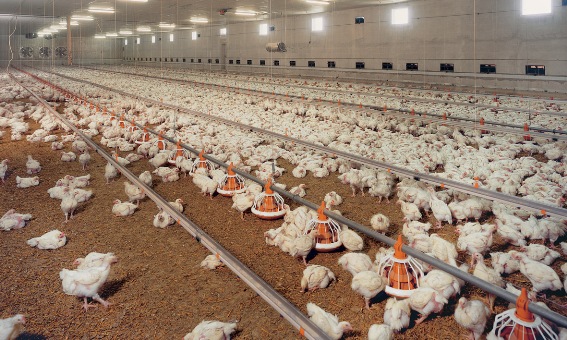
The Dutch broiler sector features a diversity of production systems. More than 95% of farms are members of the IKB quality assurance programme. In addition to conventional broiler production systems — in which fast-growing breeds (primarily Ross 308) are housed entirely indoors at relatively high stocking densities (39–42 kg/m²) — in recent years there has been a significant increase in broiler rearing systems with higher welfare requirements.
The most prevalent alternative production system is the ‘Beter Leven one star’ system, which is a free-range indoor system whose criteria are defined by the Dutch Society for the Protection of Animals.
The most important characteristics of these farms are the use of a slower-growing breed, slaughtered at a minimum age of 56 days. Organic production has a relatively low market share in the Netherlands, at only 0.5% in 2020.
In the Dutch broiler sector, the level of integration is relatively low compared to other EU countries, although with the increasing number of farms operating under a Beter Leven 1-star label, the level of integration has risen somewhat, meaning there are structures in which producers are linked to specific slaughterhouses and, in turn, connected to specific feed companies and veterinary practices. Nevertheless, growers remain independent and are able to make many decisions for themselves.
The majority of broiler growers are members of one of two farmer organisations, either LTO-NOP or NVP. Both are members of Avined, the organisation representing all poultry farmers in the Netherlands. Other members of Avined include Nepluvi (the organisation of all slaughter plants), ANEVEI (egg traders), and COBK (hatcheries and breeding organisations).
For further information:
-. Analysis of the BROILER SECTOR in Europe at NeXusAvicultura.com
-. Poultry sector analyses from NeXusAvicultura.com