
France reassesses the vaccine’s persistence over time and vaccination protocols (frequency) in response to rising case numbers
The start of the 2025 migratory season has brought a challenging reality for French poultry farming, especially in the west of the country. Despite having been the pioneering country in the European Union to implement a mass mandatory vaccination campaign against Highly Pathogenic Avian Influenza (HPAI) since October 2023, which resulted in a dramatic 96% drop in outbreaks during the 2023/2024 season (falling from 1,378 to just 11 cases on commercial farms), the current virulence of the virus has put the immunological persistence of the vaccine and the need to adjust its protocols to the test.
Since 22 October 2025, mainland France has been at “high risk” level for HPAI, a measure implemented much earlier than in previous seasons due to the early circulation of the virus in Europe and the strong infection dynamics detected in migratory corridors.

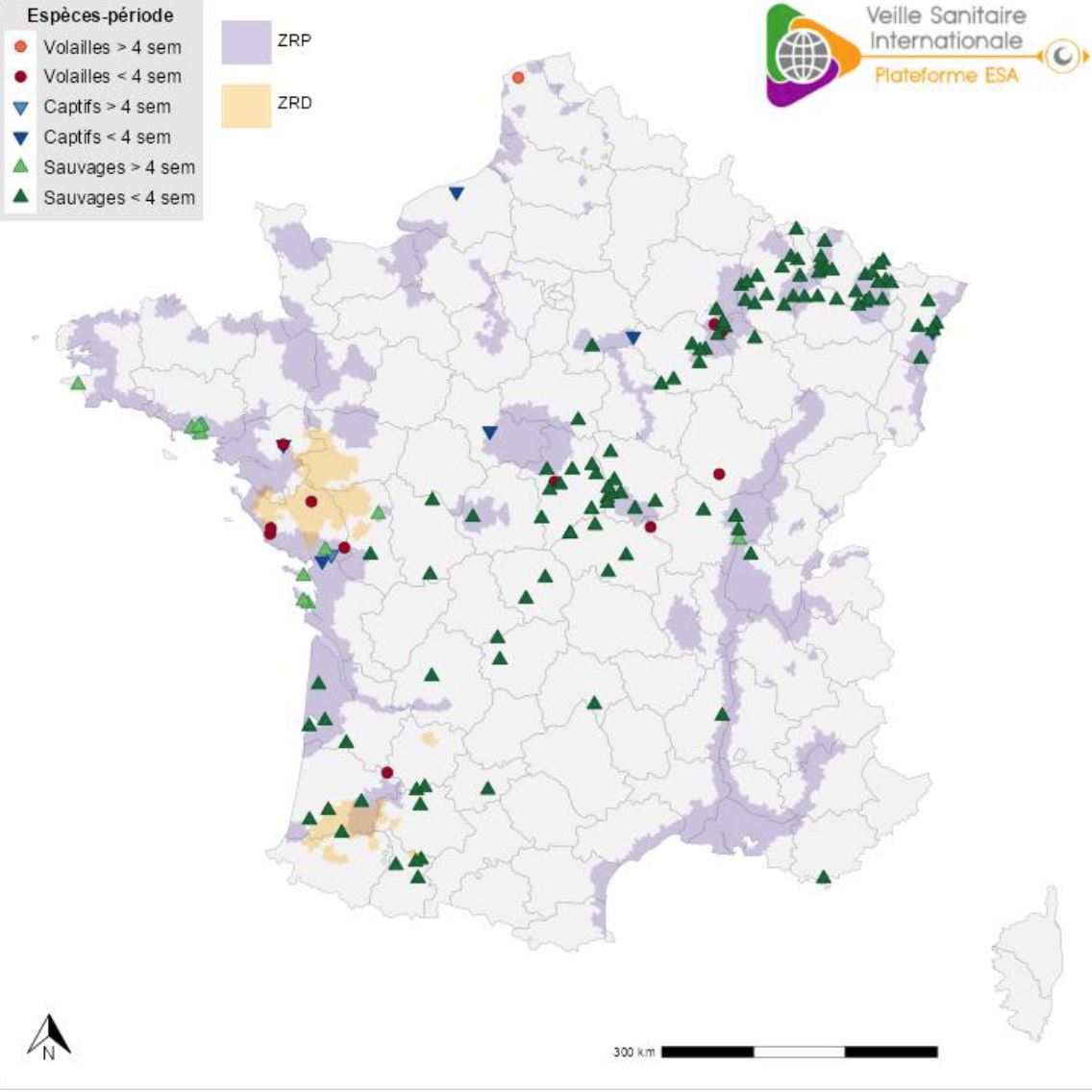
Update as of 19 Nov. 2025: Location of outbreaks in “poultry”, outbreaks in captive birds and cases in wild birds of highly pathogenic avian influenza detected in France since the start of the 2025-2026 season and in the last four weeks. On the map, Particular Risk Zones (ZRP) and Diffusion Risk Zones (ZRD) are shown in purple and yellow, respectively (source: European Commission, ADIS, 10/11/2025).
Vendée: the epicentre of the November resurgence
The department of Vendée (Pays de la Loire) has emerged as the primary focus of concern at the end of 2025.
November data confirms a worrying escalation:
- In less than a month, nine outbreaks were identified in Vendée, with eight occurring on farms and one in a backyard flock in Vix.
- Between 7 and 9 November 2025, the Vendée Departmental Laboratory specifically confirmed five new outbreaks in the municipalities of Les Achards (two), Coëx, Saint-Julien-des-Landes and La Boissière-de-Montaigu.
- By 18 November 2025, the number of confirmed outbreaks in Vendée had risen to around twenty, primarily in duck farms.
At the national level, the spread is widespread. Up to 17 November, 27 outbreaks had been reported on commercial farms and 8 in non-commercial backyard flocks and captive birds, affecting regions such as Pas-de-Calais, Loire-Atlantique, Lot-et-Garonne, Vendée, Cher, Haute-Marne, Allier, Côte-d’Or, Marne, and Dordogne, among others.
The outbreaks in Vendée are severely impacting key waterfowl sectors, affecting Muscovy duck (meat production) and Mulard duck (foie gras sector) farms.
The biological challenge: immunity and the third dose
The main biological lesson from this wave is the confirmation of immunological insufficiency in the current protocol.
Outbreaks are being detected in ducks that had already been vaccinated. These animals were of “a certain age” and had received their second injection several weeks before infection. Experts warn that protection wanes over time. Immunity is lost particularly as animals age, especially if the first dose was administered at the hatchery.
In response to this situation, the General Directorate for Food (DGAL) has reacted swiftly:
- Authorisation of the third dose: The DGAL authorised, as of 5 November, the administration of a third vaccine dose in Muscovy ducks, initially for those destined for force-feeding and now extended to Muscovy ducks in general.
- Reinforced strategy: Recent trials in waterfowl demonstrate that a three-injection schedule significantly strengthens the immune response and limits viral transmission through to the end of the production cycle.
- Potential mandatory status: The third dose, currently voluntary, should soon become mandatory in territories identified as being of particular risk, such as Vendée and neighbouring departments.
- Optimisation: The possibility of changing the interval between the first and second injection is also being studied in order to increase flock immunity and potentially avoid the need for a third dose.
The exogenous threat: wildlife
The elevated risk is driven by viral circulation in environmental wildlife. The risk of virus introduction onto farms remains very high, driven by wild birds, both migratory and resident.
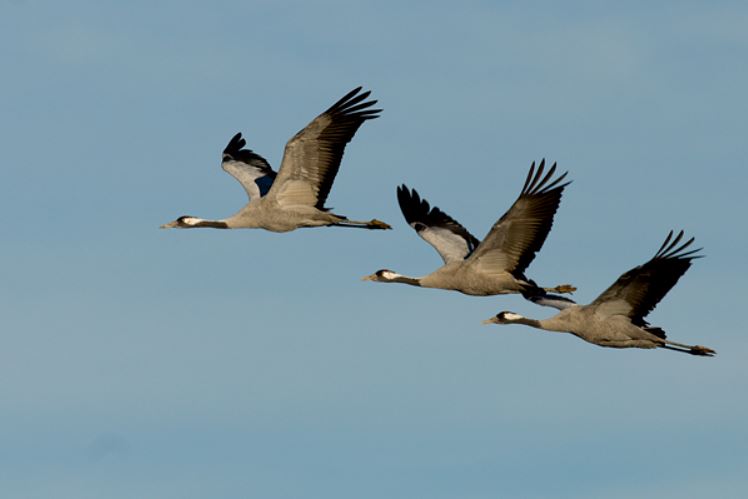
- Migratory vectors: The spread is associated with the migration of common cranes along the northeast/southwest corridor. The migration of these cranes has been linked to high mortality in Vendée and Deux-Sèvres.
- Controversy: It is important to note that, while authorities link the resurgence to wildlife, some ornithologists in Germany and environmental groups suspect the opposite: that wild and migratory birds are being infected by viruses that previously circulated on poultry farms. These critics point out that it is “extremely unlikely” that cranes would contaminate closed farms.
Economic impact for the affected poultry farmer….. and neighbouring farms
The “high risk” classification entails the activation of enhanced prevention and biosecurity measures throughout mainland France:
- Confinement: Birds of all species must be kept indoors. Holdings with fewer than 50 birds must confine them and protect them with netting; larger holdings must keep them in a closed building and protect feed from access by wild animals.
- Regulated Zones: Protection and surveillance zones have been established around affected municipalities.
- Sanitary Controls: Measures include the depopulation of affected premises, possible preventive culling within a defined perimeter, and cleaning and disinfection of sites. Movement restrictions and hunting activity restrictions also apply.
The economic impact is severe. Although the directly affected farms number around twenty, the restrictions have impacted hundreds of satellite businesses (slaughterhouses, neighbouring farms, shops, etc.) in Vendée. In addition to the costs of preventive culling and the lower value of flocks withdrawn prematurely, vaccination funding has been reduced. The State, which covered 70% of the cost last season, now only funds 40% of vaccines. This leaves poultry farmers concerned that “there is no guarantee today that any part of the vaccination costs will be borne” by the government.
For more information:
-. Poultry farming in France
-. Avian Influenza at NeXusAvicultura
Want to stay one step ahead in poultry farming?
Subscribe free to our eNewsletter and receive a weekly selection
of the best information to anticipate trends, stay up to date and grow as a poultry industry professional.
NeXusAvicultura: Vision, Criteria, Quality and Context.