
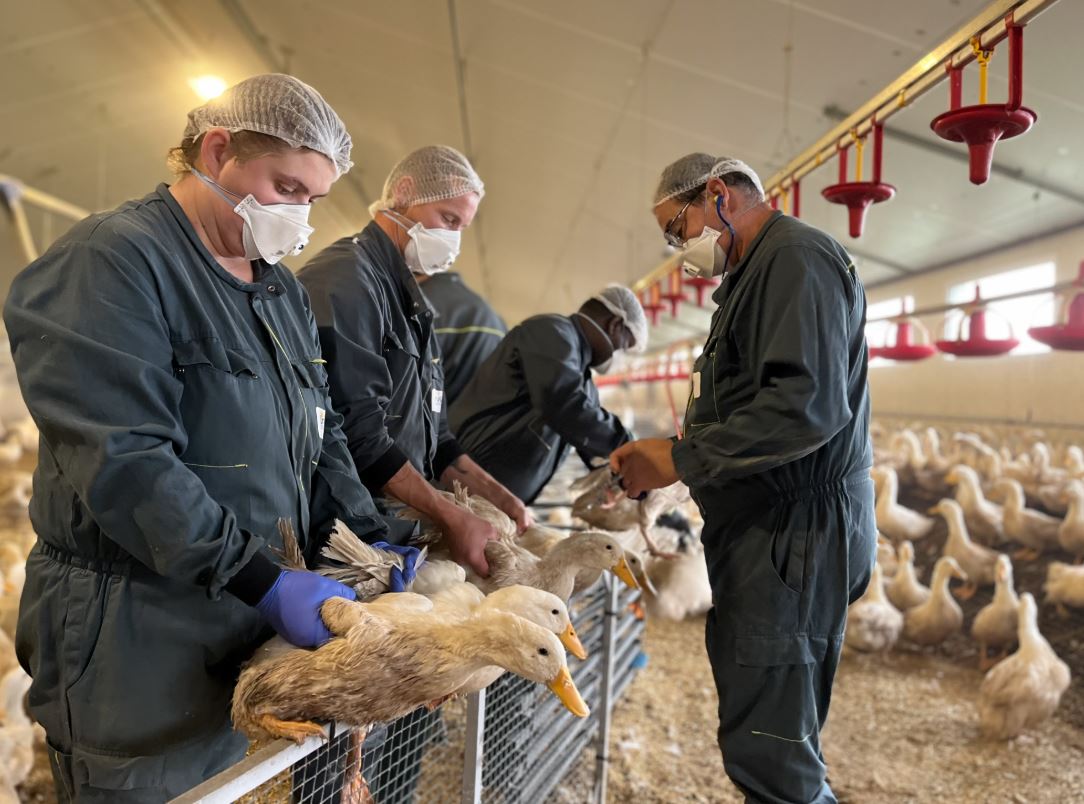
France launched its second vaccination campaign against highly pathogenic avian influenza (HPAI) in ducks on Tuesday, 1 October 2024. The sector and public authorities can build on the success of the previous campaign, launched on 1 October 2023, which helped limit the number of outbreaks in 2023/24.
France is thus renewing its preventive vaccination strategy against highly pathogenic avian influenza (HPAI), based on compulsory vaccination of farmed ducks, deployed in 2023/24. This campaign, unprecedented at European level, has enabled the vaccination of 60 million ducks over the past twelve months.
This strategy has helped limit the number of outbreaks on farms to just ten for the 2023/24 campaign, compared with more than 400 in the previous campaign. A study by the Chair of Biosecurity and Poultry Health at the National Veterinary School of Toulouse found that several hundred outbreaks were prevented thanks to this vaccination strategy.
To date, approximately 61 million ducks have been vaccinated. It is important to note that vaccination is considered a complementary measure, not a substitute for essential biosecurity practices. Furthermore, both the European Union and the World Organisation for Animal Health (WOAH) have endorsed vaccination as a valuable addition to traditional HPAI control measures.
Among the results achieved is a reduction in outbreaks. Only ten HPAI outbreaks were reported throughout the year, of which just two occurred on vaccinated farms. Research suggests that, without vaccination, France would likely have faced around 487 outbreaks.
There has also been a reduction in costs, as the total cost of the vaccination campaign was approximately €105 million for 60 million ducks, including 1.2 million breeding ducks. This is significantly less than the €1,400 million loss incurred during the 2021–2022 HPAI crisis.

This vaccination campaign, costing approximately one hundred million euros, will receive 70% financial support from the French State until the end of the year. The precise cost-sharing arrangement was drawn up in conjunction with the main stakeholders in the affected poultry sectors and was validated on 30 August. The system is fully operational, following the first vaccination campaign, which was successfully organised.
It should be recalled that vaccination is compulsory for farms with more than 250 ducks (Muscovy, Moulard and Pekin) whose products (meat and foie gras) are intended for commercial sale. This applies across the entire French territory (with the exception of Corsica), representing approximately 62 million ducks to be vaccinated on 2,500 farms.
Annie Genevard, Minister of Agriculture, Food Sovereignty and Forestry:
“I salute the commitment of all stakeholders who, together with the Ministry’s departments, have made it possible to launch this vaccination campaign, and in particular the poultry farmers, veterinarians and their representatives, as well as the vaccination teams, the vaccine and diagnostic laboratory producers, and the scientific experts.”
Vaccination does not mean lowering one’s guard
The Ministry of Agriculture, Food Sovereignty and Forestry calls on all sector stakeholders to remain vigilant with regard to highly pathogenic avian influenza and to strictly observe biosecurity measures. Surveillance, biosecurity and vaccination are indeed the three pillars for preventing the spread of highly pathogenic avian influenza.
Several hundred outbreaks potentially prevented through vaccination in 2023/24 (study)
A study by the Chair of Biosecurity and Poultry Health at the National Veterinary School of Toulouse (IAP Unit – ENVT-INRAE), published online as a preprint on 29 August 2024, estimates that, in the absence of vaccination, France could have experienced up to 701 farm outbreaks in 2023/24, far higher than the ten outbreaks actually recorded. The researchers drew on predictive models based on outbreak data detected on farms and in wildlife across several Western European countries since 2016.
Source: French Ministry of Agriculture