
NeXusAvicultura
Analysis article | 1 April 2026 19:45 h
Order APA/300/2026, published today in the BOE, partially revokes the confinement measures decreed in November 2025. Poultry raised in free-range systems may return outdoors across most of the country, but holdings located in special risk and surveillance zones — as defined in Annexes II and III of Order APA/2442/2006 — remain under confinement. With 16 outbreaks on farms, nearly 3 million birds culled in 2025, and an unprecedented level of viral pressure across Europe, the de-escalation comes with a clear message: biosecurity admits no relaxation.
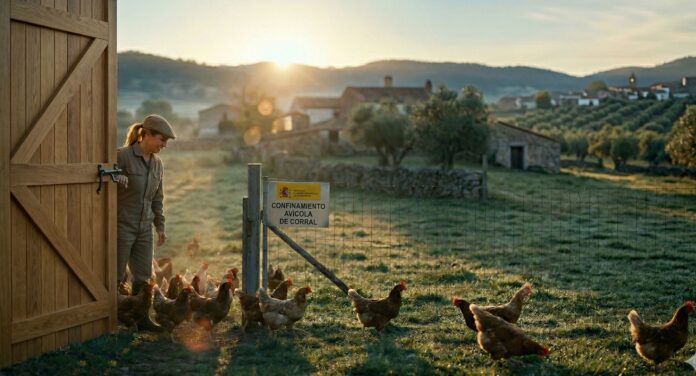
Return to free-range rearing
The BOE of Wednesday 1 April 2026 (No. 80) publishes Order APA/300/2026, of 31 March, signed by the (still) Minister Luis Planas Puchades (the Spanish government has put Planas forward as Director-General of FAO). Its operative content can be summarised in a single sentence: the confinement measures of Order APA/1288/2025, of 11 November, are hereby revoked for all holdings located in municipalities not included in Annexes II and III of Order APA/2442/2006.
In practical terms, laying hens, broilers, turkeys and other poultry reared in free-range systems across most of Spain may return to outdoor areas as of today, 1 April 2026. However, for poultry keepers whose municipalities appear on the lists of special risk zones (Annex II) or special surveillance zones (Annex III), the confinement remains in force. In total, 1,201 municipalities spread across all autonomous communities and the cities of Ceuta and Melilla remain under restriction.
The general confinement is lifted, but the regulatory shield remains active in 1,201 municipalities. Biosecurity is not a switch you turn off: it is a culture you maintain.
Why now and not before
Order APA/300/2026 itself sets out the three factors justifying the de-escalation: the absence of detected cases in wild birds over the past two weeks, the forecast rise in temperatures (spring reduces virus survival in the environment and decreases the density of migratory birds at Iberian wetlands), and the application of spatial risk-management tools for virus incursion developed by the Ministry itself.
There is a fourth implicit factor: since 10 February 2026, Spain has regained its status as a country free of highly pathogenic avian influenza (HPAI) before the World Organisation for Animal Health (WOAH), having completed the 28-day period free of active outbreaks following disinfection of the last affected holding. Maintaining a general confinement order over a country declared free of the disease was becoming increasingly difficult to sustain, both from an epidemiological standpoint and from political and commercial perspectives.
Nevertheless, the Order includes a significant caveat: should the favourable situation persist over the coming weeks, steps will be taken to revoke Order APA/1288/2025 in its entirety — that is, to lift the confinement in the 1,201 municipalities still under restriction. The door is open, but the Ministry is preserving its room for manoeuvre.
The Order opens the door to a full de-escalation if the favourable situation is consolidated.
But MAPA keeps its options open: no automatisms.
Five months of confinement: the chronology of an unprecedented season
To fully appreciate what is being lifted today, it is worth reviewing the sequence of events. On 13 November 2025, MAPA decreed the mandatory confinement of all free-range poultry in Spain via Order APA/1288/2025. Restrictions in the special risk and surveillance zones under Annexes II and III of Order APA/2442/2006 had already been activated a week earlier. The decision was a response to the worsening epidemiological situation in Europe and the accumulation of outbreaks in Spain: between July and November 2025, 14 outbreaks had been declared on production holdings.
The 2025–2026 season has been, in terms of ambient viral pressure, the worst in Europe over the past five years. The EFSA quarterly report published in March 2026 recorded more than 2,100 HPAI detections in wild birds — the highest figure for that period since records began (2016) — and nearly 16 million farm birds culled across 18 countries on the continent. In Spain, the final tally stands at 16 outbreaks on farms (15 in 2025 and one in January 2026), 165 detections in wild birds and six in captive birds.
The Spanish outbreaks were geographically concentrated along the Valladolid–Toledo–Lleida axis, with a particularly severe impact on laying hen operations: the farm at Villalar de los Comuneros (Valladolid), with 760,000 laying hens, and that at Bellpuig (Lleida), with 235,000, illustrate the devastating potential of a single outbreak. In total, Spain culled nearly 3 million farm birds in 2025 — the highest figure ever recorded in the country for this cause.
Nearly 3 million birds culled
in Spain across 15 outbreaks in 2025:
the highest figure on record.
HPAI is no longer a theoretical risk.
The 1,201 municipalities still under confinement: where and why?
The rationale behind the restrictions that remain in place is purely epidemiological. The municipalities still under confinement are those listed in the Annexes II and III of Order APA/2442/2006 — that is, those that surround or include wetlands identified as critical concentration points for migratory waterfowl. These include the Doñana marshes, the Ebro Delta, the Albufera de Valencia, the Aiguamolls de l’Empordà, the Villafáfila lagoons, the Gallocanta lagoon, the San Pedro del Pinatar saltpans and dozens more reservoirs, ponds and riverbanks distributed throughout Spain.
The breakdown by autonomous community reflects the correlation between wetland density, migratory routes and concentration of holdings: Castilla y León leads the list with 250 affected municipalities, followed by Catalonia (224), Andalusia (197), the Valencian Community (138), Aragon (128), Extremadura (99), Galicia (40), Cantabria (31), Castilla-La Mancha (18), the Community of Madrid (16), the Balearic Islands (14), Navarre (12), the Region of Murcia (11), the Principality of Asturias (8), the Basque Country (6), La Rioja (6) and the Canary Islands (1), as well as Ceuta and Melilla.
For poultry keepers in these municipalities, the practical situation does not change today: their birds must remain housed indoors, water supplies must be protected against wild birds, and poultry fairs and gatherings remain prohibited unless expressly authorised. Order APA/2442/2006, with its comprehensive set of biosecurity measures, remains the regulation governing their day-to-day operations.
FOR 1,201 MUNICIPALITIES Order APA/2442/2006, with its comprehensive set of biosecurity measures, remains the regulation governing their day-to-day operations.
The key question: until when?
Order APA/300/2026 offers a clue: “should this situation persist over the coming weeks, steps will be taken to revoke in its entirety” the confinement order. In other words, if spring confirms the favourable trend — fewer migratory birds, rising temperatures, no new outbreaks — the lifting of restrictions could be extended to the remaining 1,201 municipalities. The 2024–2025 season sets a precedent: in April 2025, preventive measures in the risk and surveillance zones were lifted following a much more benign season.
But the 2025–2026 season also leaves a more uncomfortable lesson. EFSA documented that 82% of outbreaks on European farms were primary introductions from wildlife, not farm-to-farm transmissions. Biosecurity is effective in preventing farm-to-farm spread, but it cannot prevent a virus circulating in millions of migratory birds from finding a gap through which to enter. Ambient viral pressure during the winter of 2025–2026 was three times higher than the previous year, and in the Netherlands, serological evidence of HPAI exposure in dairy cattle has been detected for the first time in the EU — a signal that the virus is broadening its host range.
82% of European outbreaks were direct introductions from wild birds.
Biosecurity curbs farm-to-farm transmission, but cannot stop what flies above the farms.
The unresolved debate: to vaccinate or not to vaccinate?
While France has been mandatorily vaccinating ducks since October 2023, and the Netherlands is advancing with field trials demonstrating the efficacy of vaccines such as VECTORMUNE AI (Ceva) and VAXXITEK HVT+IBD+H5 (Boehringer Ingelheim) in commercial layers, Spain continues to operate under a model based exclusively on biosecurity, surveillance and sanitary culling. The EFSA report of March 2026 notes that 14 of the 39 French outbreaks occurred on vaccinated duck holdings, with very low mortality, and that none of them had outdoor access.
The data are still insufficient for definitive conclusions, but the evidence points in the direction that vaccination significantly reduces outbreak severity and excreted viral load.
How many more seasons can Spain sustain a model based on housing and culling without incorporating vaccination as a complementary tool? This Order does not answer that question, but each winter makes it more pressing.
What is being lifted today is an extraordinary precautionary measure.
No one should mistake de-escalation for relaxation.
Immediate effect: the end of confinement does not mean the end of the threat.
MAPA has been explicit in its communiqué of 1 April: the lifting of the general confinement does not mean the end of the threat.
The official recommendation is to maintain and reinforce biosecurity measures on all holdings, not only those still under confinement.
MAPA also recommends strengthening passive surveillance, reporting any suspicion to the official veterinary services without delay, and rigorously applying the alert thresholds defined in Article 7 of Order APA/2442/2006:
feed consumption drop >20%,
egg production drop >5% for more than 2 days,
mortality >3% per week
remain mandatory obligations for all Spanish poultry keepers, whether or not they are in a risk zone.
Avian influenza is here to stay as an endemic risk. What is being lifted today is an extraordinary precautionary measure; what remains is the structural framework for prevention and control. No one should mistake de-escalation for relaxation.
Source:
-. MAPA: The Ministry of Agriculture, Fisheries and Food lifts the poultry confinement order as the avian influenza risk situation improves. Official communiqué, 1 April 2026.
Further reading:
-. Avian Influenza on NeXusAvicultura
-. The mandatory confinement in Spain
-. News on Vaccination of poultry keepers and personnel in contact with production birds to prevent zoonosis risks.
-. News on Vaccination of production poultry to prevent AI outbreaks
Want to stay one step ahead in poultry production?
Subscribe free to our eNewsletter and receive a weekly selection
of the best information to anticipate trends, stay up to date and develop as a poultry industry professional.
NeXusAvicultura: Vision, Insight, Quality and Context.