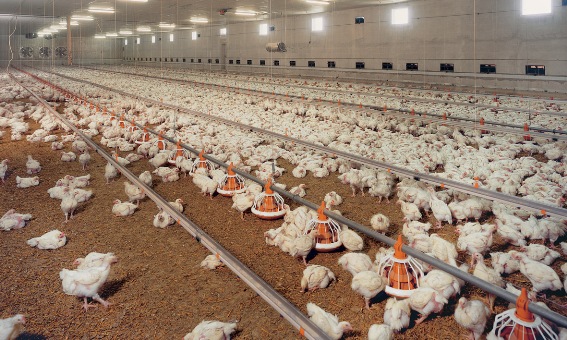


On-farm chick hatching technology is already commercially available and has just come of age with its adoption by one of the largest broiler integrators in the USA — one that has been particularly keen to position itself on sustainability with its customers.

On 23 January 2025, Perdue Farms, one of the five largest broiler integrators in the USA with 1,400 integrated broiler farms, announced that it will implement the on-farm hatching technology developed by NestBorn, becoming the first major poultry producer in the country to adopt this cutting-edge innovation.
This followed the successful completion of several trials on the Delmarva Peninsula, where two NestBorn machines were installed to place fertile eggs — after 18 days of incubation — directly onto fresh, prepared litter ready for a new flock, since with this technology it is eggs, not day-old chicks, that arrive at the farm.
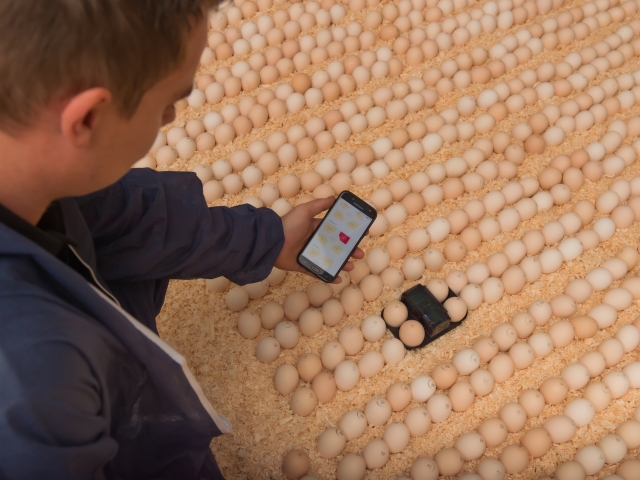
These eggs, with the house pre-warmed, are delivered and laid out in orderly rows across the entire clean litter surface, hatching directly on the bedding over the following 48 to 72 hours after arrival.

What makes this technology disruptive is that hatching does not take place in the hatchery — as it does on 99.9% of broiler farms worldwide — but inside the very house in which the birds will grow until they are removed for slaughter.

Perdue’s decision is particularly significant given recent trends in the US broiler sector. Although consumers are demanding that the US poultry industry produce chickens raised with no antibiotics whatsoever, their use has not yet been entirely eliminated. The various on-farm chick hatching systems, trialled for several years primarily in the Netherlands and Belgium, have now moved beyond the experimental stage into commercial application, having demonstrated that on-farm hatching dramatically reduces the need for antibiotics — as evidenced by European studies in which farms using this technology were 5.6 times more likely to remain antibiotic-free.

The production benefits are also substantial: farms that have adopted this technique report up to 4.4% higher final live weight and a significant reduction in mortality, since it is the egg (a living organism far less susceptible to stress) that is transported, rather than the day-old chick.
This system allows a wide hatching window and, above all, ensures that from the very first minute after hatching the chick has immediate access to feed. This aligns with Perdue’s commitment to “No Antibiotics Ever” by providing a practical means of maintaining antibiotic-free production while simultaneously driving operational efficiency.
Freedom of movement and immediate interaction with an ideally temperature-controlled environment greatly facilitates socialisation among chicks. Hatching in this setting means that instead of experiencing the stress of handling and transport from the hatchery, chicks have immediate access to feed and water as well as appropriate environmental conditions. This represents a paradigm shift in broiler production, one that is gradually gaining ground in Belgium and in certain other European countries where several hundred million chicks may already be hatching on-farm each year.

For the US broiler sector, Perdue’s adoption of this technology could mark the beginning of a significant shift towards production methods that better serve both animal welfare and operational efficiency. As Bruce Stewart Brown, Chief Science Officer at Perdue, notes, this innovation represents an important step forward in the company’s mission to “raise animals responsibly for food”.
How does the NestBorn on-farm hatching system work?
I was able to see this system first-hand in 2018, when Belgian company NestBorn had just launched it. In essence, the concept involves sending embryonated eggs to the farm immediately after candling at day 18. On arrival at a fully clean, prepared and pre-warmed house, the eggs are distributed directly onto the litter and hatch on it.
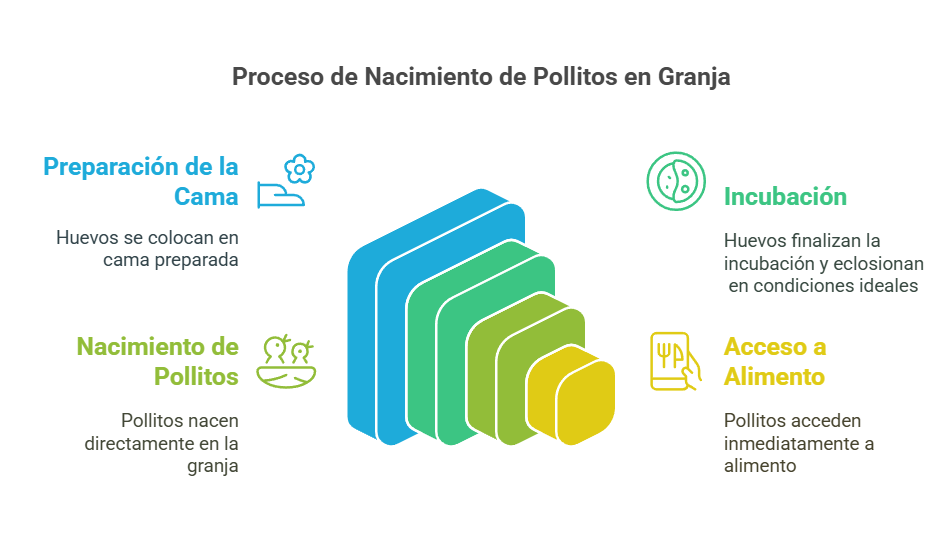
Precise environmental control in the house is obviously essential, as the house temperature must be approximately 38°C at the time of egg arrival. This diagram explains the full process.
The operation is carried out using a purpose-built, partially robotised vehicle that picks up eggs from trays and automatically places them onto the litter, which has previously been laid out in several strips or lanes across the house. It is a rapid process: in 2018 the vehicle placed 45,000 eggs per hour; by 2025 the speed can now reach up to 60,000 eggs per hour.
Federico Castelló
Founder and Director of NeXusAvicultura.com