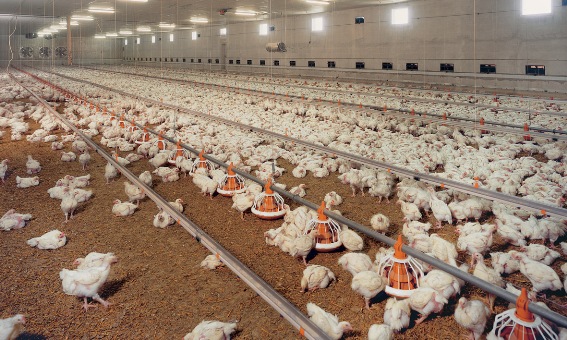


Temperature sensors should be placed 1.50 to 3 m from the sidewalls
Temperature sensors in a poultry house are, in a sense, its “eyes”, allowing us to “observe” what is happening inside in order to accurately determine what we need to do to maintain the appropriate environmental conditions. As a result, the grower’s ability to maintain adequate conditions is only as good as the information received from those “eyes”/sensors.
In today’s large poultry houses, it is not uncommon to see different temperatures in the centre of the house compared to the sides, between the centre and the end walls, and between the floor and the ceiling. If the grower is unaware of the hot and cold spots within the house due to poor sensor placement, they cannot take the corrective measures necessary to address these differences, and flock performance, health and welfare may suffer.
The following is a list of common mistakes when positioning sensors in poultry houses, which can affect the grower’s ability to provide the appropriate conditions for broiler growth.
1) Installing sensors along the centre of the house: Temperature sensors positioned in this location tend to give the most favourable readings because this is the zone where temperatures are usually most stable. The problem is that conditions near the sidewalls can be very different both in summer and in winter. During warm weather, the central axis of the house tends to be the coolest zone. However, on a hot summer’s day, the grower needs to be aware of what is happening in the hottest spots to ensure that birds near the sidewalls are not suffering from heat stress due to naturally lower air velocities and heat entering through the walls, particularly if they are poorly insulated. Conversely, during cold weather, it tends to be cooler near the sidewalls than along the central axis of the house due to excessive heat loss through poorly insulated walls, air leaks and defective sidewall inlets. Low air temperatures near the sidewalls can not only chill the birds but also increase litter moisture, as cold air does not dry it effectively.
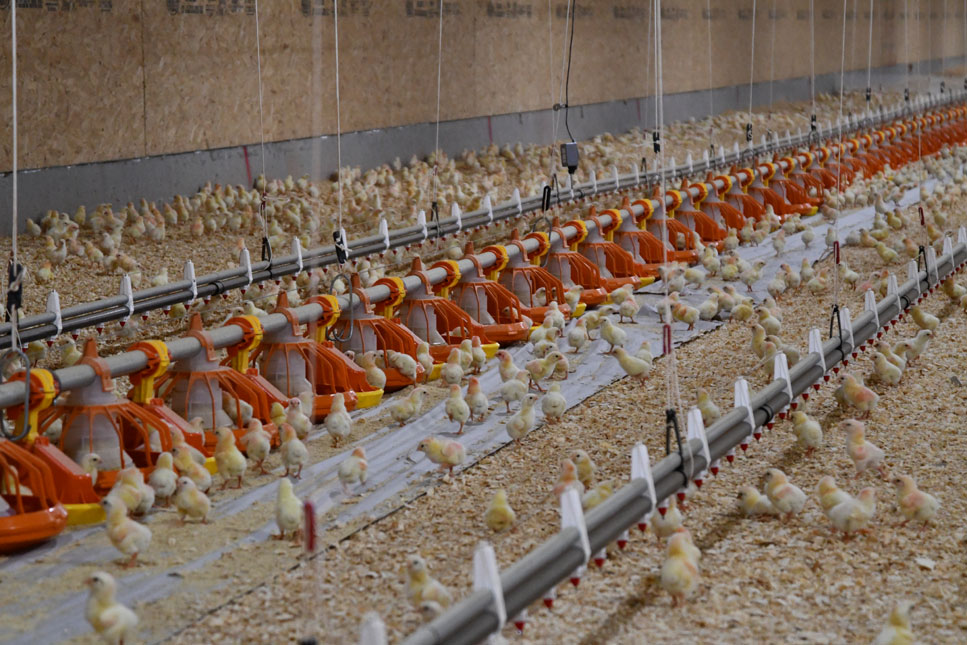
Higher litter moisture levels in turn produce higher ammonia concentrations in the house and, as a result, potential bird health and performance problems. The grower needs to be able to monitor these colder zones in order to take corrective action (e.g., activating heaters) before bird performance and health deteriorate. The key point to bear in mind is that, generally speaking, if birds near the sidewalls are comfortable, those in the centre of the house are most likely comfortable too. However, the opposite scenario is far from true.
In summary, to ensure that the majority of birds have optimal growing conditions, it is generally recommended to install temperature sensors at a distance of between 1.50 and 3 m from the sidewalls (alternating sides of the house), and ideally adjacent to a feeder or drinker line.
The correct placement of temperature sensors is crucial for maintaining bird welfare in a poultry house. They should be positioned between 1.5 and 3 metres from the sidewalls to ensure proper monitoring of environmental conditions. Placing them in the centre of the house or near radiant heaters can give incorrect readings. It is also recommended to avoid installing them too high or without slack in the cable, as this makes adjustment difficult and can negatively affect the birds.
2) Installing temperature sensors too far from the end walls or brooding curtains in the house. Temperature sensors are often placed 12 m or more from the end walls or brooding curtains of the house. The problem with this is that these zones tend to be colder than they should be during cold weather, simply because one is not aware that, traditionally, in a leaky house these areas run cold. As with low air temperatures near the sidewalls during cold weather, low air temperatures near the end walls and/or brooding curtains tend to result in greater litter caking, ammonia and bird chilling problems.
Furthermore, feeder lines are often located near the end walls, and if it is too cold (or too hot) there may not be enough birds in the area eating sufficient feed from the control pan to trigger it. To ensure that the areas near the end wall of a house remain warm and dry during cold weather and that there are enough birds to activate the control pans, temperature sensors should be placed within 1.50 m of the end walls or brooding curtains.
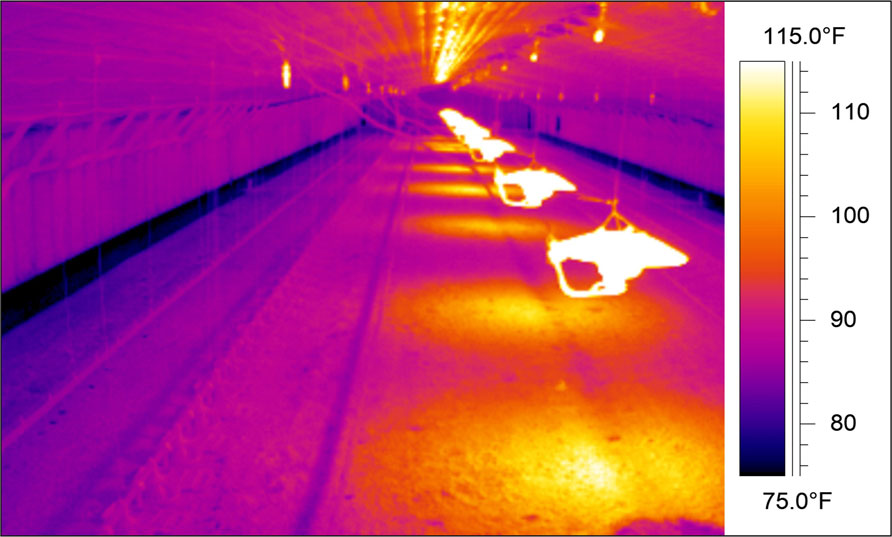
3) Placing temperature sensors too close to radiant heaters. The radiant heat produced by these heaters will warm the floor and nearby objects above the ambient air temperature of the house. The closer an object is to the heater (e.g., a sensor), the greater the amount of radiant heat it will receive and the higher its temperature will be. The problem is that those areas of the house receiving little or no radiant heat from the heater may never reach optimal air temperatures, while the grower believes the house temperature is adequate based on readings from sensors that are being heated well above the actual air temperature.
To prevent areas far from the heaters from becoming excessively cold, sensors should be placed at the edge of the radiant heat zones (the primarily heated areas). For most radiant heaters, sensors should be no less than 2.40 m away, and 5.50 m from radiant tubes.
4) Installing sensors too high above the birds. Sensors placed high above the floor are the most problematic during brooding, especially in houses without circulation fans. Sensors placed 0.60–0.90 m above the floor may fail to detect the cold air draughts that exist at chick level, due to the tendency of cold, heavy infiltrating air to remain close to the floor. To avoid this problem, sensors should be attached to drinker lines so that at the start of brooding they are less than 15 cm from the floor. This also helps to ensure that temperature sensors remain out of reach of the birds as the drinkers are raised.
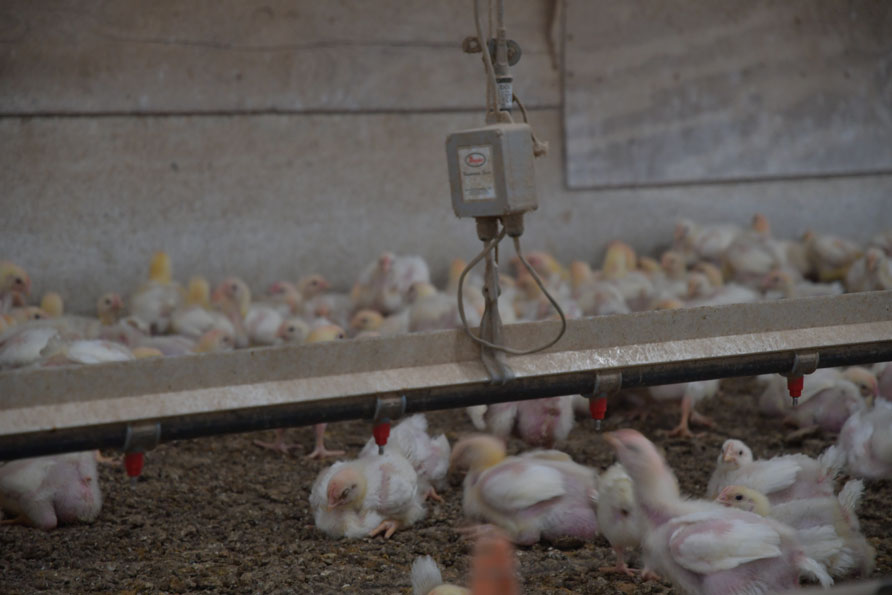
5) Installing temperature sensors without extra cable length. Although a grower may have a sound idea of where sensors should be placed, having a length of spare cable stored near the ceiling can make repositioning them much easier. A grower may find it beneficial to move a sensor further from or closer to the sidewalls. Additionally, a sensor may be positioned too close to a radiant heater or a sidewall, creating the need to move it slightly.
Source:
Michael Czarick and Brian Fairchild. Poultry Housing Tips, vol. 36, no. 3.