
A new paper-based assay promises to revolutionise surveillance of highly pathogenic avian influenza.
A new rapid diagnostic tool for highly pathogenic avian influenza (HPAI) promises to revolutionise the surveillance and control of this disease, which represents a constant threat to the poultry industry and public health worldwide. Researchers at Purdue University have developed a paper-based assay that is fast, cost-effective, easy to use and highly accurate, designed specifically for field use without the need for complex laboratory equipment.
This innovative technique, detailed in the article “A paper-based loop-mediated isothermal amplification assay for highly pathogenic avian influenza” published in April 2025 in the prestigious journal Nature Scientific Reports, could change the rules of the game in the fight against the H5N1 strain and other variants, enabling early detection that is crucial for containing outbreaks.
Unlike PCR, this method requires only a water bath and delivers visual results.
The assay detects the genetic material of the virus from a simple oral or nasal swab sample.
A solution for on-farm diagnosis
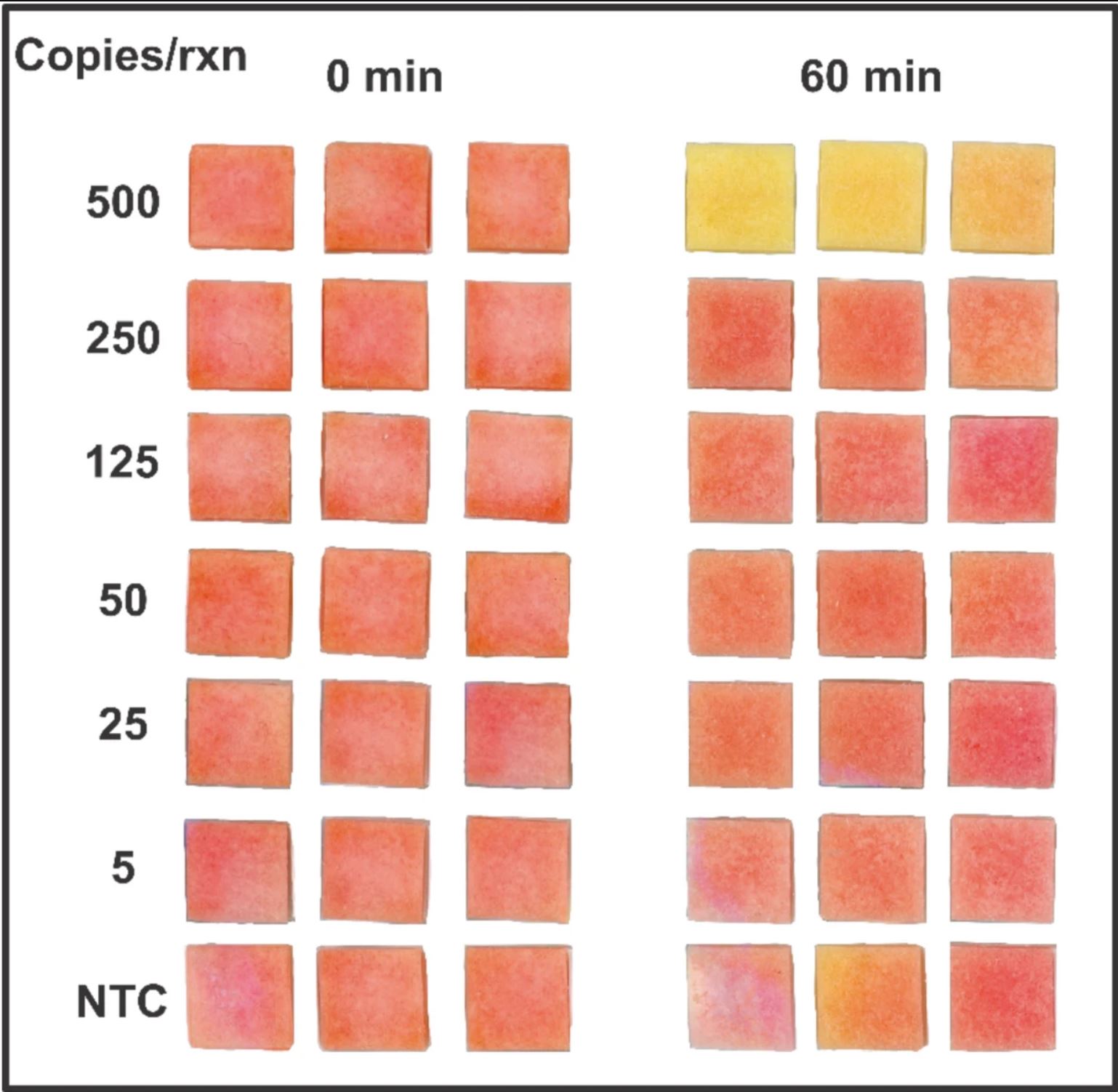
The new method is based on loop-mediated isothermal amplification (LAMP) technology and uses a simple paper device to detect the genetic material (RNA) of the avian influenza virus. Unlike standard quantitative PCR tests, which require sophisticated laboratory equipment and highly trained personnel, this new assay requires only a water bath for incubation and delivers results visible to the naked eye via a colour change.
The technique, developed by Purdue University, is designed to be used directly in the field.
The procedure is straightforward: a sample is taken using an oral or nasal swab from the bird, transferred to the paper device and, after a brief incubation period, a colour change indicates a positive result. This simplicity makes it ideal for use on farms, in rural areas or in resource-limited settings.

Its low cost and portability make it ideal for resource-limited settings.
Key advantages of the new technique
The main strength of this assay is its adaptability to field work, overcoming many of the limitations of current diagnostic tests.
- 1 Speed and simplicity: The assay requires minimal training to use and delivers rapid results, enabling management and control decisions to be made almost immediately.
- 2 High portability and low cost: Being a paper device that requires only a water bath, it is a cost-effective and easy-to-transport tool, eliminating dependence on a central laboratory.
- 3 High accuracy: Testing has demonstrated 100% analytical sensitivity and specificity, with a detection limit of 500 RNA copies per reaction.
- 4 No cross-reactivity: The assay has been rigorously validated, confirming that it does not react with 16 other common pathogens in poultry and livestock, thereby guaranteeing the reliability of its results.
- 5 Versatility of use: Although focused on the H5 strain of the virus, the platform is adaptable to detect other variants and can be used across a wide variety of species, including poultry, dairy cattle, wildlife and even humans.
The tool is versatile and can be used in poultry, livestock, wildlife and humans.
Impact on avian influenza surveillance and control
The ability to perform rapid, reliable diagnoses directly at the source of the problem is fundamental to any avian influenza control strategy. This tool enables poultry veterinarians and health authorities to rapidly identify infected animals, implement quarantine measures immediately and prevent the spread of the virus to other farms or to humans.
By democratising access to high-quality diagnostics, this paper-based assay has the potential to strengthen epidemiological surveillance programmes globally, particularly in regions where access to advanced diagnostic laboratories is limited.

Where to request further information?
The technology behind this assay is owned by the Purdue Research Foundation and is exclusively licensed to Krishi, a start-up company where Verma serves as Chief Technology Officer. The licence has been granted by the Purdue Innovates Office of Technology Commercialization. Krishi has just launched Sherpa™ as a field-deployable technology platform, which could incorporate the H5N1 test if required. Krishi is a portfolio company of Purdue Strategic Ventures.
For further reading:
-. Avian Influenza at NeXusAvicultura
-. A paper-based loop-mediated isothermal amplification assay for highly pathogenic avian influenza. Kamel, M., Davidson, J.L., Schober, J.M. et al. . Sci Rep 15, 12110 (2025). https://doi.org/10.1038/s41598-025-95452-6