

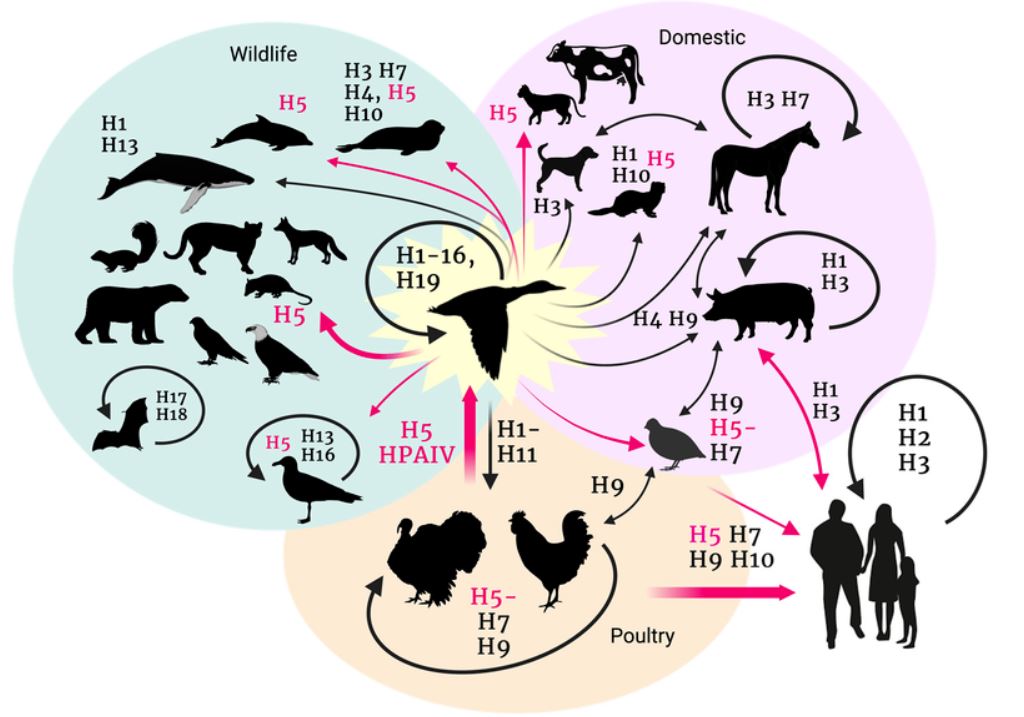
Since it was first discovered in birds in 1996, H5N1 (one of the most dangerous strains of avian influenza (AI)) has developed the tools necessary to penetrate the cells of an ever-growing list of species.
To date, it has infected and killed millions of wild and domestic birds and has been detected in at least 26 different mammal species, including mink in Spain, alpacas in the Andes, sea lions in Antarctica, and dairy cattle, domestic cats and mice in the United States, among others. Indeed, according to Dr. Jeremy Farrar, Chief Scientist of the World Health Organization (WHO), this constitutes a global pandemic of zoonotic animals.
With regard to the human species, the damage caused by AI has so far been only collateral, as we can become infected but are not truly the intended host.
However, all of that could change rapidly.
“AI actually produces mutations — in the sense of making errors when copying its genome — at a higher rate than a coronavirus such as SARS-CoV-2,” says Dr. Jesse Bloom, a virus biologist at the Fred Hutch Cancer Center in Seattle. These errors do not always work in the virus’s favour, as in most cases they are not sufficiently fit to continue replicating and surviving. But occasionally, a random error can give rise to a change that confers a selective advantage in its environment, allowing it to continue spreading and proliferating.
This means that if humans are that environment and H5N1 mutates in the right place at the right time, the animal pandemic could suddenly become a major problem for people as well.
In fact, we know that H5N1 has infected many people around the world over the past 30 years, although in general these infections have been sporadic and typically self-limiting. Nevertheless, the virus can still be fatal, as more than 50% of individuals known to have been infected with H5N1 have died.
Even so, the virus is not particularly well adapted to infecting humans. Even when it manages to enter a person and cause symptoms, it rarely transmits to another individual. “We refer to these as dead-end infections,” says Dr. Scott Weese, veterinarian and expert in zoonotic infections at the University of Guelph, Canada. The way this occurs is that if a person is exposed to a large viral load or their immune system is too weakened to resist, H5N1 gains entry. However, since it is not a virus well adapted to humans, it never truly accumulates in nasal and respiratory secretions, or in the throat and lungs, which would provide an exit route through coughing, sneezing, or even exhaled breath.
Recently, however, there have been at least three individuals who apparently sustained this type of infection among US workers on farms with infected dairy cattle. Two of them developed conjunctivitis or eye infections — with one reporting that their eyes were splashed with raw milk — while another developed respiratory symptoms following close contact with cattle. After treatment with an antiviral medication, none of them developed severe symptoms or infected others.
Regarding the H5N1 strain involved in this recent outbreak in cattle, it has been found to be unlikely that this version of the virus is transmitted via the airborne route. In experiments using ferrets — considered the ideal species for studying virus transmission to humans — researchers at the US Centers for Disease Control and Prevention (CDC) analysed a sample of the same H5N1 virus, taken from an affected individual in Texas, to experimentally infect several of these animals. Their study concluded that the virus affecting cattle in this outbreak was not well adapted for respiratory transmission.
So far, this also appears to be what is occurring in the real world. Although more than 80 dairy herds have tested positive across multiple locations in the US, the number of human infections has remained very low. This is good news, as it means the virus would need to undergo further change to become an infection capable of spreading from person to person via airborne droplets.
However, as seen with COVID, this could change as a result of minor ocular contact or a slight cough. The more opportunities the virus has to spread, the more opportunities it will have to mutate in ways that allow it to gain entry into human cells.
Furthermore, among the more than two dozen human infections with the H5N1 virus recorded worldwide since 2022, involving the virus’s most recent activity, there has been a broad spectrum of severity. According to the CDC, 14 cases were severe or critical, 7 were fatal, 6 were mild, and 8 were asymptomatic. According to Dr. Seema Lakdawala, microbiologist and immunologist at Emory University and influenza specialist, the differences in symptom severity may be attributable to prior exposure to seasonal influenza viruses. While those affected may not have had front-line antibodies ready to combat the infection, memory cells in the tissues may be capable of recognising components of a novel influenza virus and mounting a response against it.