
Challenges in Broiler Production
The global population is projected to reach more than 9.5 billion people by 2050, and global demand for animal protein (e.g., eggs, meat and milk) is expected to increase by more than 70% by that year compared to 2005. Feeding a growing world population with limited natural resources is a major challenge for animal agriculture.
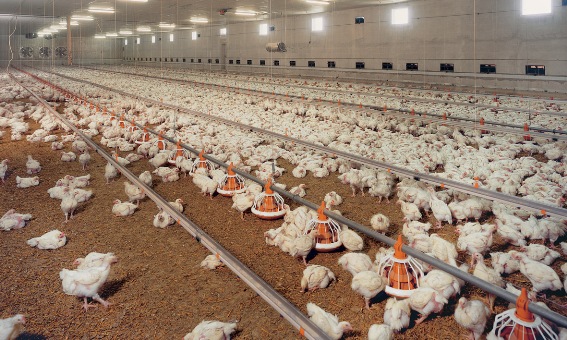
Broiler (meat) production has seen remarkable advances in recent decades. In 1950, the grow-out period for a market-weight broiler (2.3 to 2.7 kg) was 16 weeks, whereas today it takes only 5 to 6 weeks. Innovations in genetics, nutrition, vaccination, disease management and environmental control of grow-out houses have enabled this impressive progress. The efficiency achieved in poultry production has allowed broilers to dominate animal production at a global level. Currently, the United States is the world’s largest broiler producer, with annual sales valued at 40 billion dollars.
However, global broiler production faces emerging challenges related to animal health, food safety, environmental impact and growing public interest in animal welfare.
The rapid growth rate of broilers is associated with welfare problems such as lameness, which can restrict bird behaviour, cause physical discomfort and affect their fundamental freedoms. These concerns have attracted public and food industry attention, promoting improvements in broiler welfare and welfare assessment. Currently, such assessments include audits of producers’ daily records and independent third-party evaluations. As these assessments have matured and the science of avian welfare assessment has been validated, subjective or qualitative scoring systems are being replaced by quantifiable measurements. Automating welfare assessment not only eliminates subjectivity but also facilitates the assurance of poultry welfare to consumers in the products they purchase.
Imaging Technologies for Poultry Welfare Monitoring
Sensor technologies such as ultra-wideband radio frequency identification (RFID), accelerometers and computer vision-based monitoring have been and are being adapted and tested in livestock and poultry production systems to assist in welfare assessment. Monitoring methods that require direct contact with birds (e.g., RFID and accelerometers) may affect their activity, behaviour and welfare. Therefore, non-contact methods based on computer vision (i.e., cameras and automatic image processing) are considered the best option.
Behavioural monitoring of large animals (e.g., cattle and pigs) is made possible by well-developed computer vision technology for phenotyping. However, monitoring smaller animals such as broiler chickens in commercial poultry houses presents a technical challenge.
Most existing computer vision-based monitoring systems focus on the activity or behaviour of individual birds, such as feeding and drinking, light preference, time spent perching or on a platform, pecking, dust bathing and group activity or response to water spraying. Some early versions of imaging systems for the automated welfare assessment of broilers have been tested, but none are ready for use on commercial farms.
Among all the studies conducted, two groups stand out for having developed computer vision-based monitoring systems for poultry: the eYeNamic system and the optical flow method.
The eYeNamic System
The team of Daniel Berckmans in Belgium integrated a monitoring system called eYeNamic to assess walking ability in broiler chickens. This system is based on the six-point Kestin scale for evaluating broiler gait.
The eYeNamic system can detect differences in the activity index between groups with different gait scores. The activity index is quantified by the change in pixels in images over time.
This method indicates that an automatic tool can be developed to determine activity in relation to gait score (i.e., an indicator of walking ability). European Union countries use a six-point gait scoring system, while the United States employs a three-point system. A higher gait score indicates poorer leg health.

Adapted from “Application of a fully automatic analysis tool to assess the activity of broiler chickens with different gait scores”, by A. Aydin, O. Cangar, S. E. Ozcan, C. Bahr and D. Berckmans, 2010, Computers and Electronics in Agriculture, 73(2), pp. 194–199 (https://doi.org/10.1016/j.compag.2010.05.004).
© 2010 Elsevier B.V.
Broilers with scores of 4 and 5 showed significantly lower activity levels. However, the eYeNamic system was sensitive to detecting birds with scores of 4, 5 or 6, but not for intermediate scores (i.e., 2 and 3). Furthermore, there are many interferences on the floors of commercial houses (e.g., feeders, drinkers and other equipment) that affect image-based poultry activity monitoring.
This system still requires further innovation before commercialisation.
The Optical Flow Method
The team of Marian Dawkins in the United Kingdom developed an optical flow method to assess broiler chicken welfare and health. This method measures brightness changes in pixels of moving objects (e.g., chickens) and generates statistical properties of bird movement to analyse correlations with welfare indicators such as gait score, footpad dermatitis, gastrointestinal infections and hock burns.
The most recent study, “Optical flow, behaviour and broiler chicken welfare in the UK and Switzerland“, based on 74 commercial broiler flocks, indicated that the correlation between “footpad burns or lesions” and mortality can be detected automatically. However, the current method can only detect general correlations and it remains unclear how to track individual birds with welfare problems.
Currently, there are no validated systems for the automated welfare assessment of broilers in commercial houses. Nevertheless, these early studies with systems such as optical flow and eYeNamic show great potential for future poultry welfare assessment to be carried out using computer vision or artificial intelligence-based imaging systems.

Note. Lines represent the daily mean optical flow (flock movements) for Campylobacter-positive flocks (blue) and Campylobacter-negative flocks (green). From the first 10 days of life, Campylobacter-positive flocks showed lower mean movements than flocks in which Campylobacter was not detected. Solid lines show the response across ages, with points representing observed daily values. Dashed lines represent the 95% confidence limits for the responses across ages. The x-axis represents age in days.
Adapted from “Monitoring chicken flock behaviour provides early warning of infection by human pathogen Campylobacter”, by F. M. Colles, R. J. Cain, T. Nickson, A. L. Smith, S. J. Roberts, M. C. Maiden, D. Lunn and M. S. Dawkins, 2016, Proceedings of the Royal Society B: Biological Sciences, 283(1822), Article 20152323 (https://doi.org/10.1098/rspb.2015.2323).
© 2016 Colles et al.
A Case Study on Monitoring Broiler Floor Distribution Conducted by UGA
In commercial poultry houses, the density and distribution of chickens in drinking, feeding and resting areas are critical factors for assessing flock productivity, bird health and welfare. The correct distribution of broilers within the house significantly influences animal welfare and the environmental management of each house (e.g., ventilation problems affecting litter quality).
Currently, daily inspection of chicken distribution throughout each house is carried out manually, which is labour-intensive and time-consuming. Poultry science researchers at the University of Georgia (UGA) are developing an automated imaging system to monitor broiler floor distribution.
Methods
This study was conducted at the Poultry Research Centre of the University of Georgia in Athens, Georgia. Six identical pens measuring 1.8 × 1.1 metres were used to rear commercial Cobb-500 broilers (21 birds per pen) for 49 days.
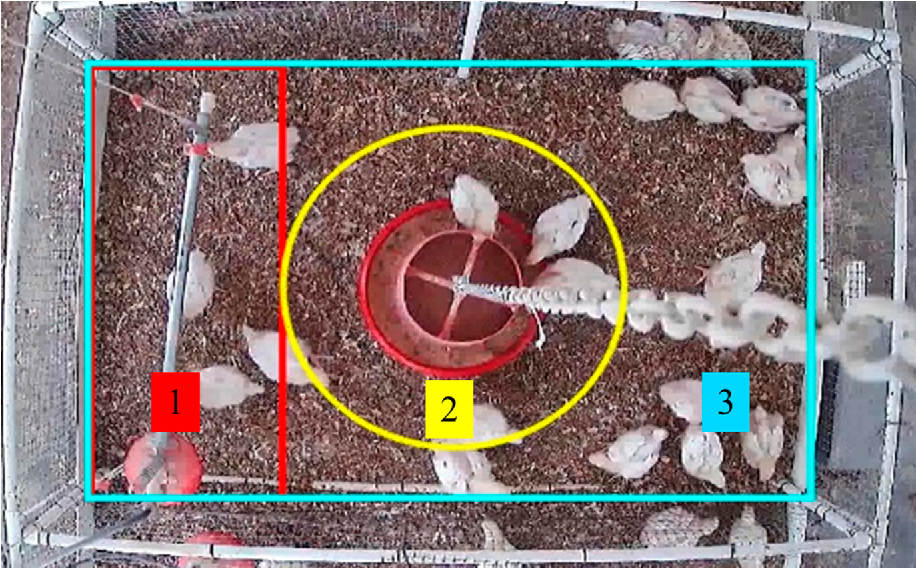
Each pen was monitored with a high-definition camera mounted on the ceiling at 2.4 metres above the pen floor, which captured videos of the group-housed chickens. For computer image analysis, the floor of each pen was virtually divided into three zones:
- Drinking zone
- Feeding zone
- Resting/exercise zone
The birds were reared antibiotic-free on reused litter (i.e., material previously used in another trial), composed of pine shavings, feed and poultry manure.
To determine the number of chickens in each drinking and feeding zone, a new computer programming method based on artificial intelligence was developed and applied.

Note. Zones are labelled: 1 – drinking zone; 2 – feeding zone; and 3 – resting zone.
Adapted from “A machine vision-based method for monitoring broiler chicken floor distribution”, by Y. Guo, L. Chai, S. E. Aggrey, A. Oladeinde, J. Johnson and G. Zock, 2020a, Sensors, 20(11), 3179 (https://doi.org/10.3390/s20113179).
© 2020 Guo et al.
Results
The distribution of broilers in the feeding and drinking zones was automatically identified using the newly developed method (Figure 4). The method first analyses the total number of chickens within the pen (Figure 3a) and then quantifies their distribution in each zone (Figure 3b).
The computer programming method was tested with 94% accuracy in detecting chickens in the drinking zone and 95% accuracy in the feeding zone (i.e., 95 out of every 100 chickens in the feeding zones were correctly identified by the method).

Source: “A machine vision-based method for monitoring broiler chicken floor distribution”, by Y. Guo, L. Chai, S. E. Aggrey, A. Oladeinde, J. Johnson and G. Zock, 2020a, Sensors, 20(11), 3179 (https://doi.org/10.3390/s20113179).
© 2020 Guo et al.
Problems and Solutions in Image-Based Monitoring
One of the problems with using any imaging technology is the viewing angle, specifically any element within that angle that obstructs the camera’s field of view.
Failed detections were mainly caused by equipment interferences, such as hanging feeder chains and water lines that blocked the view of chickens in the image. These problems were partially resolved through the use of a new image correction technology (Figure 5).

Source: “A machine vision-based method optimized for restoring broiler chicken images occluded by feeding and drinking equipment”, by Y. Guo, S. E. Aggrey, A. Oladeinde, J. Johnson, G. Zock and L. Chai, 2021, Animals, 11(1), 123 (https://doi.org/10.3390/ani11010123).
© 2021 Guo et al.
This image analysis programme was developed and tested to identify the floor distribution of broilers, specifically in the drinking and feeding zones.
We focused on the floor distribution pattern (i.e., real-time counts of the number of birds in the feeding and drinking zones) because this metric is technically quantifiable and correlates with bird welfare.
Broilers with health problems such as lameness or high gait scores tend to show less activity and to remain closer to feeders and drinkers due to locomotion limitations. The current methods provide the foundation for developing an automated approach to monitor floor distribution and broiler behaviours in a commercial production system.
Ongoing studies are focused on the detection of individual birds with different gait scores in the research facility. Despite the advances made, tracking individual birds with health or welfare problems using a computer vision-based method remains a technical challenge. However, this technology is necessary and critical for producers to be able to rapidly identify broilers with welfare problems and address those situations promptly.
Summary and Implications
The routine inspection of broiler welfare in commercial houses is carried out manually on a daily basis, which is labour-intensive and time-consuming.
For this reason, sensor technologies that can assist in welfare assessment are being tested, such as:
- Ultra-wideband radio frequency identification (RFID)
- Accelerometers
- Computer vision-based monitoring
Two early versions of computer vision-based monitoring systems, eYeNamic and optical flow, were developed for poultry welfare monitoring and tested in earlier studies. Although these systems are not yet ready for commercial use in identifying individual animals with welfare problems, they provide a preliminary model for future poultry welfare assessments based on computer vision or artificial intelligence.
An ongoing study, led by poultry science researchers at the University of Georgia, focuses on the correlation between broiler welfare indicators and floor distribution patterns (i.e., real-time counts of birds in drinking, feeding and resting zones). A computer programme for image analysis has been developed and tested. Approximately 7,000 bird profiles were extracted from 2,000 high-quality images (collected when birds were between 18 and 35 days of age) to develop the method.
Results showed that the accuracy of identifying bird distribution in the drinking and feeding zones was 94% and 95%, respectively. The majority of failed detections were caused by equipment interferences (e.g., hanging feeder chains or water lines).
This study lays the groundwork for the development of a real-time assessment tool to detect floor distribution and behaviours of broilers in commercial facilities.
However, gaps in the understanding of animal behaviour still exist. For example:
- The exact thresholds for defining a “good” or “poor” distribution of birds within the feeding, drinking and resting zones have yet to be determined.
- Hardware and software optimisation is needed for producers to be able to fully implement and use a behaviour monitoring system as part of an automated welfare assessment system.
Source:
-. “Application of Imaging Systems for Monitoring Poultry Well-being“. Lilong Chai et al. University of Georgia Department of Poultry Science
For further reading:
-. “Automating poultry farm management with artificial intelligence: Real-time detection and tracking of broiler chickens for enhanced and efficient health monitoring.” Depuru, B.K., Putsala, S. & Mishra, P. Trop Anim Health Prod 56, 75 (2024).
-. Applications of artificial intelligence in poultry production (use cases at NeXusAvicultura.com)