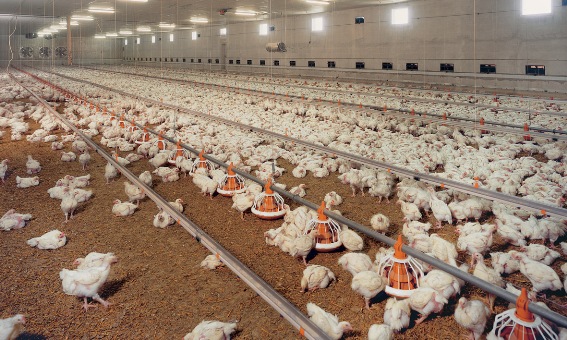

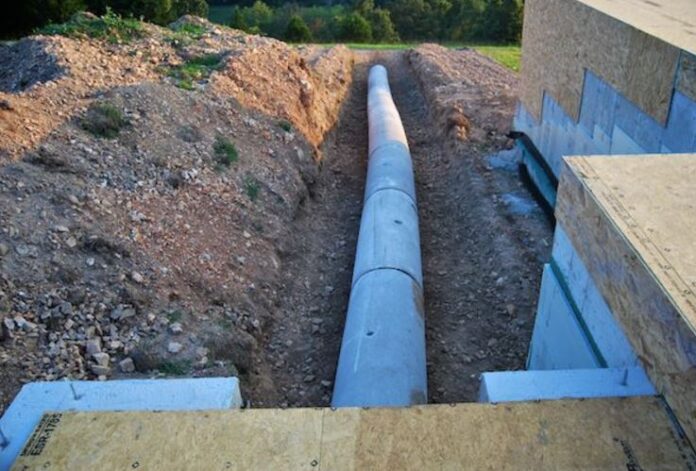
In an interesting article entitled “Performance of an earth-air heat exchanger in cooling, heating, and reducing carbon emissions of an industrial poultry farm: a case study” by Yousra Boutera, the performance and potential of a proposed earth-air heat exchanger system is studied with a view to meeting the environmental requirements of broilers and reducing energy consumption and greenhouse gas emissions in an industrial poultry house in southern Algeria. To this end, a detailed mathematical model was used to determine the thermal requirements of this industrial building. Ground temperature was analysed to estimate the appropriate depth at which to install the earth-air heat exchanger, followed by a parametric and economic study to determine its dimensions and cost. Finally, its performance was compared with the systems currently in use on this industrial farm.
The results of the study, obtained under extreme working conditions, showed that the earth-air heat exchanger can cover 45% and 38% of heating and cooling demands, respectively. In summer, the proposed exchanger was able to reduce the temperature from 47°C to 27.1°C, while in winter it managed to raise it from 4.8°C to 22.9°C, maintaining stable performance compared to the systems currently in use. Furthermore, it recorded better temperatures under extreme heat external conditions.
Furthermore, its use reduces CO2 emissions to 719 kgCO2/day in heating mode and 2,531 kgCO2/day in cooling mode, making it a suitable solution for this type of industrial building.
Note: it is important not to confuse an Earth-Air Heat Exchanger with Air-Air heat exchangers, which are the most commonly used in poultry houses.
Source: “Performance of earth-air heat exchanger in cooling, heating, and reducing carbon emissions of an industrial poultry farm: A case study.” Boutera, Y., Boultif, N., Rouag, A., Beldjani, C., & Moummi, N. (2022). Energy Sources, Part A: Recovery, Utilization, and Environmental Effects, 44(4), 9564–9583. https://doi.org/10.1080/15567036.2022.2132323
Further reading:
-. “The state of art on the applications, technology integration, and latest research trends of earth-air-heat exchanger system“