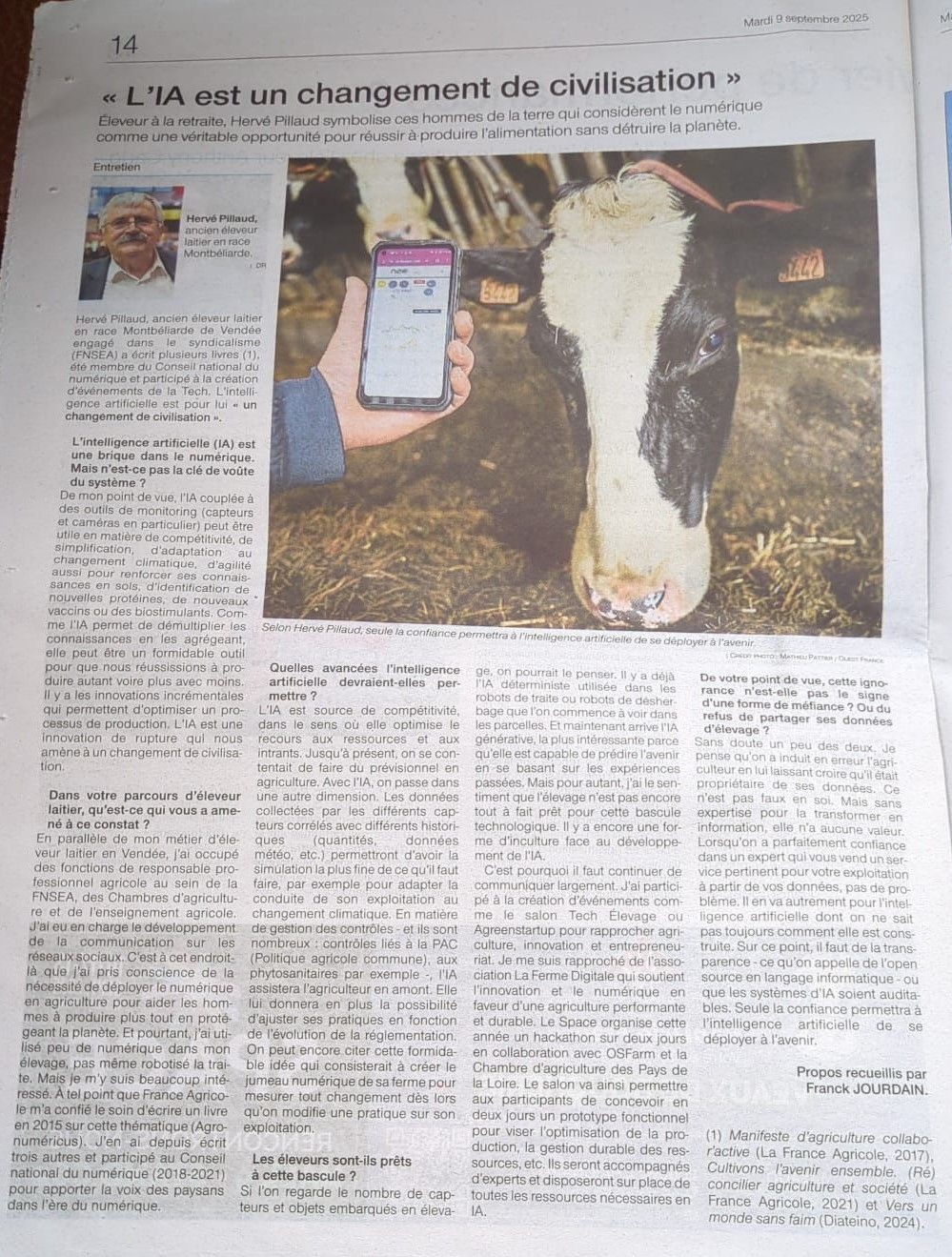


“AI IS A CIVILISATIONAL CHANGE”
Hervé Pillaud, farmer and futurist, is one of the emblematic members of those men of the land who regard digital technology as a genuine opportunity to produce food without destroying the planet.
According to Inrae, AI is the “new frontier of knowledge that enables artificial intelligence to combine with the intelligence of living systems”.
Interview conducted by Franck JOURDAIN and published by the newspaper Ouest France « L’IA est un changement de civilisation » on 9 Sept. 2025
Hervé Pillaud, a former Montbéliarde dairy farmer, was one of the first in France to robotise the milking of his animals. He is a member of the National Digital Council, the scientific advisory board of Inrae and of France AgriMer. He wrote “Towards a Civilisational Change”.
-. Frank Jourdain (FR): Is artificial intelligence (AI) being presented as the next agricultural revolution, an optimisation of the system?
Hervé Pillaud (HP): It is true that AI, together with robotisation (in particular, automated systems and cameras), can be regarded as a tool for optimising the system: optimising responses to climate change, anticipating disease, detecting oestrus, and even inventing new proteins, new manufacturing, storage and distribution processes, and reducing waste by aggregating data. It will thus enable gains in productivity and competitiveness, producing as much or more with fewer inputs (water, crop protection products, fertilisers). This would allow us to self-limit pressure on ecosystems. And that alone is enormous. But I believe it is leading us towards a civilisational change.
-. FR: Through your career as a dairy farmer, how did you reach this conclusion?
HP: I decided to become a dairy farmer while I was carrying out duties as an agricultural professional representative. Very early on I was confronted with the need for transparency and field-level information, traceability, and communication about practices. So very quickly I felt the need for data and the need to drive digital adoption in agriculture. The advent of digital technology has made it possible to produce more while at the same time protecting the planet. In 2009, moving from management IT to livestock farming, and then robotising milking, data fed decision-making in real time. To such an extent that FranceAgriMer, which published a report on the subject in 2011 (1), has a new thematic area (Agri-numérique), which since 2018 has been a priority of the national recovery and digital plan (2018–2021). We are entering the digital era.
-. FR: Should artificial intelligence become a compass?
HP: AI is a source of complexity, uncertainty and rapid change. In agriculture, until now, we were content to forecast. We operated using dashboards. AI brings another dimension: predictive data, cross-referenced, always correlated with different historical datasets. Artificial intelligence is also the capacity to produce the finest possible simulation of what needs to be done. For example, to optimise the management of one’s farm in the face of climate variability or market volatility. As we can see, the numerous compliance requirements linked to the CAP (Common Agricultural Policy) are becoming increasingly difficult to manage. AI will assist the farmer prior to decision-making, to help them choose and adjust their practices according to different parameters (agronomic, meteorological, etc.). And it is this formidable concept that consists of enabling each person to experiment on a small scale, to measure any change, provided it is traceable and scalable across their entire farm.
FR: Are livestock farmers ready for this change?
HP: Today, given the number of sensors and on-board devices in livestock farming, one might think so. There are already a certain number of precision livestock operations, but we are still in the early stages of what we are beginning to see in Silicon Valley. The whole challenge is that AI is coupled with the promise of data. However, livestock farmers do not yet have a data culture, they do not sufficiently recognise that livestock farming is not yet perceived as a sufficiently technology-driven sector. There is still a strong inertia. And for that, it takes a generation to achieve it.
That is why we must continue to train and support farmers by creating events such as “Digital Agri-Solutions”, an event that brings together agriculture, digital technology, innovation and entrepreneurship. La Ferme Digitale, with its La Ferme Digitale Foundation, which has established a research chair with Institut Agro for digital and sustainable agriculture. The Space trade fair is organising a round table this year, on 15 September, in collaboration with Osiarm and the Coopération Agricole Ouest on this topic. There is a genuine willingness among participants to jointly develop a sovereign and trustworthy AI aimed at optimising production and the welfare of both animals and farmers. They will be supported by experts and will have on-site access to all the AI resources they need.
FR: From your perspective, does this ignorance of data – also called “data ignorance” – or the reluctance to share it, have valid grounds?
HP: Having spoken with livestock farmers, I believe there is still a great deal to be done. My neighbour tells me: “data, I don’t see the point”, “I don’t see what use it is to me”, “I don’t see the value in it”. He does not understand that a single piece of information has no value on its own. But if we link data with other data, it can have genuine potential for his operation and for others. The real problem, for now, points in a different direction. It is the capture of that value by another party, by a third party, by a private company. On this point, transparency, ethics and a framework of trust are needed. Sovereignty is needed. On this point, the policy one wishes to pursue must be translated into computer language, or rather into artificial intelligence. That is the very nature of artificial intelligence: to project forward, to calculate the next move.
Source:
-. Newspaper Ouest France: « L’IA est un changement de civilisation ».