
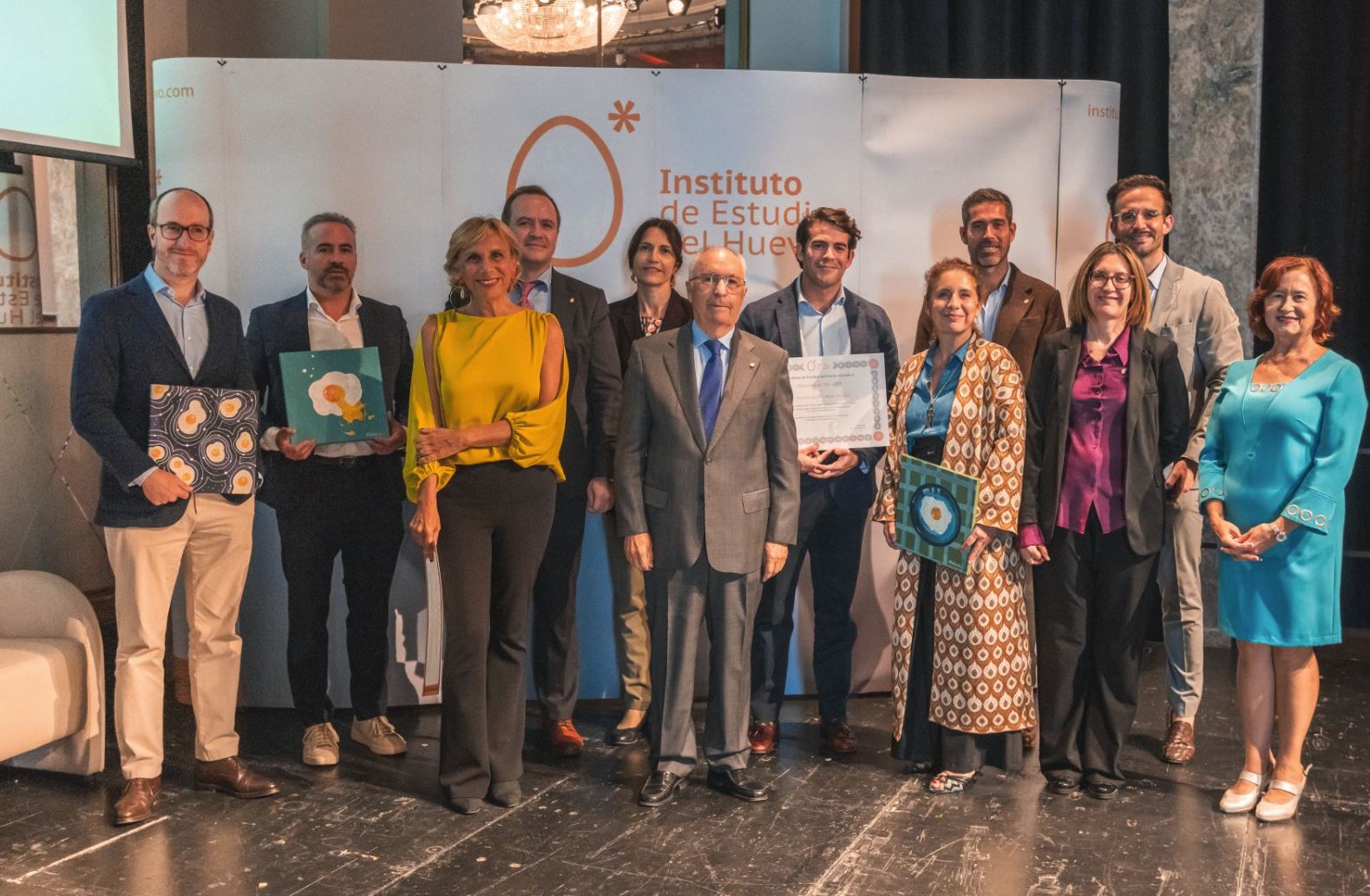
The IEH (Instituto de Estudios del Huevo) has awarded its annual research prize to Marta Garaulet, professor of physiology and nutrition, researcher and entrepreneur, for her project “The egg as a sleep modulator: Evidence from chrononutrition and circadian rhythms“.
The award ceremony was held on Wednesday, 8 October 2025, at the Círculo de Bellas Artes in Madrid, coinciding with World Egg Day, and aims to support young researchers and teams working across the many fields related to eggs.

The prize, endowed with €12,000, will contribute to the continuation of this research, as it has been doing since 1997 (see the full list of all prizes awarded at the foot of this article). The team led by Dr Garaulet at the University of Murcia, dedicated to Chrononutrition, aims to determine whether a food as complete as the egg can help us sleep better thanks to its natural tryptophan and melatonin content, especially when consumed at the right time of day.
For the professor of physiology and nutrition, “In Spain it has traditionally been common to include eggs at dinner — in the form of Spanish or French omelette, fried eggs or soft-boiled eggs — and we want to determine whether this habit, as well as being healthy, can promote sleep, both in terms of duration and quality. This award recognises the importance of investigating the relationship between diet and sleep from the perspective of circadian rhythms, and drives us to continue generating solid scientific evidence. We are grateful to the Instituto de Estudios del Huevo for its support of projects that integrate nutrition and health, and for its commitment to innovative research.”
In addition, cardiologist and science communicator Aurelio Rojas was awarded the Gold Prize.

The egg in the digital age: INPROVO and the Instituto de Estudios del Huevo debunk myths about this food
As part of the World Egg Day 2025 celebrations, the Instituto de Estudios del Huevo (IEH), jointly with the Organización Interprofesional del Huevo y sus Productos (INPROVO), at the same event held on 8 October 2025 at the Círculo de Bellas Artes in Madrid, organised a Round Table focused on debunking myths about this food in the digital age. The ceremony was opened by the President of the Instituto de Estudios del Huevo, Dr Pablo Catalá.
A highlight was the presentation of a pioneering study by Mónica Díaz-Ponte, Managing Director of Digital Addiction, who presented her work on the territory of eggs in the digital age, based on the analysis of more than 134,000 Spanish digital conversations (2022–2025) revealing how the egg has become the unexpected protagonist of the digital food revolution, positioning itself simultaneously as a gourmet product, natural supplement and symbol of “real food”.

The event also included a round table with experts in nutrition and communication, and culminated with the aforementioned presentation of the 2025 Research Award to Marta Garaulet and the 2025 Gold Prize to Aurelio Rojas.
The IEH event programme was as follows:
11:00: Registration of attendees and welcome coffee.
11:30: Welcome address – Dr Pablo Catalá, President of the Instituto de Estudios del Huevo
11:40: Guest lecture – Ms Mónica Díaz-Ponte, Managing Director of Digital Addiction: “The territory of the egg in the digital age“
12:10: Round table: “From myth to data: the egg in the digital age“
Moderator: Mr Jaime Martín, CEO of Lantern Innovation
Speakers:
– Dr Antelm Pujol, physician, scientist and science communicator.
– Mr Pablo Ojeda, nutrition expert and communicator.
– Mr Koldo Royo, chef and digital pioneer.
– Mr Rubén Martínez, egg producer and communicator.
13:00: Presentation of the 2025 Research Award – Mr Antonio Fuertes, Chairman of the Advisory Board of the Instituto de Estudios del Huevo.
13:10: Presentation of the 2025 Gold Prize – Ms Dolors Callís, Secretary of the Instituto de Estudios del Huevo.
13:20: Closing ceremony.
13:30 – 15:00: Cocktail reception.
The IEH Awards: an incentive for research into eggs and their benefits
The awards of the Instituto de Estudios del Huevo (IEH) were established in 1996 and are presented annually with the aim of recognising and honouring Spanish researchers who advance knowledge and dissemination on eggs, and who promote projects related to sustainability in egg and egg product production, their composition, quality, technology, and their appropriate use and consumption. 💡
📆 To participate in the next 2026 awards, write to institutohuevo@institutohuevo.com
List of all awards granted by the INSTITUTO DE ESTUDIOS DEL HUEVO from 1997 to 2025
2025 – “The egg as a sleep modulator: evidence from chrononutrition and circadian rhythms“, by Dr Marta Garaulet, Professor of Physiology and Nutrition at the University of Murcia. Her award-winning project investigates whether consuming eggs at dinner — a traditional habit in Spain — can improve sleep quality thanks to their natural tryptophan and melatonin content.
2024 – “Digital tools for real-time spatial monitoring of Avian Influenza in wild birds in Spain and assessment of its consequences for the sector“, developed by a multidisciplinary group from the Centro de Investigación en Sanidad Animal (CISA) – Instituto Nacional de Investigaciones Agrarias (INIA), affiliated with the CSIC. The project is aligned with the “One Health” strategy and will enable real-time assessment of the risk of spread of highly pathogenic Avian Influenza virus in Spain from wild birds, in order to apply preventive surveillance and control measures.
2023 – “Eggshell membrane with an apatite-coated outer layer: a new osteoinductive biohybrid compound for guided bone/tissue regeneration“, by a multidisciplinary research team of seven researchers and doctoral students from nine institutions, led by Mr Jaime Gómez Morales, Tenured Scientist at the Instituto Andaluz de Ciencias de la Tierra (CSIC–University of Granada). The work opens the door to the development of biomaterials from eggshell membrane, of great interest for medical applications in bone regeneration.
2022 – “Strategies for mitigating nitrogenous gas emissions on laying hen farms“, by Dr Eduardo Rosa González. This research, specifically a doctoral thesis, was carried out at NEIKER, the University of the Basque Country and the Basque Institute for Agricultural Research and Development, with Dr Pilar Merino Pereda and Dr Haritz Arriaga Sasieta serving as thesis supervisors.
2022 – “Eggshell membrane with an apatite-coated outer layer: a new osteoinductive biohybrid compound for guided bone/tissue regeneration“, by a multidisciplinary research team of seven researchers and doctoral students from nine institutions, led by Mr Jaime Gómez Morales, Tenured Scientist at the Instituto Andaluz de Ciencias de la Tierra (CSIC–University of Granada). The work opens the door to the development of biomaterials from eggshell membrane, of great interest for medical applications in bone regeneration.
2021 – “Incorporation of grape by-products into laying hen diets as a strategy to produce eggs enriched in bioactive compounds“, by a multidisciplinary research team comprising two veterinarians, two biologists and an agricultural engineer: Susana Chamorro Francisco, Mónica López Torres, Agustín Viveros Montoro, Inés Sánchez-Román Rojas and Ignacio Arija Martín. All are doctoral graduates affiliated with the Faculty of Veterinary Medicine and Faculty of Biological Sciences at the Universidad Complutense de Madrid.
2020 – “Valorisation of eggshell as a support for the development of catalysts for wastewater treatment“. Ms Paula Oulego Blanco, Ms Amanda Laca Pérez, Ms Sonia Calvo Barbería and Mr José Mario Díaz Fernández. Bioprocessors and Reactors Technology Group. University of Oviedo.
2019 – “Improvement of eggshell quality and food safety in an extended 100-week production cycle” (project). Alejandro Rodriguez Navarro. University of Granada.
2018 – “Characterisation of stress and technological treatment resistance, growth capacity and pathogenic potential of Salmonella Heidelberg, Salmonella Kentucky, Salmonella Livingstone and Salmonella Mbandaka” (project). Guillermo José Cebrián Aure. Faculty of Veterinary Medicine. University of Zaragoza.
2017 – “Peptide-based strategies for the prevention and treatment of egg allergy“. Daniel Lozano Ojalvo. Institute of Food Science Research (CIAL, CSIC–Universidad Autónoma de Madrid).
2016 – “Description of the nutritional profiles of egg consumers and their assessment in relation to all-cause and cause-specific mortality in the EPIC-Spain cohort” (project). Raúl Zamora Ros. Catalan Institute of Oncology–Bellvitge Biomedical Research Institute, L’Hospitalet del Llobregat (Barcelona).
2015 – “New products derived from egg yolk and its fractions for the packaging, cosmetic and food sectors“. José Mario Díaz Fernández. Bioprocessors and Reactors Technology Group, University of Oviedo.
2014 – “New techno-functional and health-promoting properties from egg protein hydrolysates“. Marta Miguel Castro (Institute of Food Science Research–CIAL CSIC-CIAL) and Mario Sandoval Huertas (Chef, Restaurante Coque).
2013 – “Pasteurisation of liquid egg by high-voltage pulsed electric fields“. Silvia Monfort Soler, from the Faculty of Veterinary Medicine, University of Zaragoza.
2012 – “Immune response in egg-allergic children following oral immunotherapy treatment“. Iván López Expósito and Elena Molina Hernández (Institute of Food Science Research–CIAL) and Marta Reche Frutos and Teresa Valbuena Garrido (Hospital Universitario Infanta Sofía, Madrid). (Project).
2011 – “Study of the immunological mechanisms involved in sensitisation and in the acquisition of natural tolerance in egg-allergic children“. Marta Vázquez Ortiz, Ana María Plaza Martín, Laila Alsina Manrique de Lara and María Anunciación Martín Mateos. Research Group on Infectious and Immunologically-based Diseases, Hospital Sant Joan de Déu, and Mr Manel Juan Otero, Mr Jordi Yagüe Ribes and Mr Ramón Vilella Puig from the IDIBAPS Research Group (Immunogenetics in Autoinflammatory Response).
2010 – “Technology transfer for biodegradation using closed batch digesters for the treatment of animal by-products from the laying hen sector“. Luis Manuel Navas Gracia, Mercedes Sánchez Báscones, Jesús Martín Gil, Salvador Hernández Navarro, María Ángeles Díez Gutiérrez, Adriana Correa Guimaraes and Carmen Teresa Bravo Sánchez. Higher Technical School of Agricultural Engineering, Palencia (University of Valladolid – Palencia Campus).
2009 – “Egg consumption is associated with better nutritional status, health condition and cognitive capacity in institutionalised elderly individuals with no cardiovascular history“. Aránzazu Aparicio Vizuete, Elena Rodríguez Rodríguez, Beatriz Navia Lombán, José Miguel Perea Sánchez, Pedro Andrés Carvajales, Ana Mª López Sobaler. Department of Nutrition and Food Science I (Nutrition). Faculty of Pharmacy. Universidad Complutense de Madrid.
2008 – “Treatment of egg yolk by a non-aggressive process aimed at obtaining value-added fractions“. Amanda Laca, Ms Carolina Sáez, Mr Benjamín Paredes and Mr Mario Díaz. Department of Chemical Engineering and Environmental Technology, University of Oviedo.
2007 – “Utility of skin prick tests and specific IgE determination in the follow-up of egg protein allergy in a paediatric population“. Mª Carmen Diéguez Pastor, Inmaculada Cerecedo Carballo and Belén de la Hoz Caballer (Allergology Department) and Alfonso Muriel García, Javier Zamora Romero and Víctor Abraira Santos (Clinical Biostatistics Unit). Hospital Universitario Ramón y Cajal. Madrid.
2006 – “Development of an analytical method based on pressurised solvent extraction and chromatographic analysis to verify the absence of fluoroquinolone antibiotic residues in eggs“. Ms María Dolores Marazuela Lamata, Ms Sonia Herranz de Andrés and Ms Maria Cruz Moreno-Bondi. Department of Analytical Chemistry, Faculty of Chemical Sciences. Universidad Complutense de Madrid, E-28040 Madrid, Spain.
2005 – “Effect of treatment with Antisecretory Factor, obtained from egg yolk, on the progression of TNBS-induced Colitis in Balb/c mice“. Elizabet Pedrosa Tapias, Ms Violeta Lorén Moreno and Mr Josep Mañé Almero. Research Team in Gastroenterological Pathology and Nutrition. Gastroenterology Department, Hospital Universitario Germans Trias i Pujol. Badalona (Barcelona, Spain).
2004 – “Selection of biological parameters in the quality of the potato omelette (tortilla de patatas) in catering services: the effectiveness of the Hazard Analysis and Critical Control Points (HACCP) system“. José Miguel Soriano, Jordi Mañes and Juan Carlos Moltó. Laboratory of Nutrition, Food Science and Food Safety. Faculty of Pharmacy. University of Valencia.
2003 – “Antihypertensive peptides derived from egg white proteins obtained by enzymatic hydrolysis.” Marta Miguel, Rosina López-Fandiño, Isidra Recio, Amaya Aleixandre1, Mercedes Ramos. Institute of Industrial Fermentations. Consejo Superior de Investigaciones Científicas (CSIC). 1Institute of Pharmacology and Toxicology. Faculty of Medicine. Universidad Complutense de Madrid.
2002 – “Innovations in the field of preparative-scale chromatographic separation of ovalbumin from egg white and in the application of its properties in the preparation of yoghurt mousse“. Benjamín Paredes, Samuel González, Manuel Rendueles and Mario Díaz. University of Oviedo. Department of Chemical Engineering and Environmental Technology.
2001 – “Modification of the fatty acid profile, α-tocopherol and oxidation levels in eggs enriched with ω3 polyunsaturated fatty acids after subjecting them to different thermal processing methods“. Lucia Cotinas, Jaume Galobart i Cots, Ana C. Barroeta Lajustícia and Mª Dolores Baucells Sánchez. U.D. Nutrició i Alimentació Animals. Facultat de Veterinària. Universitat Autònoma de Barcelona.
2000 – “Protective effect of lutein and other antioxidant agents present in eggs in a model of oxidative stress in the Apo-E deficient mouse“. Ms Patricia Fernández Robredo. Department of Cardiology. University of Navarra. To the “Real Escuela de Avicultura” for its outstanding contribution to the development of modern poultry farming in Spain, the training of specialists and technicians, and the dissemination of poultry science and technology.
1999 – “Modulation of cell proliferation by cholesterol“. Beatriz Ledo Trujillo. Biochemistry-Research Department, Hospital Ramón y Cajal (Madrid). “Productive and behavioural study of two laying hen strains housed in conventional and enriched-environment cages“. Maria Dolores Lidón Martín. Faculty of Veterinary Medicine. University of Zaragoza. Department of Animal Production and Food Science. “Improvement of oxidative stability in eggs and egg products enriched with ω3 or ω6 PUFA: vitamin E vs. canthaxanthin“. Jaume Galobart i Cots1, Ana C. Barroeta Lajustícia1, Mª Dolores Baucells Sánchez1 and Rafael Codony Salcedo2. 1U.D. Nutrició i Alimentació Animals. Facultat de Veterinària. Universitat Autònoma de Barcelona. 08193 Bellaterra. 2Dep. Ciències Fisiològiques Humanes i de la Nutrició. Universitat de Barcelona.
1998 – “Influence of diet and laying hen strain on the fat composition of eggs consumed in the Community of Madrid“. Francisco J. Sánchez-Muniz1*, Ovidio Jiménez1, M. José González-Muñoz2, Sara Bastida1. 1Department of Nutrition and Food Science I (Nutrition). Faculty of Pharmacy. Universidad Complutense. 28040-Madrid. 2Department of Nutrition and Food Science. Faculty of Pharmacy. University of Alcalá de Henares (Madrid). Francisco J. Sánchez-Muniz. Department of Nutrition and Food Science I (Nutrition). Faculty of Pharmacy. Universidad Complutense.
1997 – “Influence of fat and fat-soluble vitamin supplementation in laying hen diets on the dietary value of eggs“. Grobas Mosquera, Jesús Méndez Batán, Pilar Cachaldora Calderón, de Blas Beorlegui1 and Gonzalo González Mateos. Department of Animal Production. E.T.S.I. Agrónomos de Madrid. Cooperativas Orensanas (COREN, S.C.L.) “Effect of high hydrostatic pressure on egg products: microbiological aspects“. Eduardo Ponce and Reyes Pla. Faculty of Veterinary Medicine. Universitat Autònoma de Barcelona. Food Technology Area.
The Instituto de Estudios del Huevo is a non-profit organisation established in 1996 with the aim of supporting research, training and dissemination on eggs in relation to food, nutrition, health and the factors that determine quality in egg production and processing. It has an advisory board of experts who define its work and contribute their expertise and knowledge to the achievement of the Institute’s objectives.
For further information:
-. World Egg Day
-. Instituto de Estudios del Huevo
-. Terms and conditions of the IEH 2025 Research Award