
A team from the School of Earth Sciences at the University of Bristol (UK) has answered this question once and for all.
Some have argued that eggs came first, having been laid by the dinosaur ancestors of birds, while others believe that a chicken appeared out of nowhere and then proceeded to lay an egg.
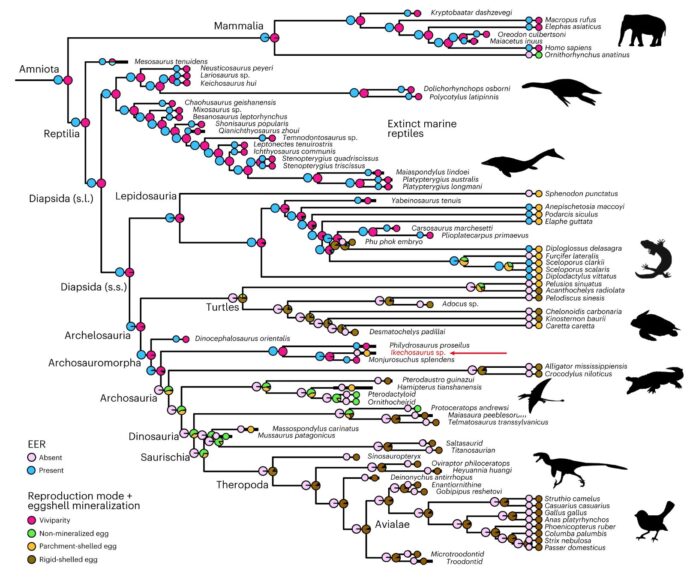
And in a study published in Nature Ecology & Evolution, a team of scientists decided to take 51 fossil species and 29 living species and divide them into two categories for examination: oviparous (laying hard- or soft-shelled eggs) and viviparous (giving birth to live young, as humans do).
The study found that the earliest reptilian ancestors of chickens were viviparous (they gave birth to live young and did not lay eggs).
“The earliest ancestors of chickens were viviparous, giving birth to live young rather than laying eggs.”
And although both teams from the University of Bristol and Nanjing in China noted that hard-shelled egg-laying has been one of nature’s greatest milestones, this research is particularly noteworthy.
The team explained that the research implies that prolonged embryo retention (where the mother retains her young within her own body prior to birth) was the ultimate form of protection for this particular group of animals; so, essentially, at that time, giving birth to a live chicken was safer than laying an egg.
And in far more scientific terms than that, Professor Michael Benton of the University of Bristol said: “before amniotes, the earliest tetrapods that developed limbs from fish fins had broadly amphibious habits and had to live in or near water to feed and reproduce, like modern amphibians such as frogs. When amniotes appeared on the scene 320 million years ago, they were able to separate themselves from water by developing waterproof skin and other means of controlling water loss, but the amniotic egg was the key.”
“The amniotic egg allowed amniotes to free themselves from water, marking an evolutionary milestone.”
Project leader Professor Baoyu Jiang adds: “this standard view has been challenged since some biologists had observed that many lizards and snakes display a flexible reproductive strategy between oviparity and viviparity, as closely related species sometimes exhibit both behaviours, and it turns out that viviparous lizards can revert to egg-laying far more easily than had been assumed.”
So it seems the debate may be settled after all — or at least defused — with scientists devising a new theory suggesting that it could be the chicken that came before the egg.
Therefore, according to this research, the chicken came first.