
The idea of joining together emerged after the pandemic, when farms noted the sharp rise in costs
Seven small organic egg producers from the provinces of Girona and Barcelona have joined a cooperative to pool their efforts and make their operations viable.
Rising prices, the threat posed by large producers, and the difficulty of balancing farm work with administrative tasks have led these operations to unite in order to gain greater strength and avoid having to close.
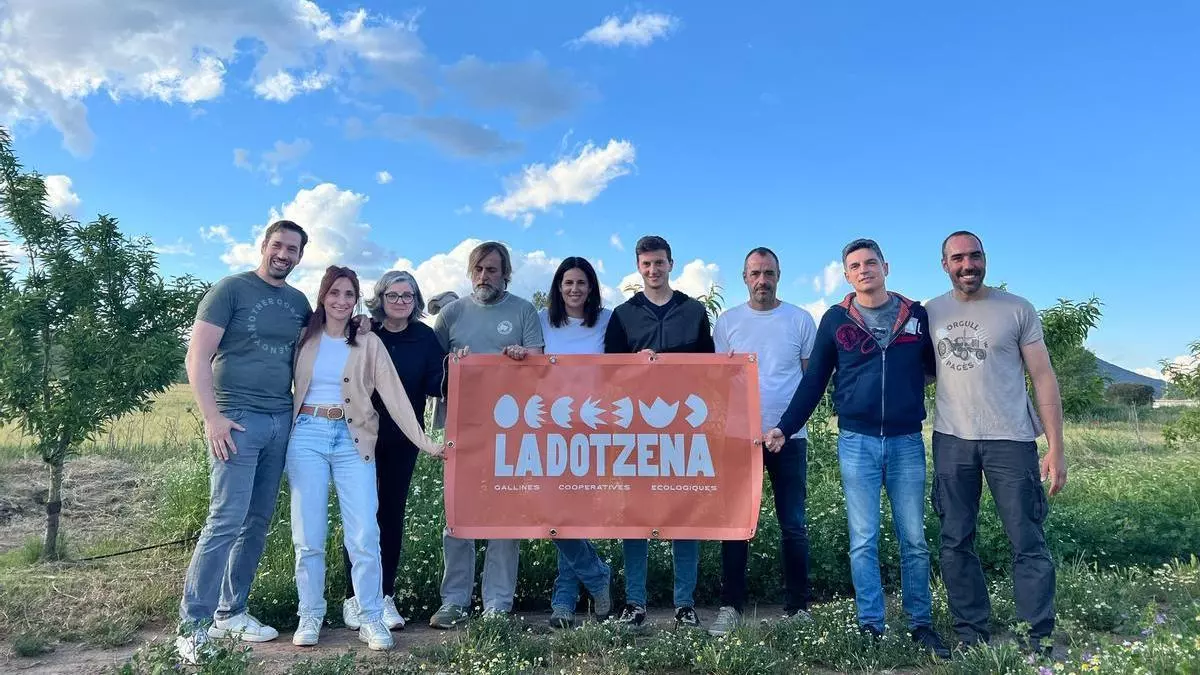
Operating under the name “La Dotzena“, the cooperative comprises Ous d’Orpí, in Anoia; Ous Eco del Montseny (Breda) and Granja Slou (Riudarenes), both in the comarca of Selva; Mas Estrach (Fornells de la Selva), in the Gironès; Les Tafaneres (Sora), in Osona; La Torrassa (Sant Esteve Sesrovires), in the Baix Llobregat; and Els Ous de l’Oriol (Cabrianes), in the Bages.
“We call ourselves the small producers’ revolution so that we can assert ourselves as small producers — we want to remain small, but we also want to be viable,” explains one of the members, Oriol Comallonga.

La Dotzena is the first cooperative in Catalonia of small organic egg producers. The seven farms, spread across various comarcas in the provinces of Barcelona and Girona, have joined forces to market under a single brand and collectively address future challenges and the threat posed by large producers.
One of the members, Gemma Jaén of Granja Slou, explains that competition in the egg market is “increasingly fierce”: “Eggs are coming in from large farms elsewhere and it is becoming ever harder to maintain profit margins.”
The creation of the cooperative, Jaén explains, has enabled the seven operations to keep working and “avoid falling into the hands of large producers”. “Many of us were at breaking point and our only options were to close down or integrate into a large producer — and we wanted neither option A nor option B,” Jaén recounts.
Joining together in a cooperative allows them to streamline processes such as packaging, distribution, and marketing. “We are now far more efficient and everyone benefits,” she concludes.
“In fact,” she explains, “until now each farm had to carry out every process in the chain individually — caring for the hens, collecting the eggs, handling customer service, the commercial side, and distribution. “It was unviable,” Jaén concludes. Now, she asserts, each producer “can focus on looking after their farm, keeping it in impeccable condition, and in doing so we will also improve egg quality.”
The idea of joining together emerged after the pandemic, when farms recognised the difficulties of staying afloat due to inflation and rising costs. Oriol Comallonga, owner of the farm Els Ous de l’Oriol, explains that on top of all this, many large conventional egg producers began setting up organic egg farms.
“We started to see organic eggs on the market being sold below our production costs, and that was a wake-up call,” he admits.

All hens in the cooperative are raised cage-free and must be guaranteed access to 4 m2 of outdoor range per bird. The Ateneo Cooperativo de les Terres Gironines and Arran de Terra Cooperativa have supported the seven farms throughout the cooperative formation process. The cooperative has opened a facility in Artés (Bages), where egg packing is carried out. Distribution is handled by the Girona-based cooperative La Diligencia.