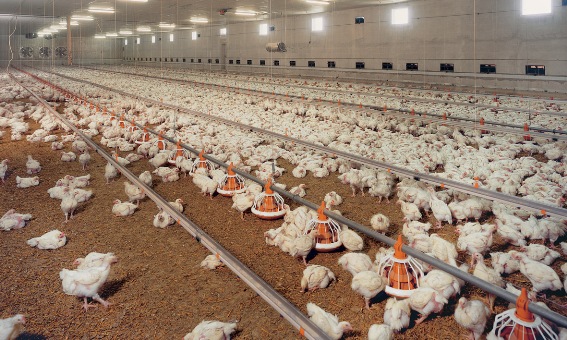

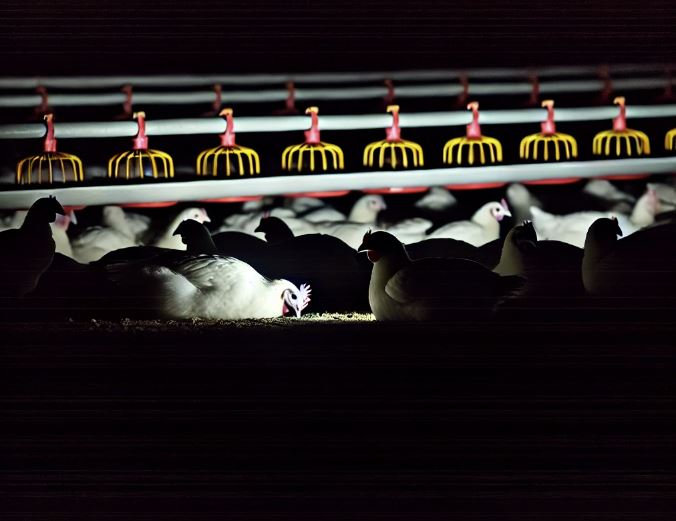
Inspired by nature, variable lighting promotes the welfare of broilers.
As is already known, the intensity, wavelength and duration of lighting influence broiler activity, feed and water intake, and overall productivity. It is also known that light intensity affects animal welfare and mortality. However, there is little research to support current lighting recommendations and, until recently, few studies have analysed how lighting affects broiler welfare.
A recent study, led by Seong Wook Kang, director of the University of Arkansas Poultry Experimental Station, examined broiler lighting preferences. The commercial-scale study was carried out at the Tyson Foods broiler research farm in Springdale, Arkansas, and revealed that broilers have lighting preferences, and that offering them the ability to choose provides benefits such as improved feed conversion, reduced fear response and fewer welfare-related issues.
These findings could change the rules of broiler rearing in terms of welfare on a global scale. Inspired by nature — for while the vast majority of commercial broiler farms operate under uniform lighting conditions, in the wild, red junglefowl live in tropical forests where light is received unevenly.
Drawing inspiration from nature, Kang set out to determine whether non-uniform artificial light could be used as a tool to promote broiler welfare and performance. In 2016 he sought to answer this question through a series of trials and, intrigued by the results, Tyson Foods offered its research farm to test the effects of “graduated lighting” or “zone lighting” under commercial-scale conditions, enabling Karen Christensen, the company’s Director of Animal Welfare, to collaborate with Kang on the project.
Broilers are diurnal by nature, meaning they eat when the lights come on and rest when they go off. On most farms, lighting programmes provide 16 hours of light and 8 hours of darkness. When the lights come on, the birds move immediately towards the feeders. In his initial trials, therefore, with the aim of stimulating feeding behaviour, Kang installed lighting directly above the feeders, observing that the birds moved to darker areas to actively rest once they were satiated, which led him to explore whether lighting could be managed for their benefit.
Trial results: improvement across all broiler performance indicators
In the commercial-scale study, day-old chicks were placed in 4 commercial houses holding 20,000 broilers or more, each divided into 4 sections. From 7 days of age, 4 lighting programmes were applied, all with 8 hours of darkness: lighting at 5 lux or 20 lux, natural light (480 lux) and variable light (2 to 540 lux), in all cases using LED lighting. The birds were free to choose between the well-lit zone containing feed and water and the darker areas designated for active rest.
Kang then compared the flocks, evaluating parameters such as behaviour, mortality, leg condition, performance and welfare indicators.
In his initial observations, Kang noted that birds fought considerably more in the brightly lit houses and that overall performance was poorer. In the variable-light houses, where birds were given a choice, greater flock uniformity was observed; the birds appeared calmer, and the number of dust-bathing pits was significantly higher than those found in the natural-light houses and in the 5 and 20 lux houses.
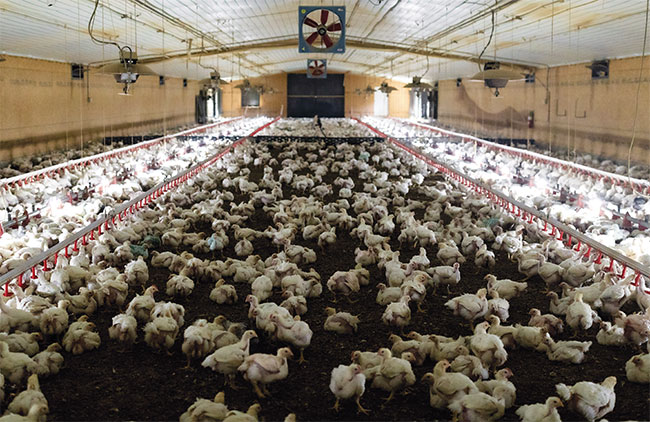
Initially, Kang said he wanted to conduct the study to address lameness issues, believing that increased activity during early stages of development could improve long-term leg health. And he was right: at the slaughterhouse, the number of birds condemned for leg problems was reduced by 30% in the variable-lighting houses. According to Kang, “previously, the house wasn’t stimulating enough — the conditions were too uniform, and providing different lighting conditions allows the birds to choose whether they prefer to go to brighter or darker zones.”
But it was not only lameness that improved. In fact, daily physical activity, footpad condition, fear response to novel objects, body weight and feed conversion ratio were all positively affected by the variable-intensity lighting programme. Furthermore, lighting costs were reduced by 70% under this system.
According to Karen Christensen, Tyson was eager to participate in the study, as recommendations regarding lighting programmes had been varied and often contradictory. “That was really concerning for us, because we didn’t mind what the light intensity was, but we wanted to make sure it was the right one for the bird,” says Kang. “There just didn’t seem to be much research behind some of the figures being cited.”
Based on their observations, there was a tangible difference in bird behaviour under the different lighting programmes. Birds reared in variable-lighting houses were visibly calmer, but what was particularly interesting was that they were not merely sitting — they were actively resting. They were actively feeding around the feeders and moving in the transition zone between the drinker lines, where there is still considerable light, before moving to the darker areas where they rest and feel secure.
But it was not only the stillness and calm, or the movement, that was surprising — it was also the discovery of pits in the litter where the birds had been dust bathing. “We really feel it is a comfort behaviour,” says Karen. “That only happens when the birds feel truly safe and secure.” The researchers observed not only improved leg condition, but also improvements in feed conversion ratio — contrary to what might have been expected when greater movement is observed.
Following this evidence, poultry giant Tyson believes so strongly in the benefits of graduated lighting that it has taken the decision to transition all 3,100 of its broiler houses to this system. While it is an enormous undertaking, its integrated growers also believe in the approach and support the transition. Overall, the variable-intensity lighting programme offers several benefits to broiler producers, as it promotes natural behaviour and physical activity in the birds, thereby improving footpad condition and leg health.