
There are institutional visits done purely for protocol — photo, handshake, and vending-machine coffee (the most tedious kind).
Then there are the “scripted” visits that end up as a video which explains but never inspires.
Finally, there are the unscripted visits that, without even trying, can deliver genuine public education about our sector: professional poultry production.
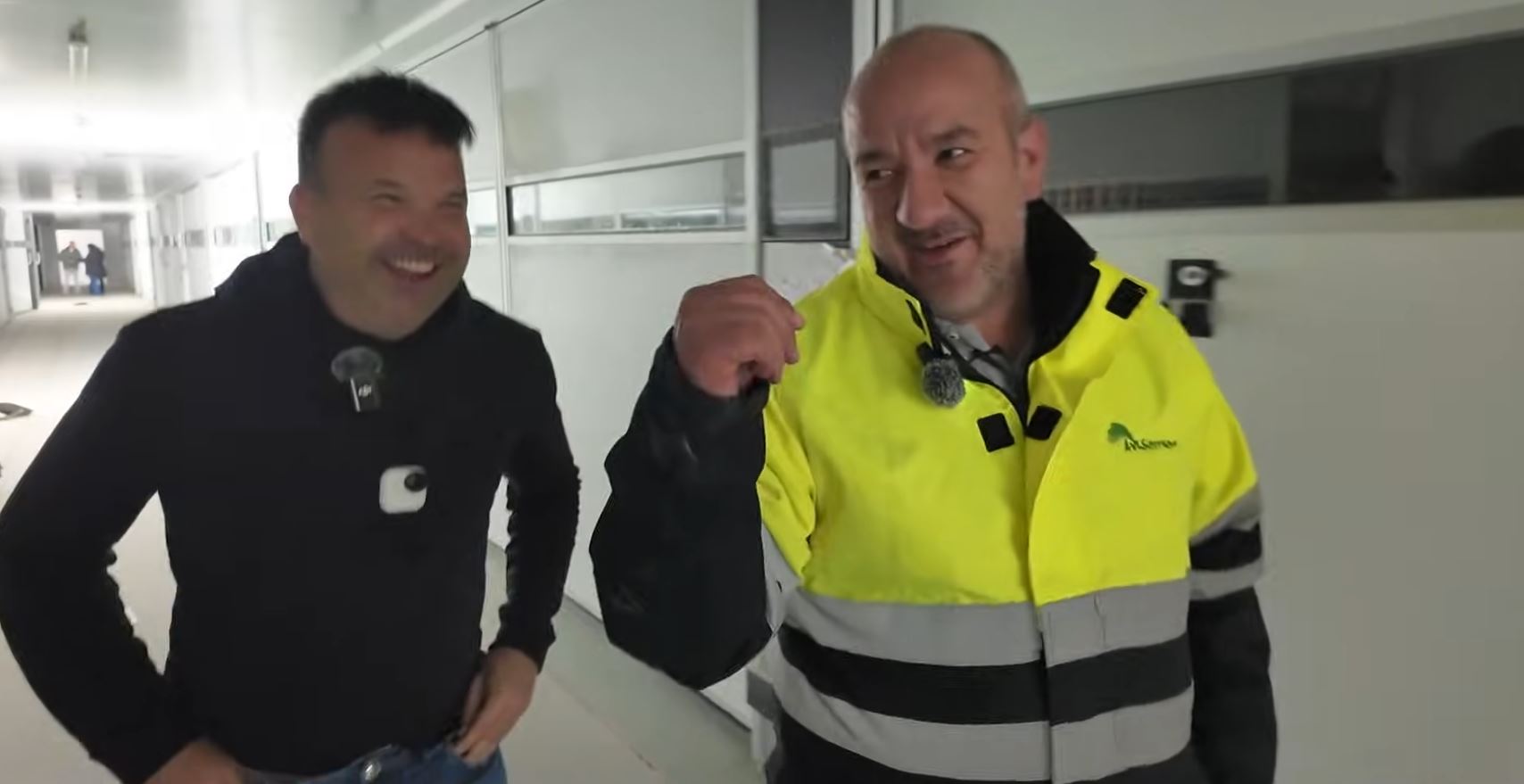
That is precisely what makes billionaire José Elías’s visit — a high-profile entrepreneur and content creator — to the new hatchery of Grupo Aviserrano so interesting: for a few minutes, poultry farming stops being “the same old thing” and becomes what it truly is… a high-precision industry, full of engineering, biosecurity control, and decisions that cost real money (the kind that hurts).
It might seem “trivial” to include this video in NeXusAvicultura — which I recommend watching over a lazy Sunday lunch — but if we want to attract new, young talent to the poultry sector, mass-audience videos like this one will undoubtedly help new generations take an interest in what we do: feeding the world.
Federico Castelló

Humilladero: 10,000 m² Built to Get the Most Delicate Process Right
The hatchery on show (located in the town of Humilladero, Málaga) — visited just weeks after completion and before it was closed to visitors for obvious biosecurity reasons — is not “a building full of machines,” as an outsider might assume. It is a purpose-built hatchery complex with 10,000 m² of constructed floor space (built by Grupo Lecru and Elías Equipamientos Ganaderos), designed with a focus on thermal control, durability and efficiency, with all cold rooms fully operational, including the corresponding compartmentalisation using concrete panels and rock-wool sandwich panels, which give the facility high structural resistance, superior thermal insulation and enhanced fire-containment performance.
And if anyone on the outside thinks that sounds “over the top,” let us remember a simple truth: in hatchery management, cutting corners almost always costs more in the end… and sometimes it costs you time you don’t have. Because what is being produced here is not a bolt: every hatchable egg that enters the facility will, ten weeks later, be on the plate of tens of thousands of families — this is “manufacturing” a premium quality food product.
This new hatchery in Humilladero was already included in Grupo Aviserrano’s Strategic Plans for 2021–2025, and the figures are impressive:
10,000 m² of constructed floor space,
total investment of €9.8 M (of which €2.8 M for civil works, €5 M for installations and €2 M for machinery).
The (affectionate) irony of it all: this isn’t about “chicks,” it’s about processes
Here comes the fun part — said with all due respect. In the video, published on Saturday 13 December 2025, we see many people — including some heavyweight business figures — arriving at a hatchery expecting to see “machines generating heat,” and leaving with the look of someone thinking “right… this is considerably more serious than I imagined.”
Because a modern, well-designed hatchery is:
- biosecurity management taken to obsessive levels (and rightly so),
- flow management (people, trolleys, materials, air),
- temperature/humidity/CO₂ management with rigorous discipline,
- hygiene management as a culture, not just a poster on the wall,
- and, above all, chick uniformity and quality management, which is the true first link in the chain of on-farm performance.
Put another way: the closest thing to a “miracle” here is not the hatch itself; it is that the entire process is repeatable.

Technical specifications
- Incubation technology: Petersime setters, X-Streamer range
- Machine fleet: 30 setters.
- Capacity per setter: 129,000 eggs.
- Total installed capacity: 30 × 129,000 = 3,870,000 eggs (installed static capacity).
- Operational start-up: beginning with 1,200,000 eggs/week, with a progressive ramp-up as processes stabilise, demand grows and the learning curve matures.
That last point is pure gold for anyone who has ever commissioned a hatchery: you don’t “open the tap” to 100% on day one. In hatchery operations, the ramp-up is not just caution — it is risk management.

Here are the “greatest hits” from the visit, analysed through our professional lens (and with a touch of humour).
1. Biosecurity: You shower or you don’t get in (even if you’re worth millions)
Elías opens by discovering what every poultry vet or hatchery manager lives with as their daily bread: biosecurity. The look on the entrepreneur’s face when he finds out that entering an operational hatchery means leaving behind your street clothes, your mobile phone, your dignity, and showering “in the buff” (as he puts it) is priceless.
The lesson: It doesn’t matter how many zeros are in your bank account; when it comes to biosecurity at a top-tier hatchery, we are all equal (and we all wear the same unflattering white scrubs).
2. “Tinder” and the “Delivery Suite”
Elías, with his trademark candour, renames our technical terminology. He calls the breeder farms “Tinder for hens” and the hatchery the “delivery suite.” He laughs — but then he walks into the machine room and the laughter turns to amazement. When he sees the setters with a capacity of 129,024 eggs each, he starts doing the sums. And Elías likes sums. Watching him try to absorb the fact that inside those machines there is more technology controlling temperature, humidity and turning than in many of his own businesses is a genuine win for the sector.
“Bloody hell, getting the hen to know it has to keep turning the thing is hard to get your head around” — José Elías, discovering egg turning. (Don’t worry, José — we’ve been marvelling at the same thing for years.)
3. Technology that makes SpaceX look ordinary
For me, the highlight of the video is when they reach the transfer and vaccination area.
This is where the uninitiated realise that this is no Playmobil farm set. The live-embryo detection system, the automatic removal of infertile eggs and, above all, in-ovo vaccination blow his mind completely.
Elías’s question is exactly what anyone unfamiliar with the industry would ask: “Doesn’t the needle kill the chick?” The patience shown in explaining how the injection is made into the amniotic fluid without touching the embryo is nothing short of saintly. Ladies and gentlemen, we have technology that detects live embryos and adjusts the climate with pinpoint precision. We are the NASA of the farming world. We need to say that louder and more often.
4. Chick sexing at 50,000 chicks per hour
If anyone still thought sexing meant squinting through a magnifying glass, they should watch the wing-web sexing machine with artificial vision featured in the video. Elías, a man accustomed to speed, could not believe what he was seeing.
Why does it matter that someone like José Elías sets foot in here?
Not because we need his “validation” (the poultry sector does not need anyone’s permission to exist). It matters for a far more practical reason: because it makes the invisible visible.
José Elías is known for his business profile and for communicating in a direct, straightforward way on social media, and he consistently emphasises the importance of a country’s real productive capacity, the “real economy,” and launching new business ventures. That framework fits a hatchery like a glove: few things better represent the productive economy than a facility where decisions are made, literally, about the start of millions of animals destined to feed people.
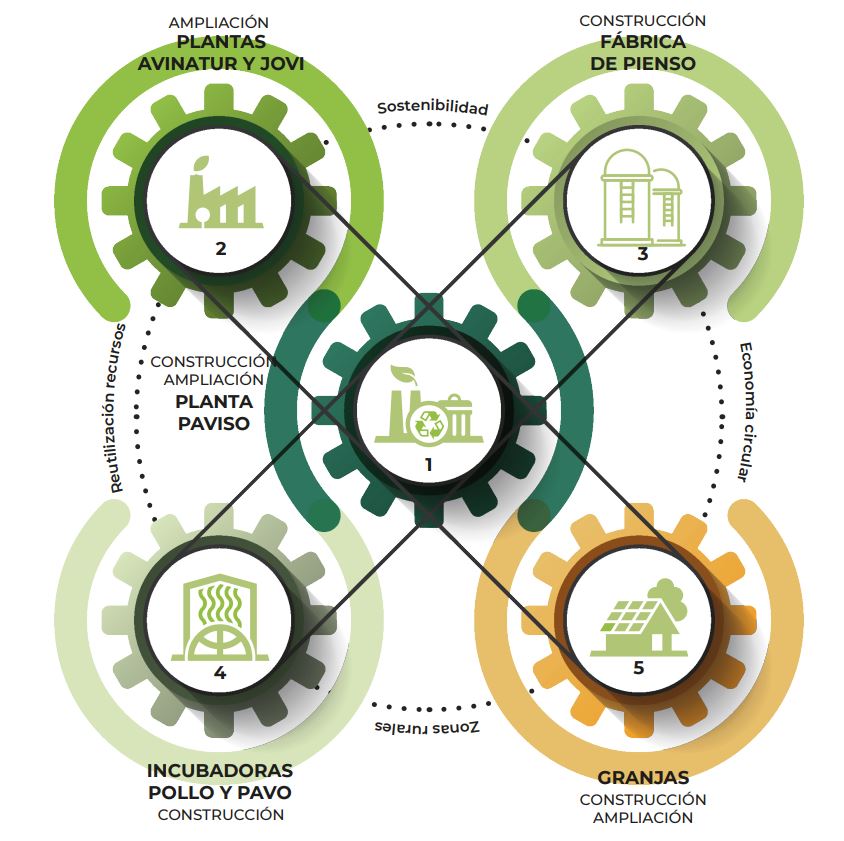
And there is a positive message here worth underlining: the poultry sector invests, modernises, adopts new technology and builds for the future. Aviserrano, furthermore, is not “a standalone brand” but a group with several business divisions (Avinatur, Jovi Serrano and Paviso Alimentación, among others), which helps us explain that this is the logic of a vertically integrated chain — the much-talked-about integration that efficiency-illiterates so often demonise with the dismissive buzzword “mega.”

Worth noting
Footnote: Let us thank José Elías for spreading the word about the professionalism of what we do — but let us never forget the thousands of professionals and business people who make it possible. In the photo, the “anima mater” team behind the project.
Three takeaways from the visit (and one serious conclusion)
- The cultural contrast: as a sector we have made mistakes by not knowing how — and sometimes not even trying — to communicate what we do and how we do it to the general public. That is why it is welcome to see a video circulating (regardless of the fact that it was made by a self-made billionaire who, like 99.99% of the population, has no reason to know how a hatchery works) with a positive portrayal of poultry farming that, even if it does not aim to go into technical detail, explains transparently and constructively what the poultry sector does.
- The language contrast: outside the industry, people talk about “scaling up”; inside, scaling up means not sacrificing flock uniformity and not compromising health status along the way.
- The “technology” contrast: some still believe agriculture is behind the times; but in modern poultry production — although there is still much to be done, and in hatchery operations in particular — today’s technology delivers a level of automation, efficiency and chick welfare that we should be showing off to society with pride (biosecurity permitting).
For all these reasons, when a hatchery is designed and built to this level of engineering and process control, the benefit goes far beyond improving a single KPI. It strengthens the entire system: greater consistency, greater health resilience, better energy efficiency and a stronger capacity to respond.
Poultry Pride
The video ends with Elías promising to return to see the plant in full operation (shower included, we hope). But the message that lingers is a powerful one: the Spanish poultry sector is operating at a level that leaves anyone who bothers to look “behind the scenes” genuinely awestruck. So the next time you have a tough day on the farm, on the road or at your desk, remember: what you do is so complex and technologically advanced that even a billionaire thinks it’s magic.
To find out more on NeXusAvicultura:
-. The poultry investments of entrepreneur José Elías
-. Grupo Aviserrano
-. Company news and investment in the poultry industry
Want to stay one step ahead in poultry?
Subscribe free to our eNewsletter and receive a weekly selection
of the best information to anticipate trends, stay up to date and grow as a poultry industry professional.
NeXusAvicultura: Vision, Insight, Quality and Context.